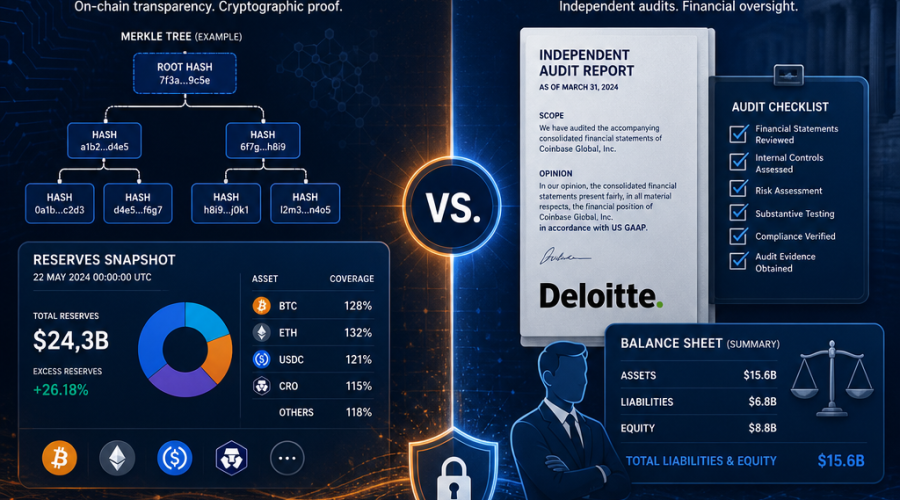
In the wake of high-profile collapses and increasing scrutiny of the cryptocurrency industry, questions about the transparency and integrity of major exchanges remain at the forefront. Two leading platforms, Crypto.com and Coinbase, have taken distinctly different approaches to proving their financial health and asset security. Understanding these differences is vital for users, investors, and industry observers alike. This article provides an in-depth examination of Crypto.com’s proof-of-reserves process versus Coinbase’s audited financial statements, highlighting why these approaches matter, where they fall short, and how they shape trust in the crypto sector.
Introduction: The Need for Transparency in Crypto Exchanges
As digital assets rise in prominence, so does the scrutiny upon the organizations that manage vast pools of customer funds. The need for robust, transparent mechanisms to verify the safety and sufficiency of these funds has intensified, particularly in the aftermath of industry shocks such as the FTX collapse. Two methods commonly discussed in industry circles include “proof-of-reserves” reports and full annual audits by reputable accountancy firms. At first glance, these may appear similar, but in practice, they serve different purposes and operate under distinct standards.
Understanding Proof-of-Reserves: Crypto.com’s Approach
Proof-of-reserves is a method whereby a cryptocurrency exchange—or in some cases, a custodian—demonstrates to the public the assets it holds on-chain at a specific moment in time. The intention is to provide assurance that the platform holds sufficient reserves to cover user balances. Historically, Crypto.com, along with exchanges like Binance and KuCoin, engaged the services of the global accounting firm Mazars to generate these reports.
The process primarily involves mapping internal records of user balances to public wallet addresses, with the aim of demonstrating that these wallets collectively contain an amount of crypto equal to or exceeding customer deposits. Often, a cryptographic Merkle tree is used to allow users to verify that their accounts were included in the assessment, without revealing overarching customer data.
The Limitations of Proof-of-Reserves Reports
While proof-of-reserves can increase visibility into an exchange’s asset holdings, its core flaw is that it proves only what the exchange has—not what it owes. It provides assurance on assets, not liabilities. If an exchange holds $10 billion worth of cryptocurrencies, but owes $15 billion to customers and creditors, a proof-of-reserves snapshot alone cannot reveal the shortfall. It also does not account for off-balance sheet obligations or competing claims to the same assets.
This limitation was expressly commented on by financial professionals and watchdogs. For example, Joseph Collement, general counsel at Bitcoin.com, explained that proof of reserves “mean very little without proof of liabilities.” Additionally, Francine McKenna, a lecturer in financial accounting, warned that these exercises amount to “matching” rather than holistic audits, thus failing to provide a complete picture of financial stability.
The Mazars Incident: Pausing the Proof-of-Reserves Movement
In December 2022, proof-of-reserves practices suffered a serious blow when Mazars, the lead accounting firm providing these reports for Crypto.com, Binance, and KuCoin, paused all such engagements worldwide. Citing “concerns regarding the way these reports are understood by the public,” Mazars’ move reflected a lack of confidence in the clarity and usefulness of the methodology as it was then executed.
The repercussions were immediate: Bitcoin and leading tokens such as Binance’s BNB dropped notably in value, and hundreds of millions in stablecoins, bitcoin, and ether were withdrawn from major exchanges. This was reminiscent of the post-FTX “bank run” mentality, with users losing trust in the currently available attestation models.
After the Mazars withdrawal, no major public accounting firm is known to have independently verified Crypto.com’s reserves. According to an industry report published in August 2026, Crypto.com had reverted to providing a “Merkle-based verification interface,” enabling customers to manually check that their balances were included in publicly published reserve snapshots. However, this system is not overseen by any recognized third-party auditor or accountant.
The Dashboard Dilemma: What a Reserve Snapshot Cannot Show
A transparent dashboard might display $10 billion in digital assets, but on its own, it lacks the corresponding figure for total customer or creditor obligations. It also fails to clarify whether any other party has legal or practical claim over some or all of those assets. Even more, regulatory organizations like the Public Company Accounting Oversight Board (PCAOB) and the U.S. Securities and Exchange Commission (SEC) have both warned that proof-of-reserves reports are not subject to the same rigors as regulated audits. These dashboards cannot be fully trusted as substitutes for complete and independently audited financial statements.
Coinbase’s Comprehensive Audit: Enter Deloitte
Distinct from most of its crypto-native peers, Coinbase stands as a publicly traded U.S. company. By virtue of its Nasdaq listing, Coinbase must undergo regular, comprehensive audits, conducted in its case by Deloitte, one of the world’s “Big Four” auditing companies.


Deloitte’s audit extends far beyond a simple tally of assets. The process scrutinizes the company’s full financial statements against conventional accounting standards. This includes probing the breadth of Coinbase’s operations: its debt obligations, collateral arrangements, derivatives positions, commitments, subsidiary relationships, and even related-party transactions. Deloitte is also responsible for auditing the company’s internal controls over financial reporting—the policies and procedures that ensure the integrity and accuracy of its financial disclosures.
What Audited Financials Actually Mean
Even with this robust infrastructure, a certified audit does not represent an ironclad guarantee against all risks. Auditors verify that the numbers are fairly presented and the controls scrutinized, not that the business can or will withstand a sudden run on withdrawals or a catastrophic management or technical failure. The audit process, nonetheless, offers a level of external oversight that is materially wider in scope and depth than any proof-of-reserves process.
Comparing Oversight: Proof-of-Reserves vs. Financial Audits
The confusion between these methodologies is widespread in popular reporting, often leading headlines to suggest equivalence between “audits” and proof-of-reserves attestations. In reality, and as highlighted by industry experts, proof-of-reserves reports like those once provided by Mazars are “often misunderstood as actual audits.”
The formal audit process tests the complete set of financial statements in accordance with recognized accounting standards. The auditor not only examines the existence of assets but also investigates and confirms liabilities, ownership, related-party risks, and the efficacy of internal controls. By contrast, a proof-of-reserves report checks specifically that a certain amount of assets exists in specified wallets at a chosen point in time—it is limited in both scope and assurance level.
The Current Status and Information Gaps
Presently, there is a significant information shortfall regarding Crypto.com’s most recent reserve totals, the ratio of reserves to obligations, or even the date of its latest Merkle-tree snapshot. No public evidence indicates that Crypto.com has engaged any reputable third-party accounting firm for a formal review since Mazars stepped back in December 2022. The lack of such transparency leaves customers in a position of trust rather than informed security.
Conversely, while Coinbase’s public audits provide considerable transparency and confidence, they are not a guarantee against loss under extraordinary circumstances. An audit shows that financial statements are fair representations as of a given date—not that the company is immune to fast-moving withdrawals or managerial errors.
Conclusion: Transparency, Trust, and the Way Forward
The juxtaposition of proof-of-reserves and audited financial statements underscores the evolving conversation about trust in the cryptocurrency space. Most proof-of-reserve methodologies remain voluntary, have not been standardized, and are not subject to the same oversight as corporate audits. While they represent a step forward in transparency, they lack the completeness needed to fully assure user funds.
Robust financial audits like those undertaken by Coinbase offer a deeper level of assurance, particularly as regulatory scrutiny and investor expectations grow. Still, even these have their limitations, and users should be aware that no system is foolproof.
Ultimately, the future of crypto exchange transparency hinges on continued development of standardized proof methodologies, broader participation in independent third-party audits, and regulatory frameworks that demand both asset and liability verification. Only through these combined efforts can the industry move closer to the safety and reliability that mainstream adoption demands.