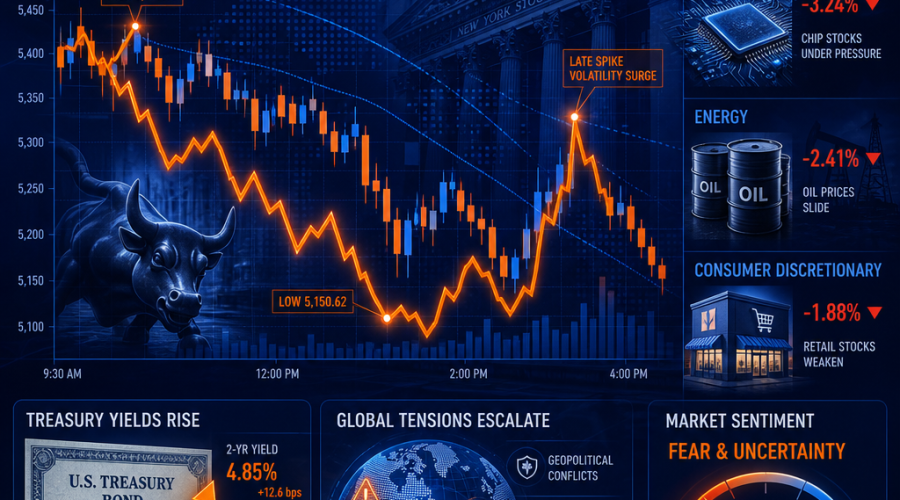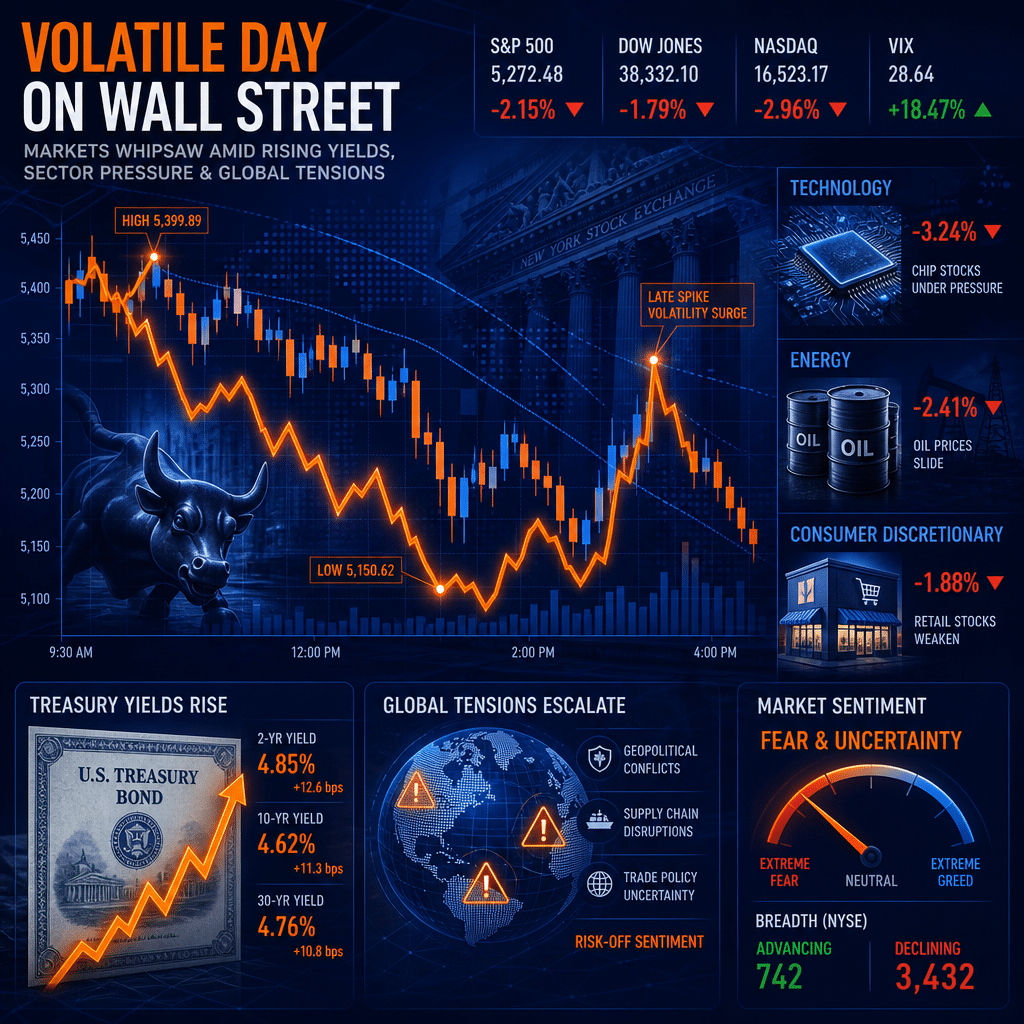
Wall Street faced a challenging session on Tuesday, as a confluence of negative market forces erased recent gains and left investors grappling with volatility. Chips and technology stocks led the decline, pressured by surging Treasury yields and heightened geopolitical uncertainty, while energy and select retailers bucked the trend in a fragmented trading day. This comprehensive report breaks down the day’s pivotal events and market movers, analyzes what’s behind the swings, and explores the wider implications for investors in 2024.
Market Overview: Rising Yields and Heightened Uncertainty
Tuesday’s trading saw significant downward movement in major stock indices. The technology-heavy Nasdaq was hit hardest, as long-term U.S. Treasury yields climbed higher and crude oil prices spiked. The S&P 500 and Dow Jones Industrial Average followed suit, though the losses were more contained outside of tech and semiconductor names.
Several factors contributed to market anxiety:
- Rising Treasury yields: Higher yields (especially on 30-year bonds) make future cash flows less valuable, pressuring fast-growing and highly valued companies such as semiconductor manufacturers.
- Climbing oil prices: Escalating tensions between the U.S. and Iran ignited a rally in crude oil, stoking inflationary fears and complicating the Federal Reserve’s monetary policy outlook.
- Company-specific disappointments: Big names such as Klarna and Micron issued guidance or results that jarred investors.
This combination resulted in sharp losses for leading chip stocks, weakness among AI-related names, and sector-wide volatility—showcasing the sensitivity of today’s market to both macro trends and micro-level news.
Nvidia and Semiconductor Giants: Sentiment Sours Ahead of Key Earnings
Semiconductor companies bore the brunt of Tuesday’s sell-off. The Philadelphia Semiconductor Index dropped approximately 3.7%, underscoring broad-based pressure across the sector. Industry bellwether Nvidia fell about 2%, while other major chipmakers like Micron and Sandisk experienced even deeper declines.
This sector-wide weakness was directly linked to the move in U.S. Treasury yields. As yields rise, the present value of future earnings declines—a dynamic that especially impacts high-growth technology businesses. Many AI and semiconductor companies have premium valuations built on aggressive growth assumptions, so any increase in the cost of capital (as reflected by higher yields) can spark abrupt share price adjustments.
Investors are now looking ahead to Nvidia’s upcoming earnings report, slated for August 26. As a leader in both AI hardware and the broader semiconductor landscape, Nvidia’s results and outlook will serve as a critical barometer. The market will be watching for signs that AI-driven demand remains robust, as well as management’s commentary on macro headwinds and competition.
With earnings season underway, any deviation from lofty expectations in the chip sector could trigger further volatility.
Klarna’s Slashed Forecast: High Growth, High Scrutiny
In the fintech sector, Klarna delivered a jolt to investors by revising its revenue outlook downward. The payment technology company now projects 2026 revenue in the range of $4.08 billion to $4.16 billion, a notable cut from its earlier forecast of roughly $4.34 billion.
Weakness in the German market was cited as a central factor. This regional softness cast a shadow over what was otherwise a solid quarter: Klarna grew second-quarter revenue by 27% year-on-year and reported a surprise profit.
However, the narrative quickly shifted from past performance to future prospects. The market’s reaction was swift and severe—demonstrating the unforgiving environment for growth companies. In today’s climate, investors have little patience for downward revisions, even if those companies continue to deliver impressive current results. Forward-looking guidance now matters more than ever.
Klarna’s experience serves as a warning for other high-multiple tech firms: valuations are built on expectations of relentless growth. Any cracks in that story can lead to sharp, sudden stock declines.
Home Depot Surprises to the Upside: Retail Resilience Shines
Not all earnings news was negative. Home Depot, the world’s largest home improvement retailer, posted second-quarter revenue of $47.86 billion—well ahead of analysts’ consensus estimate of $47.27 billion. Adjusted earnings per share reached $4.92, also topping forecasts.


Comparable sales in the United States rose by 1.3%. While the housing market remains subdued due to high mortgage rates, the numbers suggest robust consumer interest in “stay-at-home” upgrades. Smaller, routine repair and maintenance projects are still on the agenda for many households, even as bigger renovation projects remain on pause.
Home Depot’s beat offers a glimmer of optimism for retail investors, highlighting ongoing demand in certain consumer segments despite headwinds from inflation and borrowing costs. The company’s results will be closely watched as an indicator of potential pent-up demand: if economic conditions improve, larger renovation activity could return, further boosting the retail home improvement sector.
Oil Prices Hit Three-Week Highs: Energy Stocks Rally
Energy markets took center stage on Tuesday as crude oil prices soared to their highest levels in three weeks. The rally was driven primarily by renewed geopolitical tension, following indications that nuclear talks between the U.S. and Iran were faltering. Comments from Iran suggesting a more aggressive stance in the key Strait of Hormuz further rattled market participants.
For investors, higher crude oil prices present a double-edged sword. On the one hand, energy producers and oil-related stocks typically benefit from such moves, and that pattern played out as energy shares outperformed. On the other hand, rising energy costs threaten to reignite inflation, placing pressure on margin-sensitive sectors and creating additional challenges for central banks attempting to engineer a soft economic landing.
This week’s oil price surge heightens the stakes for Federal Reserve policymakers. Persistent energy-fueled inflation could delay or even derail anticipated interest-rate reductions, a scenario that would further test equity valuations—especially in rate-sensitive tech sectors.
Micron’s Volatility: AI Tailwinds Collide with Rate Pressures
Micron Technology, a leading memory chipmaker and a staple of the AI and data center supply chain, reflected the broader market’s seesaw sentiment. After surging on Monday, Micron reversed course dramatically on Tuesday, dropping around 6% as investors rotated out of AI-related stocks amid higher Treasury yields.
Micron has been riding a wave of demand for high-bandwidth memory chips used in AI accelerators and data centers—a structural trend supporting its long-term outlook. Nevertheless, the abrupt reversal reveals just how jittery investors remain, even regarding “must-own” AI infrastructure plays. Uncertainty over the future path of interest rates, concerns about global growth, and questions about the sustainability of recent outperformance are all contributing to heightened volatility.
The sharp back-and-forth underscores the importance of separating short-term market turbulence from the bigger-picture, long-term narratives. For Micron and its sector peers, Tuesday’s drop is a stark reminder of elevated risks at high valuations, even with strong demand in secular growth industries.
Investor Takeaways: Volatility Is the New Normal
Tuesday’s market action vividly demonstrated that volatility remains a defining feature of the post-2020 investment landscape. As macroeconomic and geopolitical risks persist, no sector is immune:
- Tech and high-growth stocks are sensitive to bond market movements and must constantly justify their valuations with both present execution and future promise.
- Retail and consumer-facing companies face headwinds from rates and inflation, but leaders can outperform with focus and execution on core trends.
- Energy stocks and inflation hedges gain in periods of uncertainty, but underlying price spikes can challenge the entire market by complicating monetary policy and consumer behavior.
The key for investors in this environment is agility. Rigorous research, close attention to market signals, and a willingness to adapt as conditions evolve are more critical than ever.
Looking Ahead: What Will Drive Markets Next?
As Wall Street digests this week’s developments, several storylines will remain front and center:
- Federal Reserve policy signals: With oil prices up and Treasury yields climbing, expectations for near-term rate cuts may need to be adjusted.
- Corporate earnings season: Especially in tech and AI sectors, company guidance will either calm nerves or exacerbate volatility.
- Geopolitical flashpoints: Potential escalation in the Persian Gulf region could keep financial markets on edge.
Above all, investors must balance long-term conviction in transformative trends (like AI and technology infrastructure) with the realities of market cycles, macro shocks, and ever-present uncertainty. Best-in-class research, disciplined risk management, and a diversified approach are the keys to navigating the turbulence of today—and capitalizing on the abundant opportunities for those with vision and resilience.