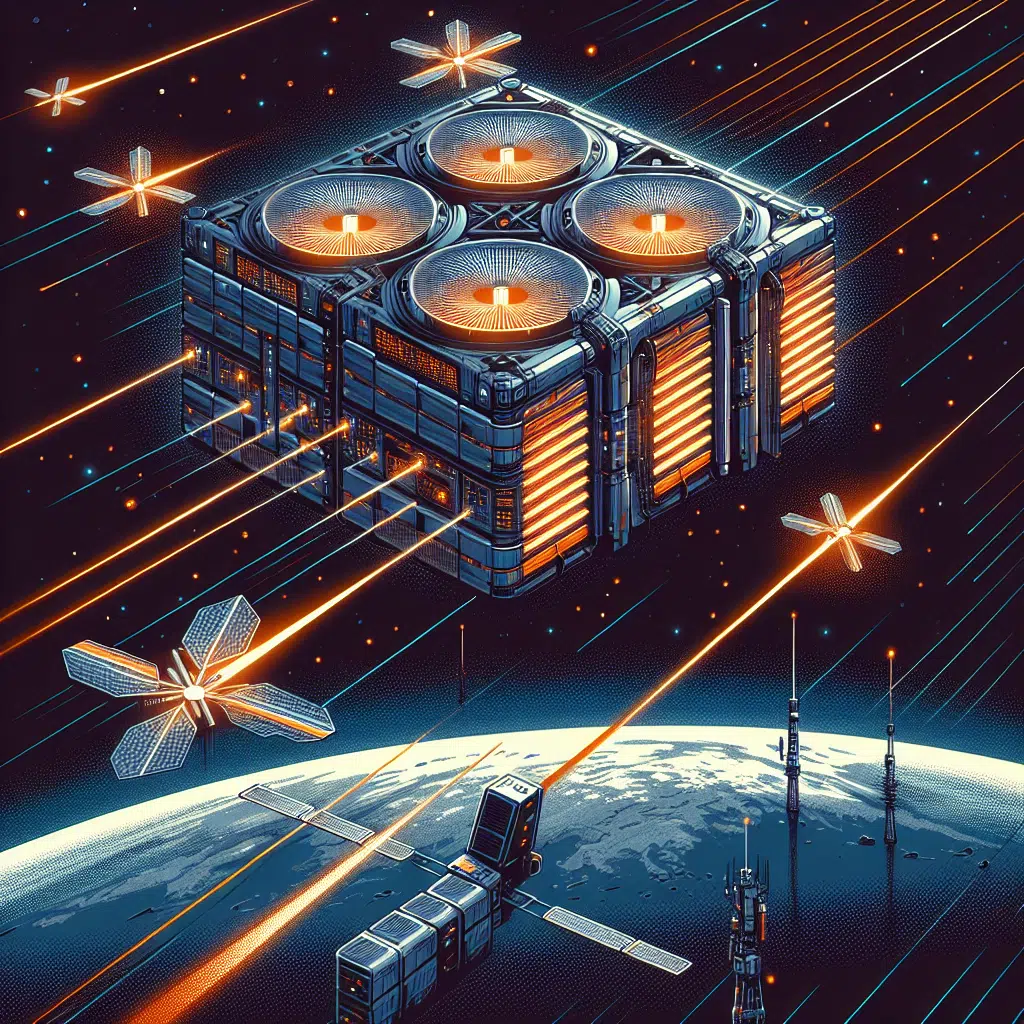
As technology continues to evolve at an astounding pace, the frontier of data processing and cloud computing may soon stretch beyond Earth’s surface. At the vanguard of this revolutionary vision is Voyager Technologies, whose CEO, Dylan Taylor, recently shed light on both the potential and the profound challenges facing the establishment of space-based data centers. While the concept of leveraging the unique environment of space for data processing offers remarkable possibilities, it is fraught with engineering dilemmas—none more pressing than the formidable task of cooling hardware in the vacuum of space.
The Quest for Space Data Centers: Opportunities and Ambitions
Data centers are the unsung heroes of the modern digital age, powering everything from social media to financial transactions. As terrestrial data centers consume enormous amounts of electricity—much of it dedicated to cooling—innovators are now setting their sights on space-based alternatives. Why space? The promise lies in the microgravity environment, the opportunity for abundant solar energy, and the potential to harness new communication technologies free from atmospheric interference.
Voyager Technologies, a leader in advanced space infrastructure, is one of the forerunners in turning this vision into reality. With their Starlab project and high-profile collaborations, including industry giants like Palantir, Airbus, and Mitsubishi, Voyager is spearheading a new era in both space commercialization and data management. Yet, as Dylan Taylor stresses, ambition does not diminish the formidable physical challenges encountered in orbit.
Why Cooling Is the Achilles’ Heel of Space Data Centers
At first glance, the cold expanse of space might seem like an ideal environment to keep hardware temperatures low. However, as Taylor highlights, the reality is far more counterintuitive. The vacuum of space lacks air—or any physical medium—needed to carry heat away from equipment. Unlike Earth, where fans and air conditioning units can circulate air to dissipate heat, space-bound data centers have no such luxuries.
“It’s counterintuitive, but it’s hard to actually cool things in space because there’s no medium to transmit heat to cold,” Taylor explained in a recent interview. With no air or water to absorb and transfer heat, all energy must be dissipated through a slow and technically demanding process known as thermal radiation. This means that every watt of heat produced by processors or memory chips must be emitted as infrared radiation—a process that is far less efficient than terrestrial cooling methods.
Adding to the difficulty, any heat-radiating infrastructure must be carefully shielded from the Sun, which can otherwise overload systems with additional thermal energy. The need for large radiators, precisely oriented and robust enough to endure the harsh conditions of space, requires a level of engineering still in its infancy.
Harnessing Innovation: Voyager’s Space-Bound Experiments
While the cooling hurdle is daunting, it has not deterred Voyager Technologies from actively pushing the boundaries of what is possible. As Taylor recounts, the company has already begun experimenting with infrastructure in low-Earth orbit. Voyager has successfully deployed cloud computing equipment aboard the International Space Station (ISS), providing valuable data on the operational realities and engineering demands of outer-space computing.
This pioneering work provides a testbed for perfecting the necessary hardware and software adaptations. Engineers are investigating new materials with extremely high thermal resistance and designing radiative cooling systems that can function effectively in orbit. The ISS deployments also offer insights into how to ruggedize delicate electronics against cosmic radiation and micro-meteoroid impacts, which present risks far beyond those faced in conventional Earth-bound data centers.
Strategic Partnerships Propel the Space Data Center Revolution
Voyager Technologies is not pursuing these monumental goals in isolation. Its partnership network reads like a “who’s who” of industry titans. Palantir, renowned for its big data analytics and artificial intelligence applications, is collaborating on how to process and manage vast amounts of data generated in space. Airbus, a cornerstone of aerospace manufacturing, brings unrivaled expertise in spacecraft design, orbital deployment, and mission reliability. Mitsubishi adds its experience in electronics and infrastructure, helping to drive forward the industrialization of orbital systems.
These partnerships are not merely symbolic—they are critical to integrating cutting-edge innovations across hardware, software, and satellite technologies. By pooling resources and expertise, the coalition aims to develop viable space data centers that can function reliably and cost-effectively, despite the immense challenges posed by the space environment.


Laser Communication: Bridging Distance at the Speed of Light
Beyond the problem of cooling, another technical challenge looms large: how to transmit data between orbiting data centers and customers on Earth. Taylor is optimistic about solutions here, citing advancements in laser communication technologies. High-capacity laser links could provide unprecedented data speeds between space and ground stations, enabling new use cases from real-time scientific analysis to secure defense communications.
Unlike traditional radio-frequency transmission, laser communication is less susceptible to interference, can handle vastly greater volumes of data, and is inherently more secure—an essential consideration as satellites and orbital data centers become targets in an increasingly contested space environment.
A Surge in Investment: The Business Case for Orbital Data Centers
Taylor’s remarks are set against a backdrop of explosive growth in space-related investment. According to recent figures from Seraphim Space, private investment in space technology surged by 48% in 2025, reaching $12.4 billion. This dramatic uptick is closely linked to escalating government interest, particularly in defense-oriented satellite systems and communications infrastructure. The demand for secure, resilient, and globally distributed data centers is no longer just a commercial concern but a matter of national security and strategic advantage.
Industry observers note that the rapid expansion of the “new space” economy is creating opportunities for startups and established firms alike. Venture capital firms are increasingly channeling funds toward companies, like Voyager Technologies, that are pushing the limits of off-world data processing, in-orbit manufacturing, and autonomous spacecraft operations. As the sector matures, investors anticipate not just radical technological breakthroughs but also entirely new business models built around space’s unique advantages and constraints.
The Road Ahead: Engineering, Policy, and Market Demand
The timeline for large-scale deployment of orbital data centers depends not only on overcoming technical barriers but also on several external factors. Regulatory environments, international cooperation, and the development of standards for in-space operations will all play vital roles in shaping the industry’s future.
Moreover, sustained demand will hinge upon the ability of space-based systems to provide real-world benefits over terrestrial alternatives. Potential advantages include: relief of Earth’s overtaxed data infrastructure, ultra-secure communications, support for space-based robotics and manufacturing, and even enabling edge computing close to satellites or lunar bases. But for these advantages to be realized, the core engineering puzzle of how to keep hardware efficiently cooled in a vacuum must be decisively solved.
None of these are trivial problems, and as Dylan Taylor cautions, they will delay the emergence of large, fully functional orbital data processing facilities. However, each successful experiment aboard platforms like the ISS, each collaborative breakthrough among Voyager, Palantir, Airbus, and Mitsubishi, brings the vision closer to reality.
Conclusion: A Pioneering Effort That Could Define the Next Era
The effort to build and operate data centers in orbit encapsulates the very spirit of modern innovation: reaching for solutions beyond our immediate grasp, forging partnerships that span industries and continents, and tackling the hardest problems head-on. As investments pour into space technologies and companies like Voyager Technologies work to crack the code of cooling and data transmission in the harshest environment known to humanity, we may well be witnessing the dawn of a new chapter in the global digital revolution. In years to come, the cold emptiness of space could become the hottest frontier in the relentless quest for faster, more secure, and more sustainable computing power.