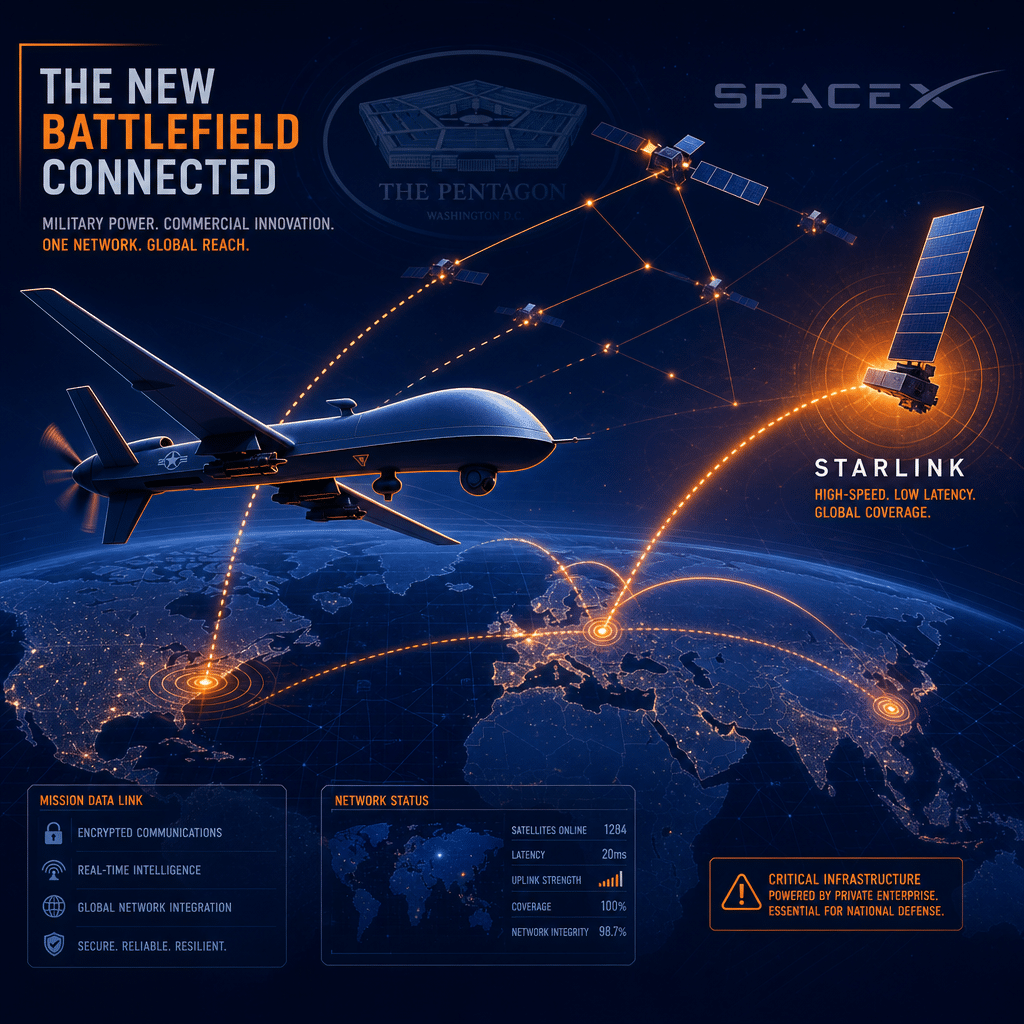
The Pentagon has recently found itself at the center of a high-stakes dispute with SpaceX over the price of Starlink connectivity for its LUCAS suicide drones operating in Iran. As the war effort intensified and no credible alternatives were available, the Defense Department ultimately agreed to SpaceX’s significant price hike—raising costs per terminal from $5,000 to $25,000 per month. This contentious decision exposes the increasing influence SpaceX wields over U.S. military operations and underscores the national security implications of relying on commercial satellite providers.
The Battle Over Starlink Terminal Pricing
At the heart of this dispute is the Pentagon’s use of LUCAS, a U.S.-designed loitering munition inspired by similar Iranian drones such as the Shahed. These inexpensive, unmanned aerial vehicles (UAVs) are able to circle their targets before diving in for a precision strike. Their guidance and communications depend heavily on commercial satellite internet—in this case, SpaceX’s expansive Starlink network.
Originally, the Department of Defense (DoD) secured Starlink terminals at $5,000 each—an already expensive proposition considering the short operational lifespan of drones designed for one-way missions. However, SpaceX soon claimed that the drone missions warranted an “aviation-tier” service package, inflating the price to $25,000 per terminal per month.
This fivefold increase stunned senior Pentagon officials. Their primary argument against SpaceX’s price was the nature of drone usage: LUCAS drones typically utilize Starlink connectivity for mere minutes or hours before the UAVs are destroyed. Pentagon negotiators contended that it was inappropriate to classify them alongside manned aircraft or long-endurance platforms, which may consume bandwidth for extended missions.
However, SpaceX executives were adamant. During high-level meetings, the company insisted that the unique operational requirements of the drones justified this aviation-grade fee. In the heat of ongoing operations in Iran and facing a lack of viable alternative satellite providers, the Pentagon was left with little choice but to acquiesce to the new terms.
How the Price Hike Affected U.S. Operations
Accepting the $25,000 price tag per terminal dramatically increased the cost of deploying each LUCAS drone. The per-unit price ballooned to nearly twice its original estimate, escalating from around $30,000 per drone before Starlink costs were factored in. This budgetary strain forced the Pentagon to reconsider the efficiency and scalability of its ongoing drone operations.
Despite accepting the new costs under pressure, top officials— including Deputy Secretary of Defense Steve Feinberg—remained profoundly uncomfortable with the arrangement. When a temporary ceasefire was declared in April, Pentagon officials seized the opportunity to reopen negotiations with SpaceX’s defense division, now under the leadership of retired Air Force General Terrence O’Shaughnessy.
SpaceX’s Expanding Role in U.S. Defense Infrastructure
This pricing controversy is not an isolated incident, but part of a broader trend: SpaceX’s Starlink system is becoming increasingly indispensable to U.S. defense operations. The Pentagon, recognizing the vulnerability of relying on a single commercial entity, has sought to diversify its options through the Department’s Commercial Satellite Communications Office. To date, however, no other provider is capable of matching SpaceX’s coverage or capacity for high-stakes, rapid-deployment scenarios.
SpaceX’s dominance is underscored by its current constellation of around 10,000 satellites—accounting for over 60% of all active satellites in orbit. Competing projects such as OneWeb and Amazon’s Project Kuiper lag several years behind in both scale and deployment, leaving the DoD increasingly reliant on SpaceX for both commercial and military communication needs.
Moreover, SpaceX sells a specialized, military-grade version of Starlink, known as Starshield, under a 2023 agreement with the Pentagon. Starshield terminals offer dual connectivity, accessing both the commercial Starlink network and a more secure, proprietary military constellation, further tightening SpaceX’s involvement with U.S. national security.
The Stakes: National Security and Corporate Leverage
The Starlink pricing dispute over LUCAS drones is emblematic of a larger dilemma: the consequences of entrusting vital national security infrastructure to for-profit private companies. As SpaceX prepares for a potentially historic IPO, its bargaining power with federal agencies strengthens in direct proportion to the government’s dependence.


In recent years, Starlink’s rapid deployment and successful field trials have made it the network of choice for various global military applications—not just in the United States but in other conflict zones such as Ukraine, where resilient communication links have proved decisive on the battlefield. These precedents have encouraged the Pentagon to deepen ties with SpaceX despite reservations about pricing and control.
One particularly sensitive issue involves initiatives to expand Starlink’s reach to Iranian civilians by enabling direct-to-cell connections, effectively circumventing state-sponsored internet blackouts. However, even this humanitarian effort has become a point of contention due to disagreements over pricing and technical challenges, further illustrating the complex and sometimes adversarial relationship between SpaceX and the U.S. government.
The Future of Military Satellite Communications
With demand for reliable satellite communication skyrocketing—not just for drones, but for all forms of modern warfare—military planners acknowledge the urgent need for alternative providers. However, building a globally competitive network with the reliability and scale of Starlink will take years and billions in investment.
This reality has prompted increased scrutiny within defense circles as officers consider future procurement strategies. Some advocate expanding Department of Defense investments into new satellite constellations, while others call for a more aggressive antitrust approach to prevent any single company from wielding too much influence over mission-critical networks.
In the short term, Pentagon leaders are expected to continue negotiating with SpaceX in hopes of achieving more favorable terms. However, as evidenced by the recent LUCAS drone contract, the military’s negotiating position remains weak until meaningful competition emerges.
Implications for Defense Policy and Tech Industry Regulation
The Pentagon’s reliance on Starlink for both offensive and defensive operations raises important regulatory and ethical questions. Should private companies be allowed to set pricing for services that have no alternative, especially when they relate to national security? What safeguards should be in place to ensure fair access and prevent price gouging under wartime conditions?
Lawmakers and defense analysts are increasingly calling for oversight to address these concerns. Proposals include mandating backup public networks, requiring private contractors to adhere to military pricing guidelines, and incentivizing domestic competition within the satellite industry.
At the same time, the government must balance its reliance on commercial providers with the need to reward innovation. SpaceX’s Starlink has proven itself to be a transformational asset—bringing unprecedented connectivity to war zones, disaster areas, and underserved regions. Punitive regulation, if not carefully designed, could deter the very investment and ingenuity that made such advances possible.
Conclusion: Navigating an Uncertain Future
As the LUCAS drone dispute demonstrates, the Pentagon’s future effectiveness in rapidly evolving technological battlefields will depend in part on how it navigates relationships with industry partners like SpaceX. For now, SpaceX’s exceptional capabilities come at a steep price, leaving the Defense Department searching for solutions to both immediate operational needs and long-term strategic vulnerabilities.
Going forward, the resolution of government dealings with SpaceX—including further negotiations over Starlink access and pricing—will likely serve as a template for how the U.S. balances military imperatives with private-sector innovation. The stakes are high, and the outcome will shape not only the future of space-based communications but also the nation’s ability to project power and maintain security in a rapidly digitizing world.