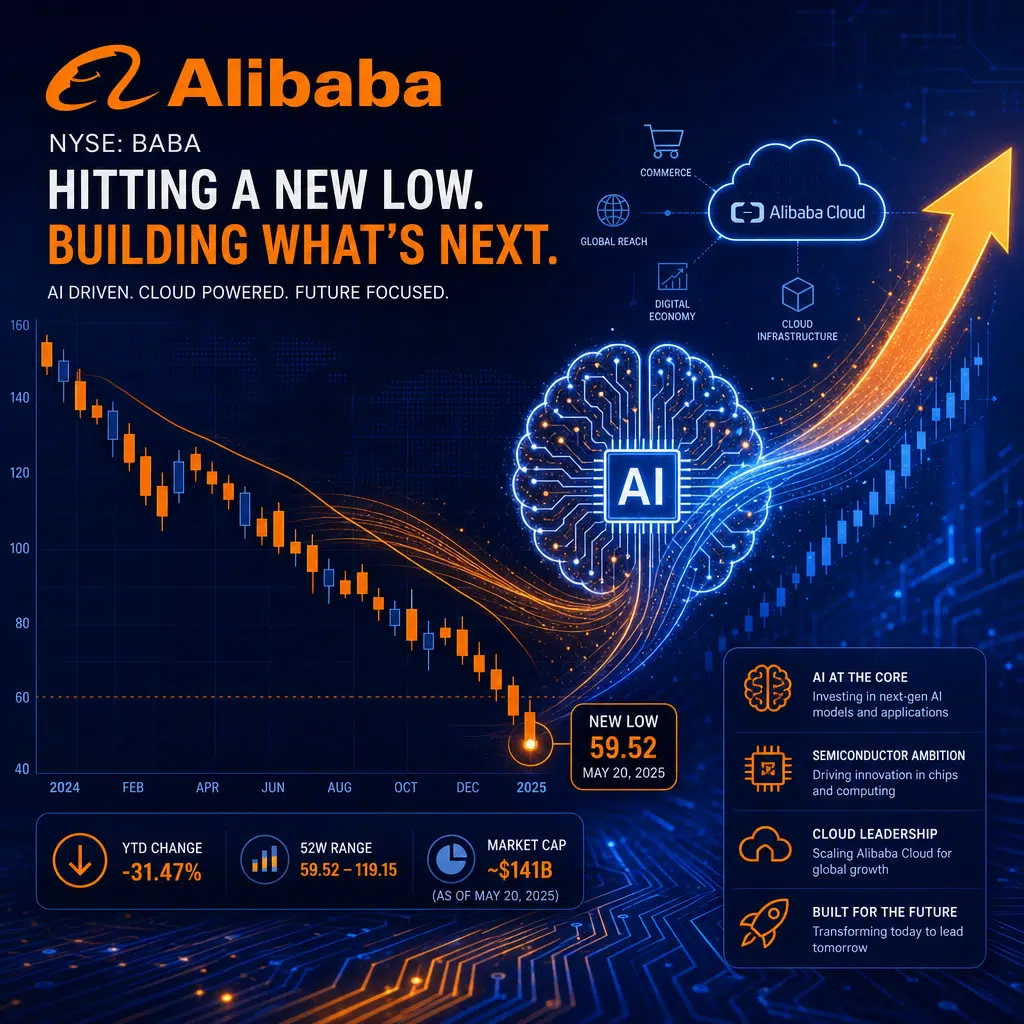
Alibaba Stock Hits 52-Week Low Amid Tech Selloff
On Tuesday, shares of Alibaba Group Holding Limited (NYSE: BABA) fell sharply, hitting a new 52-week low of $101.73 before closing near $102.59. This move, translating to a roughly 3% decline from the previous day’s close of $104.97, highlights the growing volatility and pressure faced by global technology stocks, particularly those originating from China. While the drop is significant, it’s important to note that it wasn’t sparked by any company-specific news but rather was a reaction to a broader risk-off sentiment sweeping the U.S. and global markets.
Market Selloff Drives Chinese Tech Stocks Down
The premarket session on Tuesday saw U.S. tech heavyweights in retreat, pressured by downbeat futures on all major indices. The Nasdaq futures plunged by 2.38%, dragging the S&P 500 down by 1.18% and the small-cap Russell 2000 by 1.38%. As a result, large-cap tech and Chinese American Depositary Receipts (ADRs) suffered notable declines. Alibaba, as one of the most prominent Chinese names on Wall Street, was swept up in this selloff.
This downturn in Alibaba’s stock is part of a larger wave impacting not only U.S. technology leaders but also their international counterparts. Investors’ concerns about inflation, monetary policy, global economic stability, and heightened geopolitical tensions are driving many to take risk off the table, disproportionately impacting tech firms, especially those based in China.
Technical Picture: Oversold but Still Bearish
The technical outlook for Alibaba at present is bearish and concerning for those hoping for a near-term turnaround. At its current trading level, Alibaba stock is well below all key moving averages:
- 14.8% below its 20-day moving average of $119.59
- 20.9% beneath its 50-day moving average of $128.85
- 31.6% under its 200-day moving average of $149.03
Notably, in April, Alibaba’s 50-day moving average fell below its 200-day moving average, a classic technical signal known as a “death cross,” confirming a sustained long-term downtrend. Additionally, the stock’s Relative Strength Index (RSI) stands at just 23.33, placing it firmly in oversold territory. While this level of oversold can sometimes instigate a short-term bounce due to short covering, it is not a guarantee of a reversal, especially against the backdrop of widespread bearish market sentiment and ongoing uncertainty in the sector.
The previous 52-week low, set at $103.71, is now likely to serve as a new resistance level. Immediate technical support aligns with the current premarket low near $101.75. Traders and investors will be closely watching these levels for indications of either further downside or potential stabilization.
Alibaba’s T-Head: Strategic Capital Injection and AI Ambitions
Away from the price action, Alibaba did announce a notable move regarding its semiconductor arm. The company’s chip design unit, T-Head, has tripled its registered capital to 1 billion yuan (about $148 million), marking the first such capital increase in more than three years. This move underscores Alibaba’s commitment to deepening its position within the semiconductor and artificial intelligence (AI) industries, both of which are considered crucial to the company’s future growth and China’s technology self-sufficiency ambitions.
T-Head’s recent developments include the launch of the Zhenwu M890 AI accelerator. To date, Alibaba has shipped 560,000 Zhenwu chips to over 400 clients across more than 20 different industries. These chips are expected to enhance Alibaba’s capabilities in AI, cloud computing, and the broader “new infrastructure” that China is investing in to bolster digital transformation.
In addition to chip innovation, Alibaba Cloud announced the release of HappyHorse 1.1, an upgraded AI video model that now ranks second in the world according to some tracking benchmarks. The company has also rolled out enterprise API access, aimed at capturing additional commercial use cases in AI-powered video applications.
Many analysts have flagged Alibaba’s Qwen-Robot AI initiative as a possible “full-stack physical AI inflection point,” suggesting that the company’s ambition extends far beyond its e-commerce roots. This evolving focus on AI and advanced computing could be pivotal in differentiating Alibaba from its global peers and ensuring its relevance for years to come.
Analyst Ratings and Upcoming Earnings: Cautious Optimism
Despite the recent price weakness and volatility, Wall Street’s outlook on Alibaba remains largely positive. According to consensus data, analysts rate Alibaba as a “Moderate Buy,” with an average price target hovering between $188.76 and $190.86 — a significant premium compared to its current trading levels.


Several notable investment banks and research firms have weighed in with their assessments recently. Mizuho raised its price target for Alibaba to $195, JPMorgan maintained its target at $205, Barclays also set its price target at $195, and HSBC offered a somewhat more modest $180. On the other hand, Robert W. Baird trimmed its price objective to $164 earlier in March in a sign of more cautious optimism amid ongoing headwinds.
The company is scheduled to report earnings on August 28, 2026. Wall Street is projecting earnings per share (EPS) of $2.51, a healthy increase from $2.06 for the same quarter last year. Revenue is expected to reach $38.72 billion, compared with $34.57 billion a year ago. At these levels, BABA trades at roughly 16.2 times projected earnings, which some investors may consider attractive given the company’s technological strengths and diversified business lines.
Key Challenges: Geopolitics, Regulatory Uncertainty, and AI Competition
Alibaba’s recent struggles do not exist in a vacuum. The company and its Chinese tech peers face unique challenges on several fronts:
- Geopolitical Risks: Tensions between the U.S. and China continue to create uncertainty, especially involving technology transfer, data sovereignty, and supply chain security. Investors are wary that any escalation could impact Alibaba’s operations, supply chain access, or growth prospects outside mainland China.
- Regulatory Pressures: Chinese authorities have tightened oversight of platform companies, e-commerce players, and fintech operations over the past two years. While the regulatory environment has somewhat stabilized, uncertainty lingers, particularly with the AI and semiconductor sectors being a strategic focus for both Chinese and global regulators.
- AI Investment Concerns: While Alibaba is investing heavily in artificial intelligence and chip design, investors worry about the rapid pace of spending in these highly competitive fields. Market participants are closely watching how efficiently Alibaba can balance its innovation pipeline and R&D expenses with profitability, especially as global rivals like Amazon, Microsoft, and Google press ahead with similar strategies in cloud and AI.
- Profit-Taking: After volatile swings and inconsistent momentum, some institutional investors may simply be taking profits or reallocating capital to sectors that appear less risky.
Against these headwinds, Alibaba’s management team is under pressure to execute flawlessly while maintaining investor confidence during a volatile and uncertain period for global technology sectors.
Alibaba’s Long-Term Outlook: Innovation, Restructuring, and Global Ambitions
Despite short-term market pressures and technical setbacks, Alibaba continues to invest aggressively in technological innovation and business restructuring. The strategic injection of capital into the T-Head chip unit speaks to its vision of making Alibaba a leader in AI infrastructure — a move that could diversify its revenue sources and reduce its reliance on traditional e-commerce.
There is speculation that Alibaba may look to restructure T-Head in preparation for a potential spin-off or initial public offering (IPO). If successful, this could unlock significant shareholder value and further highlight the company’s capabilities outside its core marketplace businesses.
Moreover, Alibaba’s advancements in AI video models and cloud computing suggest it is keen to stay at the forefront of digital transformation. Its foray into “full-stack” AI, robotics, and chip design signals a desire to not only power its own operations but also serve as an infrastructure provider to other businesses across China and beyond.
Ultimately, Alibaba’s future trajectory will depend on its ability to navigate geopolitical tensions, regulatory environments, global competition, and technological change. If management can deliver on its AI and chip ambitions while stabilizing core businesses and maintaining consistent earnings growth, Alibaba could yet deliver on the bullish forecasts being promoted by much of Wall Street.
Conclusion: Opportunity Amid Volatility
Alibaba’s sharp decline to a 52-week low is a microcosm of the challenges and opportunities facing global technology companies in today’s complex environment. With no company-specific negative catalyst, the selloff highlights sensitive market sentiment and the outsize influence of macro factors. Yet, with strong analyst support, robust innovation in AI and semiconductors, and a demonstrated capacity to adapt, Alibaba may be poised for long-term value creation for patient investors. As the company approaches its next earnings report and continues to showcase new technologies, both traders and long-term shareholders will be watching closely to see if the worst is behind — or if further volatility lies ahead.