Nvidia Aims for $500 Billion in AI Infrastructure Investment
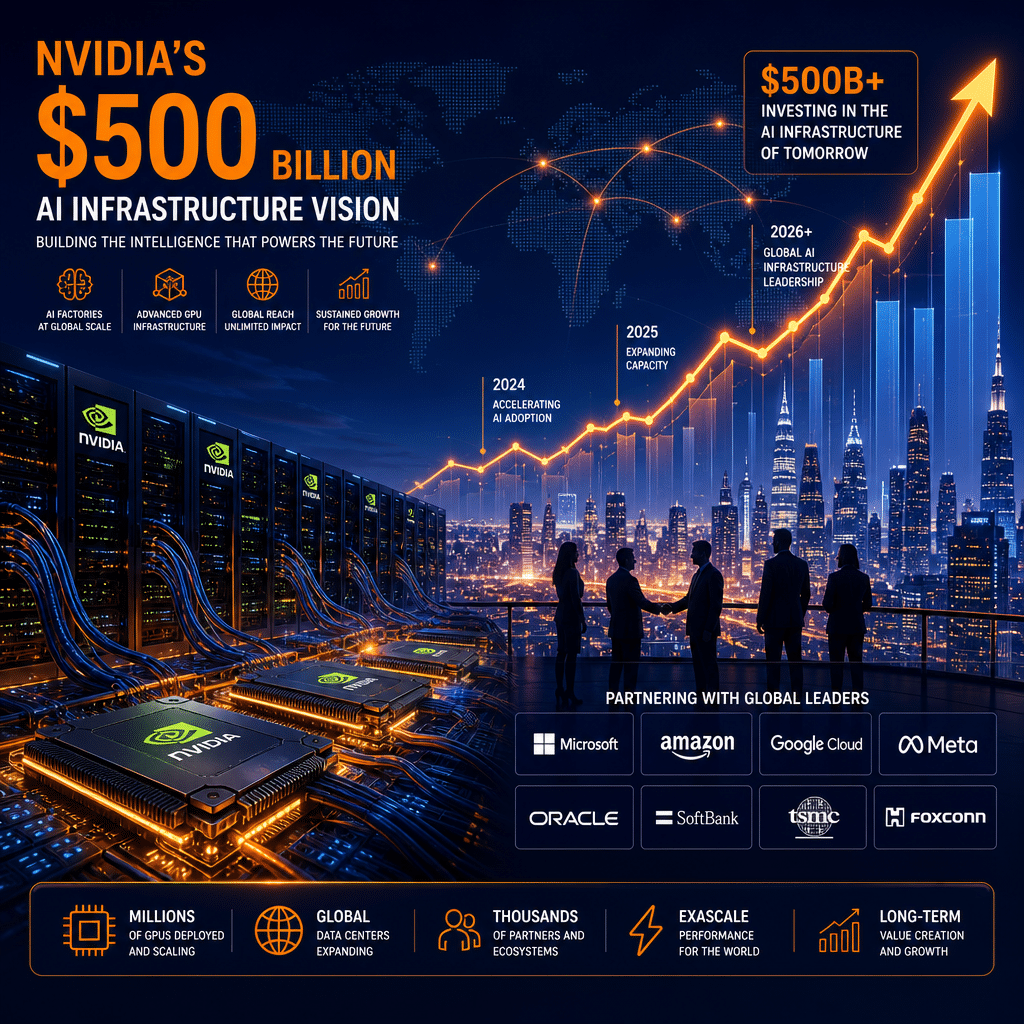
In a groundbreaking move that could reshape the landscape of artificial intelligence and technological infrastructure, Nvidia has announced its ambition to mobilize up to $500 billion in potential investments aimed at accelerating global AI development. The initiative, backed by six of the world’s most prominent institutional investment partners, represents an unparalleled commitment to AI-centric computing infrastructure and positions Nvidia at the heart of the next wave of digital transformation.
Ambitious Vision: Mobilizing Massive Capital for AI Factories
Nvidia’s new plan is centered around enabling independent compute financing platforms in collaboration with leading institutional investors, including Apollo, BlackRock, Brookfield, and Goldman Sachs. These platforms are tasked with evaluating and financing cutting-edge “AI factories” — vast data centers and supporting infrastructure specifically designed to power AI workloads at massive scale.
Each participating partner will rigorously vet projects on a case-by-case basis, leveraging their financial expertise and resources to drive innovation and capacity in the AI sector. Nvidia has indicated that, in addition to the external investment, it may provide up to 25% of residual support for any given project, underscoring its confidence in the sector’s potential growth.
This approach seeks to catalyze the buildout of computational capacity required by burgeoning AI applications—ranging from generative models to autonomous systems—while distributing risk and ensuring that Nvidia does not appear to be merely financing demand for its products.
Market Performance: Nvidia’s Financial Strength
The market’s confidence in Nvidia’s strategy is evidenced by its current standing on Wall Street. Nvidia’s stock (NVDA) opened at $225.16, falling within a 52-week trading range of $164.07 to $236.54, and boasts a staggering market capitalization of $5.45 trillion. This valuation places Nvidia as one of the world’s most valuable corporations and highlights the seismic shift in investor sentiment toward AI leaders.
In its latest earnings report, Nvidia disclosed quarterly revenue of $81.61 billion, marking an 85.2% increase year-over-year—and well above analyst estimates of $78.42 billion. The company also outperformed in earnings per share (EPS), reporting $1.87 against the consensus forecast of $1.76. Such results illustrate the meteoric pace of Nvidia’s growth amidst the AI gold rush.
Further cementing confidence, Nvidia has authorized an $80 billion share repurchase program and raised its quarterly dividend from $0.01 to $0.25, signaling robust cash flow and a firm commitment to returning value to shareholders.
Analyst Insights: Broadly Bullish Sentiment Persists
Wall Street analysts, including those at Morgan Stanley, JPMorgan, Bank of America, and Truist, have responded to Nvidia’s announcements with a series of upward revisions to their price targets and ratings. Morgan Stanley, for instance, reaffirmed its “Overweight” rating and established Nvidia as its top pick within the semiconductor sector, maintaining a $288 price target.
According to Morgan Stanley’s analysis, should Nvidia achieve a 35% revenue share above breakeven on these new AI infrastructure investments, the company could see more than 10% additional upside to its earnings per share by fiscal 2029. Much of this upside hinges on future GPU pricing and the rate at which these new AI factories are deployed.
Additional analyst endorsements include JPMorgan raising its NVDA target from $265 to $280, Bank of America lifting theirs from $320 to $350, Benchmark increasing from $250 to $335, and Truist boosting from $287 to $307. Across the board, the consensus rating for Nvidia hovers at “Buy,” with MarketBeat tracking 48 Buy ratings, three Strong Buy ratings, and just two Holds, averaging a target price of $305.94.
UBS, meanwhile, remains aggressive in its outlook, anticipating that Nvidia could exceed its Q2 revenue guidance—set at $91 billion—by several billion dollars, driven by escalating demand for the new GB300 GPU platform.


Shareholder Structure and Institutional Support
Showing the depth of institutional faith in Nvidia, ownership of NVDA shares among major investors stands at a robust 65.27%. Notably, CoreCap Advisors recently increased its position by 1.6% in the second quarter, raising its holdings to 243,104 shares valued at approximately $48.6 million. Such moves from significant investment firms exemplify the overarching sentiment that Nvidia is well-positioned for continued leadership in the AI revolution.
Analysts are projecting full-year EPS of $8.79 for the current fiscal year, further underscoring the market’s high expectations as Nvidia continues to innovate and expand.
Potential Risks: Caution Amidst Optimism
Despite the overwhelmingly positive outlook, not every expert is convinced that Nvidia’s trajectory is free of pitfalls. Bearish voices, including high-profile investor Michael Burry, have warned of risks if AI financing turns “circular” — that is, if end customers primarily use borrowed capital to purchase Nvidia’s own products, potentially inflating demand artificially.
Morgan Stanley addressed such concerns, emphasizing the advantages of a third-party financing structure. This arrangement is intended to prevent Nvidia from simply underwriting its own sales while still exposing it to new revenue opportunities. Nonetheless, analysts caution that the $500 billion figure represents potential, not committed, capital—it is contingent on project assessments by institutional investors and ongoing global market conditions.
Additional risks flagged by industry observers include:
- Increased credit exposure tied to large capital-intensive AI infrastructure projects;
- Potentially higher systemic leverage within the AI ecosystem;
- Supply chain constraints that could hinder data center and GPU deployment;
- Power and energy infrastructure bottlenecks, given the immense computational requirements of AI factories;
- Geopolitical uncertainties, particularly the risk that Chinese developers and customers might pivot from US-made GPUs—including Nvidia’s offerings—to alternatives from domestic companies like Huawei.
These factors create a degree of uncertainty, reminding investors of the volatility inherent in rapidly advancing technological sectors.
Strategic Implications: Accelerating the Fourth Industrial Revolution
Nvidia’s strategy comes on the heels of relentless AI advancements, highlighted by the explosion of generative models, natural language processing capabilities, and real-time AI-powered applications across nearly every industry. The semiconductor leader’s gambit for a $500 billion AI infrastructure mobilization reflects not only its faith in the upward trajectory of AI but also a broader industry understanding that breakthroughs require vastly expanded computational resources.
By leveraging partnerships with heavyweight institutional players, Nvidia is seeking both to reduce risk and to seed a new class of investment-driven AI super-infrastructure, further entrenching its position atop the semiconductor and AI value chain.
Looking Ahead: Nvidia as a Cornerstone of the AI Economy
As Nvidia continues to outpace analysts’ expectations and secure marquee partnerships, the company stands at the nexus of innovation and capital. The proposed $500 billion in potential AI infrastructure investments not only underscores Nvidia’s strategic foresight but also sets the stage for exponential global AI adoption.
Moving forward, Nvidia’s trajectory will be shaped by its ability to navigate sector risks, collaborate with its financial backers, and scale its hardware and software ecosystem. With a positive analyst consensus, robust earnings growth, and expansive institutional support, Nvidia appears primed to shape the future of computing in the age of artificial intelligence.