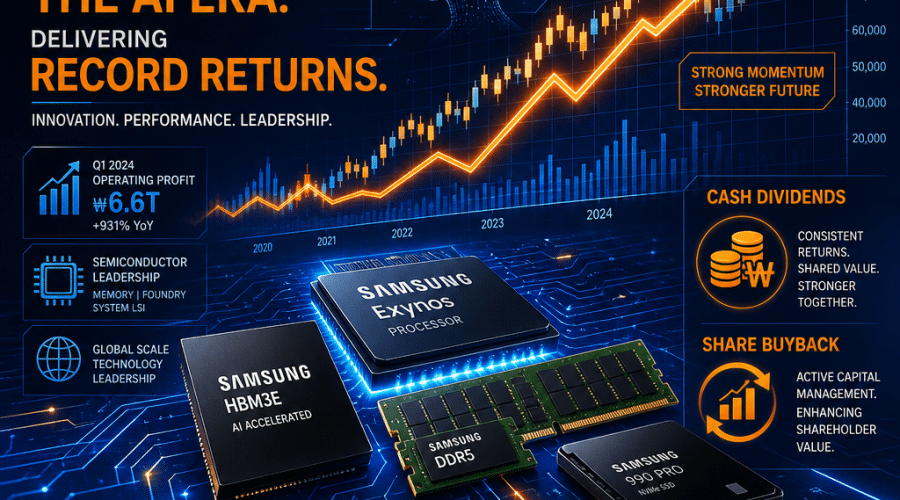
Samsung Electronics, one of the world’s leading technology powerhouses, has ignited renewed investor interest by unveiling an unprecedented shareholder return program, a move that sent its stock soaring and is reshaping expectations across South Korea’s chipmaking sector. On Friday, Samsung’s shares jumped 3.87% to close at ₩281,500, buoyed by the announcement of a record-breaking shareholder rewards plan that top analysts see as a response to intensifying market competition and growing investor demands.
Samsung’s Historic Shareholder Return Plan: Setting New Benchmarks in South Korea
The announcement from Samsung Electronics marks the largest shareholder return initiative ever detailed by a South Korean corporation. The company revealed plans to deliver between 90 trillion won and 110 trillion won—approximately $80 billion—in total shareholder returns by 2026. This mega-scale package dwarfs previous industry figures and reflects Samsung’s robust financial health, bolstered by the ongoing boom in high-end chip markets.
As part of this sweeping return program, Samsung has earmarked about 30 trillion won in cash dividends for the third quarter alone. This significant payout combines Samsung’s well-established quarterly dividend with additional components designed to respond directly to investor demand for greater cash returns. The board of directors will finalize this third-quarter dividend at a meeting slated for late October. Details on how the remainder of the plan will be distributed—whether through further special dividends, share buybacks, or share cancellations—are set to be determined in a subsequent board meeting in January 2027.
While a large proportion of the announced figures focuses on direct rewards to outside shareholders, it’s important to note that the company has also purchased around 15 trillion won worth of shares to fund employee stock compensation plans. Though these shares act primarily as employee incentives, they underscore Samsung’s multi-pronged approach to both retaining top talent and maximizing shareholder value.
Competitive Pressures Intensify Following SK Hynix’s Bold Moves
Samsung’s sweeping shareholder reward initiative comes closely on the heels of an aggressive buyback plan announced by one of its primary domestic rivals, SK Hynix. Recently, SK Hynix committed to a 40 trillion won share repurchase program, with the intention to cancel all acquired treasury shares after the repurchase’s completion. This move placed mounting pressure on Samsung to channel its ample cash reserves into similar or greater return initiatives, particularly as expectations for capital returns intensify in Korea’s semiconductor industry.
SK Hynix’s strategy is to allocate more than half of its free cash flow from 2025 to 2027 toward share buybacks and shareholder returns. In comparison, Samsung already maintains a shareholder return policy that commits to allocating 50% of accumulated free cash flow for the 2024-2026 period. Regular annual dividends under this policy amount to roughly 9.8 trillion won, further cementing Samsung’s commitment to consistent shareholder compensation.
The semiconductor sector is currently enjoying tailwinds from a rapid surge in demand for memory technologies driven by artificial intelligence (AI) infrastructure spending. Both Samsung and SK Hynix are at the forefront of this trend, and their bold return programs signal a new era of shareholder empowerment and financial discipline within South Korea’s crucial chip industry.
AI-Driven Chip Profits and Soaring Cash Positions
Crucially, Samsung’s ability to initiate such an ambitious return plan is rooted in the company’s rapidly strengthening financial position—a direct result of booming profits from its semiconductor division. Recent results revealed that Samsung’s semiconductor profits soared over 250-fold in the second quarter compared with the same period a year earlier. This dramatic surge has allowed Samsung to amass a sizable cash war chest, providing the flexibility to reward shareholders while continuing to invest in essential research, new production capabilities, and strategic market initiatives.
Analysts now estimate that by the end of this year, Samsung and SK Hynix together could command a staggering $263 billion in net cash. To put this in perspective, this amount is projected to surpass both Nvidia’s current cash holdings and the combined reserves of several major American tech giants. The sheer scale of this liquidity underscores the transformative impact of the current global memory-chip supercycle as AI and data-driven applications escalate demand for high-performance memory solutions.


While the share price of Samsung Electronics has already risen by over 135% this year, the announcement of the shareholder return package reaffirmed investor confidence, pushing the stock even closer to its all-time highs. In fact, on the day of the announcement, Samsung shares briefly touched ₩285,000 before settling at their closing value, indicating robust trading activity and positive market sentiment.
Strategic Shareholder Incentives: Balancing Growth and Returns
Industry observers note that Samsung’s record payout blueprint is not only a defensive maneuver against rivals like SK Hynix but also a strategic affirmation of its long-term competitiveness and appeal to global investors. The approach strategically aligns with ongoing efforts by international investors and South Korean policymakers to encourage higher corporate cash payouts, more transparent governance, and share-friendly capital management.
Samsung’s payout plan is carefully structured to leave management sufficient financial flexibility. The proposed framework allows Samsung to select the mix of future shareholder incentives—be it through cash dividends, repurchasing and canceling shares, or other capital return mechanisms. This adaptability ensures that Samsung can respond vigorosly to market dynamics, investment needs, and the evolving expectations of both domestic and international shareholders.
The Broader Implications for South Korea’s Chipmaking Sector
Samsung’s ambitious shareholder rewards program is poised to trigger ripple effects throughout South Korea’s semiconductor ecosystem. As SK Hynix, Samsung’s closest rival, pursues its own record-breaking buyback and cancellation scheme, other chipmakers and listed companies may face greater scrutiny from investors seeking similarly robust capital returns. The cascading effect from these industry giants could drive higher payout ratios and foster a more competitive, shareholder-oriented corporate landscape across Asia’s fourth-largest economy.
At the root of this shift is a fast-changing global technology environment in which capital discipline, investor trust, and transparency are increasingly seen as competitive advantages. The semiconductor industry, in particular, is witnessing unprecedented technological leaps thanks to the advent of AI, big data, and cloud computing. By prioritizing substantial returns, Samsung aims not only to secure investor loyalty but also to attract long-term institutional capital and strategic partnerships.
Challenges Ahead: Competition, AI Development, and Execution Risks
Despite strong fundamentals and investor enthusiasm, Samsung faces several challenges moving forward. The company remains locked in fierce competition with SK Hynix, especially in the high-bandwidth memory market that powers advanced AI applications and next-generation computing workloads. While Samsung’s larger return program could offer near-term stock price support, the effectiveness of this strategy will hinge on its execution and the reception among different shareholder factions.
Moreover, a sustained AI-driven memory-chip cycle is never guaranteed. A downturn in demand for AI infrastructure, tightening global chip supplies, or the entrance of new competitors could all impact profits and, as a result, future payout capacity.
Conclusion: A Defining Moment for Investor Returns and Tech Leadership
Samsung Electronics’ record-breaking $80 billion shareholder return commitment illustrates the magnitude of change underway in the global technology and semiconductor arena. The move responds decisively to both competitive pressure and evolving investor preferences for capital returns, transparency, and disciplined balance sheet management. As Samsung and SK Hynix press forward with their game-changing initiatives, the eyes of the financial and technology world are closely watching how this new capital strategy will shape the future of South Korea’s flagship industry and recalibrate the standards for corporate stewardship worldwide.
For investors and policymakers, Samsung’s payout blueprint confirms that Asian technology titans are ready to match—or even outpace—their Western peers when it comes to maximizing shareholder wealth. As demand for AI, memory chips, and next-generation infrastructure shows no sign of abating, generous shareholder returns could become the new competitive baseline for the region’s most influential companies.