As the calendar year draws to a close and the cryptocurrency market digests another volatile week, investors are keenly analyzing sectoral shifts, ecosystem performances, and trending narratives. While conventional equities and safe-haven assets like gold inch upward, certain crypto tokens and networks are breaking from the broader script, revealing a market in flux as 2025 approaches. Beyond price action, underlying trends in DeFi lending, decentralized exchange volume, and protocol revenue continue to reshape the digital asset landscape. This report dissects the latest developments, offering insights geared toward traders, analysts, and blockchain enthusiasts.
Traditional Markets: Gold Shines, BTC Diverges
Last week witnessed continued risk-on sentiment in traditional markets, with investors betting on a resilient macroeconomic environment. Gold stood out as the top-performing traditional asset, climbing 3.57% over the week. This upward momentum in gold—often seen as a hedge against volatility and inflation—suggests persistent uncertainty, even amidst risk appetite elsewhere. Meanwhile, the S&P 500 notched a 1.15% gain, and the tech-heavy Nasdaq 100 rose 0.84%, reinforcing the view that equities remain robust as the year ends.
Contrary to these gains, Bitcoin bucked the trend with a 0.90% decline. This rare instance where BTC’s performance diverged from both risk assets and “digital gold” narratives served as a reminder that cryptocurrency continues to move to its own rhythm. From regulatory speculation to shifting capital flows between digital and traditional markets, the nuance behind BTC’s pullback is complex and multifaceted.
Crypto Sector Indices: Solana Ecosystem Dominates
Amidst the tepid performance of Bitcoin, sector rotation within the crypto market was striking. The Solana ecosystem led the charge with a 4.4% rally across its tokens, capitalizing on developer momentum, user adoption, and renewed narrative interest. Other winners included Launchpads (+3.23%), DePIN (Decentralized Physical Infrastructure Networks, +2.23%), Perpetuals (+2.17%), and Modular blockchains (+1.7%). Decentralized exchanges (DEXs, +1.42%) and AI-related tokens (+1.07%) also delivered modest returns, reflecting growing experimentation outside of legacy chains.
However, it wasn’t all green. Layer 2 solutions (L2s) experienced the most pain, sinking 8.27%. The Lending sector was close behind, dropping 6.82%, while the Ethereum ecosystem gave up 6.57%, and Crypto Miners fell 5.97%. These declines point to profit-taking, sector rotation, and, in some cases, concerns about protocol or regulatory risks.
Spotlight: Solana’s Winners and Losers
Within the bullish Solana segment, JTO surged 10.30%—the strongest gainer—underpinning renewed excitement around liquid staking. DRIFT climbed 8.10%, reflecting interest in perpetuals and derivatives trading on emerging platforms. Decentralized exchange tokens JUP (+4.14%), ORCA (+3.81%), and RAY (+3.40%) also posted healthy gains, showing that the core DEX landscape remains resilient.
On the other hand, some tokens failed to keep up. MPLX lost 2.68% and PUMP, a memecoin-launchpad token, extended its losses by another 5.11%, highlighting waning enthusiasm for speculative launches and short-term trends in the memecoin space.
DeFi Lending: Aave’s Grip Loosens as Challengers Emerge
The decentralized finance (DeFi) lending battlefield has, for much of the year, been dominated by Aave. The protocol captured 86% of sector revenue in 2025, generating an impressive $120.9 million year-to-date. While this revenue concentration underscores Aave’s centrality in DeFi credit markets, there are unmistakable signs of increased competition. Aave’s share has slipped from 91% in January to 86% by December.
Newer entrants are beginning to leave their mark. HyperLend, which launched in March, and Jupiter Lend, which debuted in July, already account for a combined 3.4% of protocol revenue. Fluid, an upstart among established protocols, more than doubled its share from 2.4% to 4.9% in the same period, positioning itself as the fastest-growing competitor. This increased fragmentation hints at a maturing lending landscape, as users seek alternative platforms offering better yields, unique assets, or other points of differentiation.
Loan Market Share: Movement at the Margins
Analyzing outstanding loans paints a similar picture of gradual power shifts. Aave still reigns supreme, commanding $21.3 billion in outstanding loans—74.7% of the market. This dominance has been relatively stable since January, but the real story is in the growth and contraction of smaller players. Morpho improved its market share from 10.6% to 12.8%, while Spark’s position deteriorated sharply, falling from 11.5% to just 4.7%. Fluid replicated its revenue trajectory, moving up to a 5% loan share, and the newest players—Jupiter Lend and HyperLend—carved out 2.1% and 0.7%, respectively. This churn signals a healthy underlying competitiveness, albeit still dwarfed by Aave’s scale.


Network Revenue Trends: A Marked Slowdown
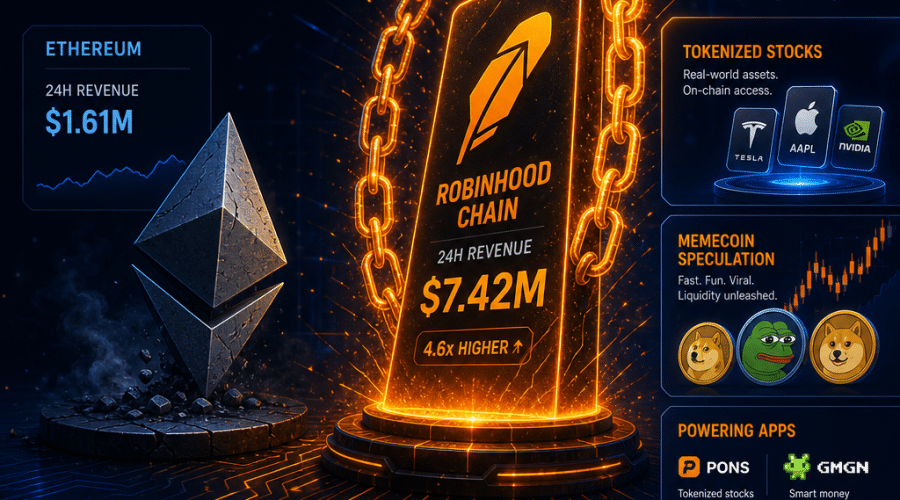
Broadly, network revenues continued a subdued trend last week, with aggregate weekly revenue falling 21% to $26.4 million—the lowest level in at least a month. The largest drops occurred in Hyperliquid (-40%, from $11.8m to $7.1m) and Ethereum (-38%, from $3.5m to $2.2m), two giants of the decentralized trading world, reflecting decreased transaction activity and fee intensity.
Although Solana weathered the storm better with only a 2% dip to $4.7 million, even it was unable to escape entirely unscathed. Tron, which has established itself as a consistent revenue generator, managed $6.1 million despite an 11% drop. Interestingly, the only notable upswings were logged by smaller L1 and L2 blockchains such as Arbitrum (+37%), Polygon (+50%), and BSC (+2%). However, the actual dollar amounts for these increases remain relatively minor in the grand scheme—the sector’s current momentum is skewed toward consolidation or stagnation at the top.
Perpetuals War: Lighter, Aster, and Hyperliquid Battle for Volume
August 2025 was a landmark month for perpetuals trading platforms. Hyperliquid registered $396 billion in monthly volume and $121 million in revenue, at one point capturing over 80% of DeFi perps market share. Despite this staggering lead, the ecosystem now appears far more competitive.
Lighter, a newer entrant, has eclipsed Hyperliquid in weekly volume, reporting $30.9 billion in seven-day volume and $203.7 billion over the last month. Its open interest stands at $1.48 billion, establishing it as a formidable contender not just in activity but also in trader engagement. Aster, another rising platform, posted $26 billion for the week and $160.6 billion over 30 days, with a more substantial $7.4 billion in open interest. Hyperliquid, meanwhile, has slipped in weekly trading volume to $21.5 billion but continues to lead in cumulative open interest, holding $2.4 billion—more than double its two primary rivals combined.
One caveat is that part of Lighter’s explosive volumes may be attributed to anticipatory trading ahead of its upcoming airdrop. Point-earning campaigns have historically led to inflated activity; whether this will be sustained after token distributions remains to be seen. Observers should watch closely to see if Lighter’s growth persists or if we see a sharp correction post-airdrop.
Key Takeaways and Outlook for 2025
Several core trends are emerging as crypto closes out a dynamic year:
- Increased competition in DeFi lending: While Aave’s dominance remains clear, rising challengers are gaining traction and chipping away at market share. The sector is evolving from a near-monopoly to a more fragmented and innovative ecosystem.
- Solana ecosystem resilience: Developer activity, vibrant token launches, and renewed trading narratives are giving Solana-based assets an edge even during mixed market cycles. But differentiation within its ecosystem means not all tokens perform equally.
- Sectoral divergence: Markets are rotating from legacy sectors (like L2s and Ethereum ecosytem tokens) toward new narratives—such as modular blockchains, physical infrastructure, DEX aggregators, and AI—offering renewed upside but also fresh risks.
- Perps trading in flux: The battle between Hyperliquid, Lighter, and Aster highlights how quickly dominance can be challenged in DeFi, especially with incentivization programs shaping short-term flows. Real, sustained adoption will come down to user stickiness, robustness, and continuous product innovation.
- Revenue and activity cooling: While network revenue dips may reflect seasonal trading lulls or macro factors, they also reinforce the imperative for protocols to diversify revenue sources, build sustainable use-cases, and capture real economic activity beyond speculation.
Final Thoughts
The latest data shows a market grappling with its own maturity: dominant players in lending and trading are no longer unassailable, and fresh narratives can ignite new growth cycles even as some sectors retreat. Solana’s robust ecosystem performance, the nuanced battles in DeFi lending, and the perpetuals trading arms race point to one truth—the crypto market is evolving and cannot be understood through singular price action alone. Instead, strength lies at the intersection of usage, innovation, and rapidly shifting trader preferences.
In this climate, market participants should build conviction not merely from weekly gains or losses, but from a deep understanding of protocol fundamentals, emergent trends, and the competitive landscape. As we approach 2025, expect further volatility—but also, renewed opportunities for those who keep their eyes open and their analyses sharp.