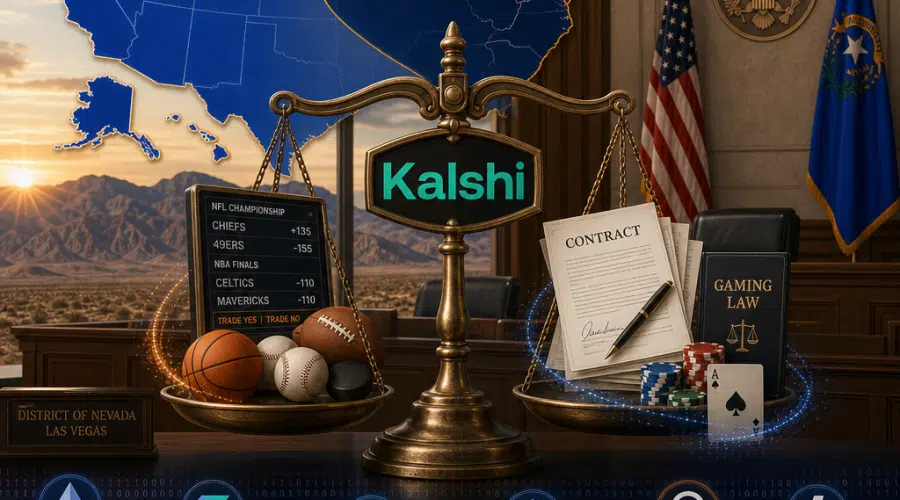
The Ninth Circuit court has given a ruling that sports event contract by Kalshi are not seen as swaps under the provisions of the Commodity Exchange Act (CEA). What this means is that Nevada is now in a position to enforce its gaming laws on the prediction market. At the heart of the matter ends up being one crucial question that could potentially affect vast commercial interests: Are these contracts really swaps? If they are, then the Commodity Futures Trading Commission (CFTC) will have complete jurisdiction over them. This would, in turn, exclude the state boundaries from having a say in the matter.
The Importance of the CEA’s Definition of a Swap
To delve deeper into the matter, we need to understand what the Commodity Exchange Act refers to as a ‘swap’. The exact definition of a ‘swap,’ according to the CEA, is an agreement that depends on an event taking place or not taking place, or to the extent of it occurring. The argument put forth by Kalshi was that their sports contracts fit the definition as mentioned above. This means they should fall under the CFTC and be out of Nevada’s jurisdiction. The court, however, turned down this argument.
For example, the occurrence of an event is when the Super Bowl happens and the outcome of an event is determined by which particular team wins. The implications of Kalshi’s interpretation are broad. Essentially anything could be termed as an ‘event’. But no one refuted the fact that the contracts are being traded on a designated contract market.
The court concluded that despite the contracts trading on a designated contract market, they are not swaps. Judges Kenneth Lee, Bridget Bade and Ryan Nelson presided over the case, with Nelson writing the opinion and Lee filing a concurrence.
Regarding CFTC Regulation
In this case, the panel also took into account the CFTC regulation 17 C.F.R. 40.11(a), which restricts contracts that relate to, involve or reference gaming. According to the court, Kalshi had listed their sports contracts through self-certification, a method that permits an exchange to introduce a product without the need for prior CFTC approval. The court stated that this self-certification was illegal under the special rule stated in the CEA for event contracts and the mentioned regulation.
Judge Lee concurred with the majority’s decision but added a separate clause stating that the special rule appears to give CFTC the authority to entirely ban gaming contracts. He concluded that this question did not need an immediate answer as regulation 40.11 currently forbids them.
Contrasting Rulings in Different Circuits
This ruling stands in stark contrast to one laid down by the Third Circuit in New Jersey in April involving the same company and same textual interpretation. The Third Circuit gave an opinion that sports outcomes are associated with potential financial, economic or commercial consequences and therefore qualify as swaps. Their judgement gave the CFTC both field and conflict pre-emption leaving New Jersey incapable of enforcing its gaming laws.


The contradictory rulings of two federal courts on the same issue provide the perfect condition for Supreme Court review.
The Way Forward
However, neither of these rulings puts an end to the lawsuits in consideration. These appeals revolve around preliminary injunctions and whether Kalshi displayed a likelihood of success at the initial stage, not a conclusive judgement on the merits of the case.
The decision only applies to the sports contracts by the Ninth Circuit, which has remanded Nevada’s challenges against the election contracts of Kalshi. The lower court now has to reconsider this in light of the new opinion.
Meanwhile, Kalshi continues to grow. After the CFTC approved its bitcoin contract, the company has been expanding into crypto derivatives and aligning its onchain presence through a strategic alliance with oracle provider RedStone.
Therefore, it remains to be seen how the company navigates these waters. The contrasting court rulings present a mixed bag of challenges and opportunities for Kalshi as it continues to innovate within the legislatory boundaries.