As the cryptocurrency market continues to evolve, the final week of December 2025 offered a fresh snapshot of shifting trends, performance metrics, and emerging sector leaders. The landscape in both traditional finance and digital assets provided insights into investor sentiment, sectoral resilience, and the growing complexity of decentralized finance (DeFi) and Layer 2 (L2) ecosystems. This news article provides a comprehensive overview and analysis of the latest developments impacting the global crypto industry and its key performers.
Traditional Markets and Cryptocurrency Diverge
Heading into the New Year, traditional markets delivered a mostly positive week. Gold led with a notable gain of 3.57%, underscoring its reputation as a reliable store of value during mixed risk environments. U.S. equities continued their upward drift, as the S&P 500 added 1.15% and the Nasdaq 100 followed with 0.84%. These advances were broadly attributed to steady macroeconomic signals and holiday-seasoned optimism.
In contrast, Bitcoin (BTC) did not follow the broader bullish trend. The world’s largest cryptocurrency slipped by 0.90%, revealing a brief divergence between crypto and traditional risk assets. As investors weighed profit-taking and anticipated regulatory developments, this modest decline in BTC’s valuation bucked the “risk-on” sentiment prevalent in other markets.
Crypto Sector Indices: Winners and Losers of the Week
This latest market snapshot brought sharp contrasts across various crypto sectors. Taking the lead, the Solana ecosystem surged by 4.4%, propelled by renewed confidence in its technology and robust performance of ecosystem tokens. Launchpads and DePIN (Decentralized Physical Infrastructure Networks) posted respective gains of 3.23% and 2.23%, highlighting investor interest in emerging project platforms and real-world asset integration.
Sectors specializing in perpetual contracts (Perps) and modular blockchains also advanced, registering moderate increases of 2.17% and 1.7%. Decentralized exchanges (DEXs) and artificial intelligence-integrated projects saw gains, albeit at a slower pace. This resilience across select sectors highlighted shifting narratives within the crypto investment community, where technological innovation and decentralized trading tools remain focal points.
However, the week also underscored significant downside for other segments. Layer 2 solutions, pivotal for Ethereum’s scalability and mainstream adoption, dropped by 8.27%. DeFi lending protocols declined significantly, falling 6.82%, while the broader Ethereum ecosystem lost 6.57% amid sectoral headwinds. Crypto mining companies also suffered, declining nearly 6% due to compression on margins, network congestion, and fluctuating coin rewards.
Solana Ecosystem Emerges as a Powerhouse
The Solana network and its associated tokens solidified their position among sector leaders. Particularly, Jito (JTO) and Drift Protocol (DRIFT) captured investor attention by posting double-digit gains of 10.30% and 8.10%, respectively. These performances highlight a renewed interest in liquid staking derivatives and innovative derivatives trading platforms within Solana’s rapidly expanding ecosystem.
Other standout Solana-based DeFi platforms such as Jupiter (JUP), Orca (ORCA), and Raydium (RAY) also notched solid weekly returns, reflecting persistent capital inflows and vibrant community engagement. The sector’s momentum was only partially tempered by the underperformance of tokens like MPLX and PUMP, which signaled possible cooling in memecoin and launchpad narratives after their prior speculative peaks.
Dominance and Competition in DeFi Lending
Aave remained the undisputed leader in the decentralized lending space throughout 2025, capturing 86% of protocol revenue and generating $120.9 million in year-to-date revenue. While these numbers are impressive, they also point to a subtle erosion in Aave’s dominance, which began the year with a commanding 91% market share. The competitive landscape is gradually fragmenting, as both established and freshly launched protocols target Aave’s customer base with innovative products and improved user experiences.
Among newer entrants, Fluid distinguished itself by more than doubling its market share, leaping from 2.4% in January to 4.9% by December, making it the fastest-growing competitor among DeFi lending protocols. Jupiter Lend and HyperLend, both debuting their services in 2025, now jointly command 3.4% of the space. Their ascent marks a broader trend of diversification and innovation within the DeFi segment, despite the vast lead maintained by early movers like Aave.


The distribution of outstanding crypto loans further supports the narrative of intensifying competition. Aave continues to hold an imposing $21.3 billion in outstanding loans, representing 74.7% of the sector. This share has remained relatively stable over the year. Meanwhile, challenger platforms are rapidly gaining scale. Morpho expanded its market share from 10.6% to 12.8%, underscoring steady organic growth, while Spark experienced a steep contraction, plunging from 11.5% to just 4.7%. Fluid, along with Jupiter Lend and HyperLend, demonstrated their ability to attract new usage and liquidity, signaling a new era of multi-protocol lending dynamics.
Network Revenues Show Downward Trend
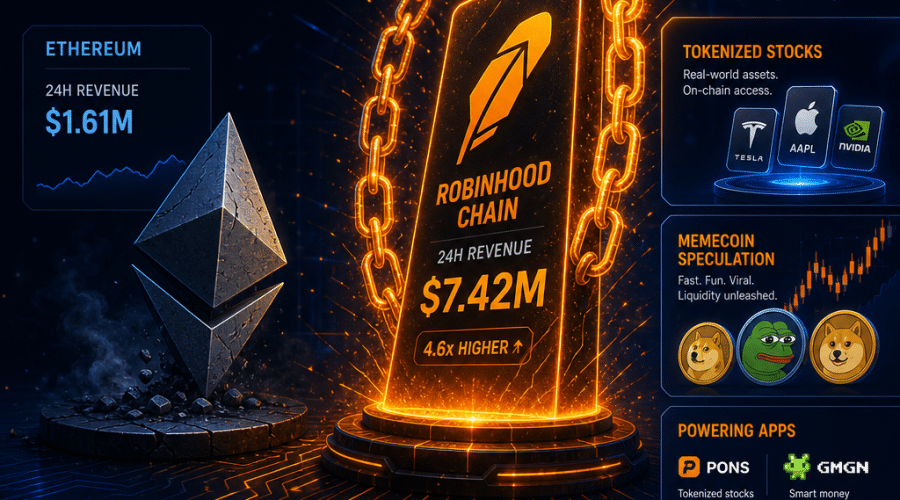
The last month saw a notable pullback in network revenues, with total weekly receipts sliding by 21% to just $26.4 million—marking the lowest figure recorded in over a month. Among the heavyweights, Hyperliquid’s revenue plunged 40%, declining from $11.8 million to $7.1 million. Ethereum, still a foundational pillar of DeFi and NFTs, suffered a steep 38% decrease, posting only $2.2 million in revenue for the week.
Despite these declines, Solana’s network proved more resilient, with movement limited to a 2% weekly slip to $4.7 million. Tron maintained its position as a leading revenue generator in the wake of Hyperliquid, reporting $6.1 million—a figure still representing an 11% decrease for the period. Meanwhile, relative upstarts Arbitrum, Polygon, and Binance Smart Chain (BSC) bucked the prevailing downtrend, notching respective gains of 37%, 50%, and 2%. While these figures are smaller in absolute terms, they reflect investor experimentation and possible shifts to more scalable blockchain alternatives.
DeFi Derivatives Protocols: The Battle for Perpetuals Market Share
DeFi derivatives protocols continued to dominate transaction and revenue metrics. August 2025 saw Hyperliquid post $396 billion in trading volume and $121 million in revenue, peaking at an extraordinary 80% share of the entire DeFi perpetuals (perps) market. This consolidation was so significant that the protocol became synonymous with DeFi perps among professional traders and high-frequency market makers.
The competitive dynamics, however, are far from static. Over the last week, Lighter reported $30.9 billion in perpetuals volume, and an impressive $203.7 billion for the last month, with $1.48 billion in active open interest (OI). Meanwhile, Aster registered $26 billion in seven-day volume—and $160.6 billion in rolling 30-day activity—but boasted the highest OI among the rising players at $7.4 billion. Hyperliquid, while trailing the top spot in weekly volumes with $21.5 billion, still maintains over double the combined OI of the nearest contenders, at $2.4 billion.
With rumors and anticipation building around a potential Lighter protocol airdrop, many analysts believe a chunk of recent volume may be artificially inflated by “points farming”—where users engage in high transaction volumes to maximize anticipated airdrop rewards. Industry observers will be watching closely in the coming weeks to see whether these volumes remain robust or taper off substantially as the points program concludes and users redeploy their capital.
Key Themes and Sector Takeaways
The end of 2025 reflected several pronounced themes in crypto investment and development. The rotation out of Ethereum-linked and Layer 2 tokens toward Solana and real-world asset sectors signals a growing appetite for scalable, high-speed blockchain environments. DeFi continues to be dominated by a handful of entrenched protocols, but competitive pressure is mounting as innovative new entrants gain market share, especially in lending and derivatives markets.
Investors should expect further segmentation and specialization as decentralized platforms race to onboard the next wave of users. Meanwhile, fluctuations in network revenue and activity signal the adaptability of capital within the crypto ecosystem, moving quickly in response to incentives, product launches, and shifting regulatory expectations. The contained losses in stalwart protocols like Aave and Solana, despite adverse market swings, illustrate the resilience and maturity of certain projects, while dramatic gains and losses in lesser-known tokens reflect the enduring volatility and experimental nature of crypto markets.
Looking Forward
As the ecosystem moves into the New Year, all eyes will be on how Layer 2 solutions address scalability hurdles, whether DeFi lending becomes more democratized, and if protocols like Lighter and Hyperliquid can maintain dominance after incentive programs draw to a close. The market’s divergence from traditional assets, sectoral rotations, and evolving leadership will undoubtedly continue to make the cryptocurrency space a test bed for investment strategies, technological progress, and financial innovation worldwide.