As the final days of December drew to a close, global financial markets and the crypto sector presented a compelling tapestry of contrasting trends and shifting narratives. Precious metals like gold took the spotlight among traditional assets, while tech and risk assets carried forward last quarter’s momentum—except for Bitcoin, which bucked the risk-on trend, dipping slightly over the past week. Among digital assets, the Solana ecosystem was a notable outperformer, while Ethereum-linked tokens and Layer 2s (L2s) experienced meaningful declines. As the decentralized finance (DeFi) space continues to evolve, Aave remains atop the lending vertical, but competitors are making significant inroads, and the decentralized perpetual contracts (perps) market is seeing fierce competition and new dynamics driven by innovative protocols and airdrops.
Traditional Market Trends and Crypto Divergence
The traditional finance world saw steady, if modest, gains throughout the last full week of December. Gold led the charge, appreciating by an impressive 3.57%. The S&P 500 index advanced 1.15%, and the tech-heavy Nasdaq 100 followed at 0.84%. This gentle upward drift reflected renewed investor confidence and a general risk-on mood as many anticipated positive developments in the new year.
Yet, Bitcoin—the leading indicator for the entire crypto asset class—broke from the pack. Despite the bullish trends in broader financial markets, BTC slipped nearly 1%, underscoring that the cryptocurrency market continues to dance to the beat of its own drum. This divergence reinforced the idea that, while correlations between crypto and traditional assets do exist, crypto often moves according to sector-specific factors and internal investor dynamics.
Sector Performance: Solana Ecosystem Leads Gains
Within the crypto industry, sector rotation was in full force. While headline indices captured some weakness, certain sub-segments outperformed. The Solana ecosystem particularly stood out, advancing 4.4% on the week. This uptrend in Solana-related projects came at a time when several Ethereum-adjacent and L2 sectors experienced pullbacks. The landscape was as follows:
- Solana Ecosystem: +4.4%
- Launchpads: +3.23%
- DePIN (Decentralized Physical Infrastructure): +2.23%
- Perps (Decentralized Perpetuals): +2.17%
- Modular Projects: +1.7%
- DEXs (Decentralized Exchanges): +1.42%
- AI-related: +1.07%
The sector leaders were robust, with a particularly strong showing among Solana’s projects. Among individual tokens:
- JTO: +10.3%
- DRIFT: +8.1%
- JUP: +4.14%
- ORCA: +3.81%
- RAY: +3.40%
This wave of optimism was driven by renewed narratives in liquid staking and perps. In contrast, projects like MPLX and PUMP lagged, the latter dropping 5.11% as memecoin and launchpad enthusiasm cooled.
On the downside, the past week put significant pressure on:
- L2 tokens: -8.27%
- Lending: -6.82%
- Ethereum Ecosystem: -6.57%
- Crypto Miners: -5.97%
Aave’s Dominance in DeFi Lending Faces New Competition
For much of the past year, Aave has maintained dominance in the DeFi lending ecosystem. In 2025, it generated $120.9 million year-to-date, capturing a remarkable 86% of all DeFi protocol revenue. However, this figure reflects a noticeable decline from January’s 91% share. The landscape is changing, with up-and-coming protocols starting to attract meaningful users and capital:
- Fluid: Increased its revenue share from 2.4% at the start of the year to 4.9%, making it the fastest-growing competitor.
- HyperLend and Jupiter Lend: Though both launched mid-year (March and July respectively), together they now account for 3.4% of the total market—impressive for such young projects.
While Aave still reigns in terms of outstanding loans—with $21.3 billion lent out (74.7% of the market)—other platforms are slowly but surely growing:
- Morpho: Grew from a 10.6% loan share in January to 12.8% in December.
- Fluid: More than doubled its share from 3.6% to 5.0% throughout the year.
- Jupiter Lend: Already holds 2.1% market share for outstanding loans.
- HyperLend: Accounts for 0.7% of total loans.
- Spark: Declined sharply, dropping from 11.5% to just 4.7% despite its initial promise.
These figures illustrate both the stickiness of established DeFi protocols like Aave and the significant room for new entrants to disrupt the status quo through innovation and tailored solutions.


Network Revenue: Downtrends and Exceptions
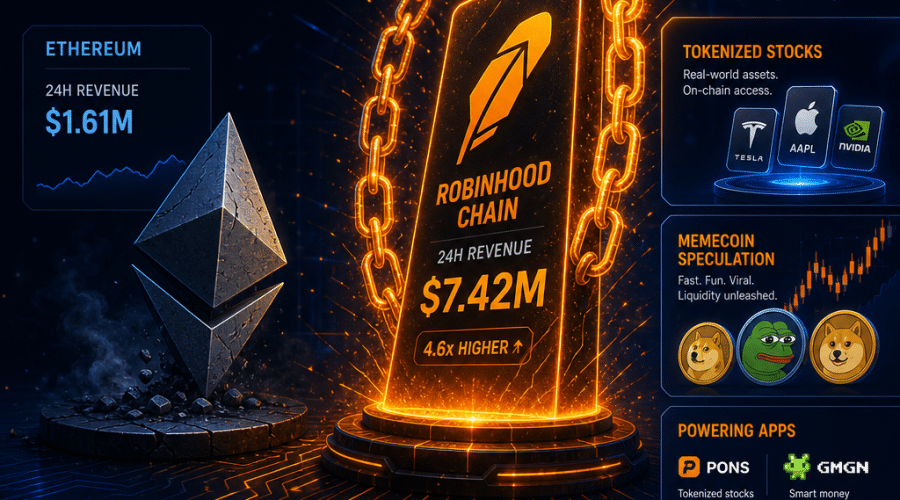
Despite sectoral winners, overall network revenues for leading crypto protocols experienced a sharp contraction. Weekly network revenue dropped by 21% to $26.4 million, reaching lows not seen in over a month, reflecting decreased activity, pressure on transaction fees, or users moving towards alternative chains.
- Hyperliquid: Suffered the biggest decline with a 40% drop—$11.8 million down to $7.1 million.
- Ethereum: Fell 38%, generating $2.2 million.
- Solana: Outperformed most, with a marginal 2% decrease, totaling $4.7 million.
- Tron: Maintained second place behind Hyperliquid ($6.1 million), despite an 11% fall.
Notably, some smaller projects bucked the downtrend:
- Arbitrum: +37%
- Polygon: +50%
- Binance Smart Chain (BSC): +2%
However, the absolute gains for these chains were modest compared to the market leaders, suggesting shifting user interest but insufficient volume to change the overall revenue direction for the sector.
The Perpetuals Market: Hyperliquid, Lighter, and Airdrop Dynamics
August 2025 marked a dramatic peak in the decentralized perpetuals space. Hyperliquid racked up $396 billion in trading volume and generated $121 million in revenue, capturing over 80% of the market at its zenith. This dominance, however, has since been challenged by agile newcomers leveraging strategic incentives and airdrop programs.
Lighter, in particular, has surged ahead recently:
- Lighter: Achieved $30.9 billion in perpetual trading volume over the previous week alone, totaling $203.7 billion for the past month and sporting $1.48 billion in open interest.
- Aster: Recorded $26 billion for the week, $160.6 billion over 30 days, and boasts $7.4 billion in open interest, indicating strong trader engagement.
- Hyperliquid: Despite $21.5 billion in weekly volume (third place), still maintains $2.4 billion in open interest—more than double the combined open interest of both Lighter and Aster.
The rapid growth in Lighter’s and Aster’s activity is widely believed to be influenced by upcoming token airdrops and associated points programs. These initiatives have successfully incentivized both volume and sticky user behavior. Nevertheless, industry observers remain cautious. Such surges are frequently followed by steep declines in activity once rewards end. The ultimate test for these protocols will be retaining users and volume in the post-airdrop period—an arena where even market giants stumble.
Conclusion: Emerging Themes for the Crypto Sector
As 2025 comes to a close, several clear themes have emerged for the crypto sector:
- Sector Rotation: Periodic shifts in capital and attention are now a defining feature, with ecosystems like Solana and DePIN currently cycling into favor as L2s and Ethereum-linked assets correct.
- DeFi Competition: While incumbents like Aave have formidable leads, the market is far from ossified. New entrants are innovating, finding niches, and winning market share—Fluid and Jupiter Lend are prime examples.
- Volume Incentives: The race for volume and liquidity in DeFi trading is being increasingly shaped by points systems and airdrop speculation. This can lead to volatile, artificial spikes in use, challenging protocols to convert mercenary users into long-term community members.
- Revenue Pressures: Network revenue declines highlight both increasing efficiency (lower fees, subsidized transactions) and possible saturation or user fatigue in established chains. Meanwhile, alternative networks and new use cases—such as AI and DePIN—present future areas for growth.
Looking Forward
Entering 2026, the crypto ecosystem appears more dynamic, competitive, and unpredictable than ever. Investors and builders alike will need to stay vigilant to sector rotations, protocol innovations, and shifting user incentives. While headlines may focus on singular blockchains or tokens, the underlying reality is a rapidly adapting landscape where today’s winner can quickly become tomorrow’s challenger. The interplay between established and emerging players will likely define the next phase of crypto market evolution, demanding strategic agility and a relentless focus on long-term value over short-term hype.
The stage is set for another transformative year in crypto—one shaped as much by technological advances and innovative incentive systems as by the tides of global capital and shifting trader sentiment.