


Forex looks simple on the surface: buy one currency, sell another, and try to profit from the move. In practice, it rewards traders who keep things boring in the right places: clear rules, sensible risk, and patience.
If you’re learning how to trade forex for the first time, start with the basics and build from there. You do not need a complicated strategy, five monitors, or heroic leverage. You need to understand how currency pairs move, how orders work, and how to protect your account when the market does something rude.
If you want the broader picture first, read our forex trading guide. This article focuses on the practical beginner path.
What is forex trading?
Forex, or foreign exchange, is the market where currencies are traded in pairs such as EUR/USD or GBP/JPY. When you trade forex, you are speculating on whether one currency will strengthen or weaken against another.
For example, if you buy EUR/USD, you expect the euro to rise relative to the US dollar. If the pair moves up and you close the trade at a better price, you make a profit. If it moves against you, you take a loss.
The forex market is open 24 hours a day during the trading week, which is one reason it attracts beginners. Another is accessibility: most brokers offer demo accounts, small position sizes, and charting tools that make it easier to learn without risking too much capital too soon.
How forex trading works

Every forex trade involves two currencies:
- Base currency: the first currency in the pair
- Quote currency: the second currency in the pair
In EUR/USD, EUR is the base currency and USD is the quote currency. If EUR/USD is trading at 1.1000, that means 1 euro is worth 1.10 US dollars.
Beginners should also understand a few core terms:
- Pip: a standard unit of price movement in most currency pairs
- Spread: the difference between the buy and sell price
- Lot size: the size of your trade
- Leverage: borrowed exposure that increases both potential gains and potential losses
- Margin: the amount of capital required to open and maintain a leveraged trade
Leverage is where many beginners get into trouble. It can make small moves feel exciting, but it can also turn a manageable mistake into a fast loss. The CFTC and the FCA both stress that leveraged forex trading carries substantial risk.
Choose the right currency pairs as a beginner
Not all pairs behave the same way. If you’re just starting out, stick with major pairs. They usually have tighter spreads, deeper liquidity, and cleaner price action than many minor or exotic pairs.
- Major pairs: EUR/USD, GBP/USD, USD/JPY, AUD/USD
- Minor pairs: EUR/GBP, EUR/AUD, GBP/JPY
- Exotic pairs: USD/TRY, EUR/ZAR and similar pairs with wider spreads and higher volatility
A sensible beginner shortlist is often EUR/USD and GBP/USD. They are widely followed, heavily traded, and easier to analyse than thinner markets.
How to start trading forex step by step
1. Learn the basics before risking real money
Understand how pairs are quoted, how pips work, what moves the market, and how stop-loss orders function. If those terms still feel fuzzy, do not rush to live trading yet.
2. Pick a regulated broker and platform
Look for a broker regulated in a reputable jurisdiction, with clear fees, sensible leverage settings, and a platform you can actually use without needing a manual the size of a novel.
Check:
- regulation and client protections
- spreads and commissions
- available markets
- order types
- mobile and desktop usability
- demo account access
3. Start with a demo account
A demo account helps you learn order execution, chart reading, and trade management without immediate financial risk. Treat it seriously. Random clicking teaches very little.
4. Build one simple strategy
Beginners do better with one repeatable setup than with six half-understood ideas. A basic trend-following or breakout strategy is usually enough to start.
If you want help reading charts, our guide to indicators is a useful next step.
5. Define your risk before every trade
Know where you will exit if the trade is wrong, how much of your account you are risking, and what would invalidate the setup. If you cannot answer those three questions, you do not have a trade yet.
6. Move to a small live account
Once you can follow your plan consistently on demo, switch to a small live account. Real money changes behaviour. That is normal. The goal is not to trade bigger. The goal is to trade the same way under pressure.
Basic forex analysis for beginners
Most traders use one or both of these approaches:
Technical analysis
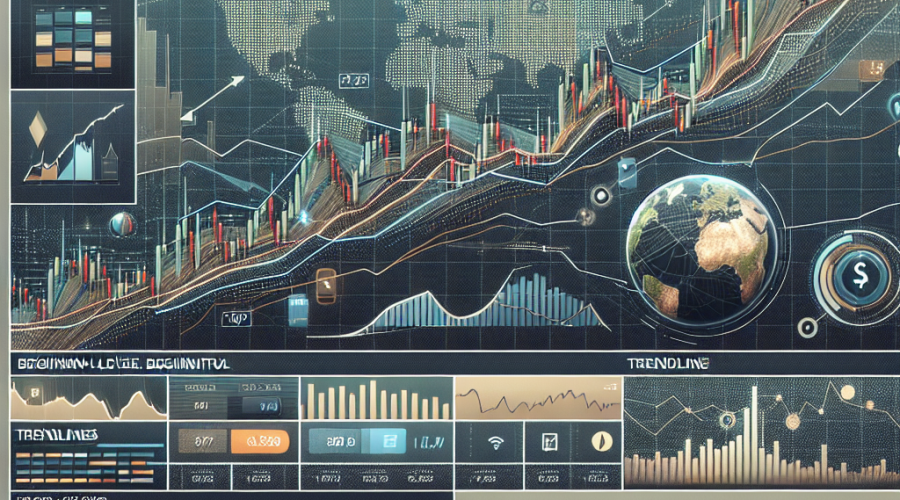
This focuses on price charts, trends, support and resistance, and indicators. It helps traders identify possible entry and exit points.
Common beginner tools include moving averages, RSI, trend lines, and support and resistance zones.

Technical analysis is especially useful when you want a structured trading plan instead of reacting to every candle like it just insulted you personally.
Fundamental analysis
This looks at economic data and central bank policy. Interest rates, inflation, employment reports, and major geopolitical events can all move currencies.
Useful sources include central bank websites and economic calendars. For example, the Federal Reserve and the European Central Bank publish policy updates that often affect major forex pairs.
Beginners do not need to become macroeconomists overnight. They do need to know when major news is scheduled, because volatility can spike quickly around key releases.
Simple forex strategies for beginners
Trend-following
This means trading in the direction of the broader market move. If a pair is making higher highs and higher lows, traders look for buying opportunities. If it is making lower highs and lower lows, they look for selling opportunities.
Trend-following works well for beginners because it encourages patience and reduces the urge to fight the market.
Breakout trading
A breakout happens when price moves beyond a clear support or resistance level. Traders use this to catch momentum when the market leaves a range.
The catch: not every breakout is real. False breakouts happen often, which is why stop-loss placement matters.
Range trading
When a pair is moving sideways between support and resistance, some traders buy near support and sell near resistance. This can work in quieter conditions, but it tends to fail when strong news pushes the market into a new trend.
Risk management matters more than your entry
Most beginner losses do not come from a lack of indicators. They come from poor risk control.
Good habits include:
- risking only a small percentage of your account on each trade
- using a stop-loss on every trade
- avoiding oversized leverage
- keeping a risk-to-reward framework
- not revenge trading after a loss
If you want a practical shortcut, think in terms of survival first. Your first job is to stay in the game long enough to learn.
For traders who want extra market context while building their own process, AltSignals trading signals can help you compare your analysis with live setups. Used properly, signals are a support tool, not a substitute for risk management.
Common forex trading mistakes beginners make
- Using too much leverage: small market moves can wipe out an account faster than most beginners expect.
- Trading without a plan: entering because price is moving is not a strategy.
- Ignoring news events: major releases can change market conditions in seconds.
- Moving stop-losses further away: this usually turns a controlled loss into a larger one.
- Overtrading: more trades do not automatically mean more opportunity.
- Expecting quick income: forex is a skill-based activity, not a shortcut.
Useful tools for beginner forex traders
You do not need every tool available. A small, practical toolkit is enough:
- a regulated broker with a demo account
- a charting platform
- an economic calendar
- a trading journal
- a position size calculator
If your focus is chart-based decision-making, our AltAlgo indicator can help you spot trend and momentum shifts more efficiently. Keep the workflow simple: analyse, plan, execute, review.
Final thoughts
Learning how to trade forex is less about finding a magic setup and more about building repeatable habits. Start with major pairs, use a demo account, keep your strategy simple, and treat risk management as non-negotiable.
The traders who last are usually not the ones chasing the biggest move. They are the ones who stay consistent when the market gets noisy.
If you want a broader foundation, start with our forex trading guide. If you want live trade ideas to compare against your own analysis, you can also explore AltSignals trading signals.
FAQ
Can I start forex trading with a small amount of money?
Is forex trading good for beginners?
It can be, provided you start slowly. Forex is accessible and liquid, but leverage and volatility make it risky if you jump in without a plan. A demo account and a simple strategy are the safest starting point.
How long does it take to learn forex trading?
That depends on how consistently you study and practise. Most beginners can learn the basics fairly quickly, but building discipline and risk control takes longer. Think in months of structured practice, not days.
What is the best forex strategy for beginners?
There is no single best strategy for everyone, but trend-following is often one of the easiest to learn. It is simple, structured, and helps beginners avoid trading against the broader market direction.






















Yes, many brokers allow small account sizes. The bigger issue is not the minimum deposit but whether your position sizing and leverage are sensible. Small accounts are best used for learning, not for trying to generate fast income.