Senate Republicans Demand Fairness in Crypto Bank Capital Rules
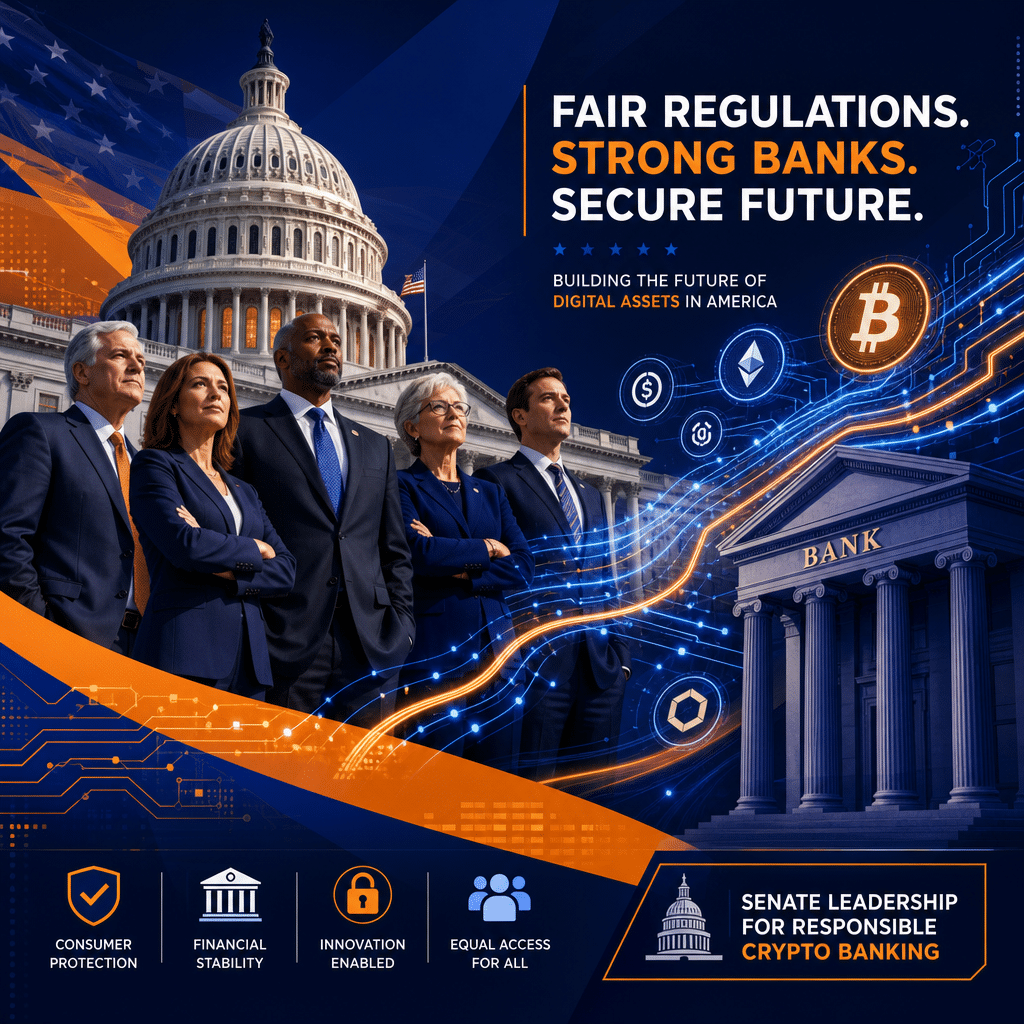
In a significant development for the digital asset industry, a group of Senate Republicans has formally called upon federal banking regulators to establish equitable and balanced capital rules for digital asset activities. Led by Senator Cynthia Lummis, this initiative centers on challenging what lawmakers perceive as disproportionately harsh capital requirements and unfair standards that threaten to stifle innovation and restrict American banks’ participation in the burgeoning crypto market.
Senate Republicans Take a Stand Against Current Crypto Capital Standards
Cryptocurrency has long struggled to achieve legitimacy and integration within the US banking sector, in part due to the uncertainty and rigor of current regulatory frameworks. At the forefront of this recent push is Senator Cynthia Lummis, known for her advocacy of blockchain and digital innovation. Alongside five Republican colleagues, she addressed a formal letter to top financial regulators: Federal Reserve Vice Chair for Supervision Michelle Bowman, FDIC Chair Travis Hill, and Acting Comptroller of the Currency Jonathan Gould. This letter directly challenges the established capital standards for digital asset exposure, as set by the influential Basel Committee on Banking Supervision.
The Basel Committee, which establishes global benchmarks for banking capital and risk supervision, has prescribed a 1,250% risk weight for certain crypto assets—a figure that stands as among the highest tiers of risk. According to the Senate Republicans, this elevated risk weighting operates as a de facto ban, making it virtually impossible or prohibitively expensive for US banks to engage in on-balance sheet digital asset activities. “Such a standard treats crypto assets as entirely detached from the realities of financial innovation and risk management,” the senators argued, emphasizing that these rules neither accurately reflect the underlying risks nor create an enabling environment for responsibly regulated bank participation.
The Call for Technology-Neutral Regulation
One of the central themes of the senators’ letter is the need for a technology-neutral approach by US regulators. Senator Lummis and her colleagues contend that regulation should focus on the activities and actual risks involved, rather than singling out the technologies used to facilitate those activities. In their view, penalizing banks simply for interacting with blockchain-based assets fails to distinguish between well-managed, low-risk activities and those that genuinely warrant higher scrutiny.
This technology-neutral approach is not only a matter of fairness but also of pragmatism. As digital assets and their underlying technologies evolve, frameworks based solely on technology risk becoming obsolete—locking the financial sector into outdated regulatory paradigms that don’t keep pace with innovation. The senators’ request, therefore, is for rules that adapt along with advances in digital finance, safeguarding both market integrity and participation by regulated institutions.
Recent Regulatory Guidance and Its Implications
The timing of the Senate letter is notable as it follows recent guidance from the Federal Reserve, FDIC, and OCC in March, where these agencies affirmed that tokenized securities—digital representations of traditional securities—would be granted the same capital treatment as their non-digital counterparts. The senators argue that this principle of equal treatment should be extended across all digital asset activities, not just tokenized securities. Failing to do so, they warn, could create fragmentation and inhibit responsible innovation among US banks.
This appeal for clear, actionable guidance highlights a pressing issue: American banks require certainty before expanding into crypto-related services. Absent defined rules, banks are reluctant to introduce on-balance sheet digital asset offerings. The senators underscore that capital requirements should reflect genuine risks rather than serve as blanket deterrents. Such clarity, they argue, is foundational for supporting safe and lawful participation in the digital asset markets and would encourage banks to develop compliant offerings rather than cede the market to unregulated entities.
Capital Standards and Congressional Crypto Legislation
This debate over capital standards arrives as the US Congress itself studies broader legislation covering the digital asset space. Potential new laws may soon empower banks to increase their activities involving digital assets, ranging from custody and settlement services to full-scale trading and lending with crypto instruments. However, as lawmakers have observed, unless regulators update capital guidance in parallel, banks could find themselves authorized by Congress yet hampered by outdated or punitive capital rules.
To minimize this regulatory mismatch, the senators stress the urgency for agencies like the Federal Reserve, FDIC, and OCC to proactively establish the necessary guidelines. This alignment between legislative intent and regulatory execution will be crucial to ensuring banks aren’t disincentivized from participating in the digital asset ecosystem once broader permissions are in place.


Risk, Opportunity, and Market Access: The Broader Debate
The senators’ letter featured the support of multiple prominent GOP lawmakers, including Senators Dan Sullivan, Bill Hagerty, Bernie Moreno, Ted Budd, and Jon Husted. Their collective stance places digital asset capital rules at the center of the political and regulatory debate over the United States’ role in global innovation. They note that capital rules must carefully balance the dual interests of managing risk and fostering financial opportunity. Importantly, the senators warn that overly restrictive standards could drive a significant portion of digital asset activity outside of supervision by regulated US banks and into less regulated—or even illicit—channels.
This position reflects a wider Republican belief that American banks should be at the forefront of financial innovation, not sidelined by regulatory inertia or one-size-fits-all controls. The senators maintain that as long as banks are held to rigorous risk management and capital standards for genuinely risky activities, they should not be penalized merely for seeking to enter the digital asset market. The risk-weighting framework, they argue, must be recalibrated so that regulation encourages lawful and innovative bank participation, not discourages it.
Anticipated Regulatory Response and Next Steps
This dispute is now set to play out before the House Financial Services Committee, where Federal Reserve Vice Chair Michelle Bowman, FDIC Chair Travis Hill, and Comptroller Jonathan Gould are scheduled to provide testimony. Their remarks and positions are likely to influence how federal agencies move forward with capital treatment for digital assets in the months ahead.
Market participants, meanwhile, are closely monitoring these developments amid hopes that regulatory clarity will finally unlock institutional participation in crypto. Industry leaders argue that, with appropriate capital requirements, American banks could provide the necessary scale, stability, and legitimacy to digital assets—key elements for realizing the technology’s mainstream potential.
The Future of Crypto Banking in the United States
At stake in this regulatory dialogue is the future of financial innovation and the international competitiveness of American banks. As digital assets become more integral to both retail and institutional finance, jurisdictions that strike the right regulatory balance are likely to capture a larger share of economic value generated by blockchain technologies.
If US regulators answer the Senate Republicans’ call and adopt more nuanced, technology-neutral capital standards, banks may soon be able to safely and confidently expand their digital asset offerings. This could herald a new era of growth and consumer choice in the financial sector, positioning the United States as a global leader in the responsible integration of digital assets.
Conclusion
The call by Senate Republicans to revisit and reform digital asset capital rules speaks to the rapidly evolving interface of policy, technology, and market participation. Achieving a fair and pragmatic regulatory framework is crucial not only for the crypto industry, but for the long-term health and competitiveness of the US financial system. As policymakers and regulators navigate these challenges, their decisions will shape the future of digital finance—determining whether innovation is led from within America’s regulated banks or forced to thrive outside its borders.