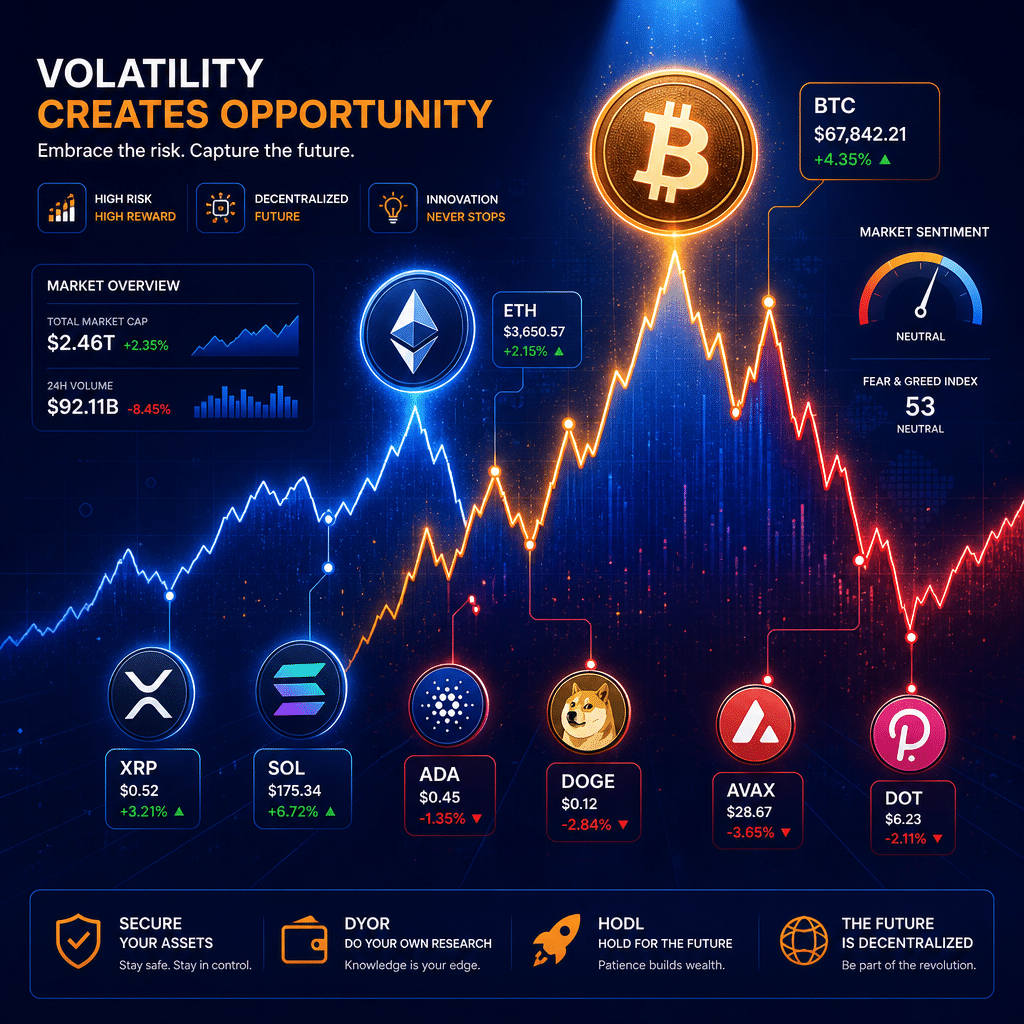
The cryptocurrency market witnessed substantial volatility on August 7, 2026, with the majority of top digital assets posting losses as investor sentiment appeared cautious amid broader economic uncertainty. The latest price movements reflect shifting market trends and underscore the inherent volatility characteristic of the crypto sector. This report presents an in-depth analysis of cryptocurrency price action on the day, examines the leading gainers and losers, and explores contributing factors affecting market performance.
Key Market Movements: A Day of Widespread Declines
At 9:30 AM KST on August 7, leading cryptocurrencies recorded red numbers, with Bitcoin and Ethereum, the two largest assets by market capitalization, failing to buck the prevailing downward trend. According to market aggregator CoinMarketCap, Bitcoin (BTC) saw a modest decline of 0.64%, trading at $64,210.56. Ethereum (ETH) followed suit, slipping 0.49% to $1,899.63. Bitcoin’s performance was closely watched by investors and analysts, as its price action often provides a barometer for sentiment across the broader digital asset landscape.
Other major cryptocurrencies also reported losses. Ripple’s XRP dropped more sharply, losing 2.62% of its value to close at $1.03—an indication of notable selling pressure. Solana (SOL), celebrated in past rallies for fast-paced gains, declined by 2.05%, trading at $72.55 at the time of publication. Dogecoin (DOGE), a favorite among retail traders, posted a 1.42% loss at $0.06904, reinforcing the market’s risk-off tone. Avalanche (AVAX) and World Liberty Financial (WLFI) were down by 3.59% and 1.42%, to $6.41 and $0.05261, respectively. Meanwhile, TRON (TRX) performed marginally better, with a limited decrease of 0.12% to $0.3267. Worldcoin (WLD) experienced the largest single-digit drop among the group, declining by 4.39% to $0.3027.
Gainers and Losers: Spotlight on Altcoins
Despite the bearish overall market sentiment, some digital assets managed to defy the trend. Amongst the top 100 cryptocurrencies by market capitalization, Lighter (LIT) stood out as the day’s leading gainer, surging by 9.13%. This impressive rally marked Lighter as a notable exception and indicated strength among select altcoins even during periods of broader market stress. The specific driver behind LIT’s surge was not immediately clear, highlighting how smaller tokens can experience significant price moves on relatively modest news or through speculative trading.
On the other end of the spectrum, Audiera (BEAT) took a major hit, recording a steep 14.28% decline over the preceding 24 hours. Steep corrections like this can result from factors including profit-taking after rapid ascents, negative news, or shifts in investor perception. The pronounced drop underscored the heightened volatility commonly associated with lower-cap cryptocurrencies.
Elsewhere in the altcoin sector, Quai Network (QUAI) posted a gain of 3.51% to settle at $0.01186, reflecting some resilience among select tokens. Aleo (ALEO) also managed to increase in value, rising 1.16% to $0.01666, signaling continued investor interest in projects with perceived innovation or unique technology offerings.
New Market Entrants: Fresh Listings Stimulate Activity
The past 24 hours saw the addition of new cryptocurrencies to the CoinMarketCap platform, including MEXC Staked SOL (MXSOL) and StonkBroker (STONKBROKER). The listing of new tokens can often generate excitement among traders seeking early opportunities in novel projects. However, it also poses risks given the often-unknown security, development trajectory, and long-term vision behind nascent tokens.
Early listings tend to attract speculative interest before price discovery settles. Investors interested in new cryptocurrencies are advised to perform due diligence, particularly for tokens with limited trading history or transparency regarding underlying technology and team credentials.
Market Analysis: Factors Influencing the Downturn
Several factors contributed to the broad-based sell-off observed on August 7. Macroeconomic uncertainties have weighed on the investor psyche, with many participants opting to de-risk portfolios in response to shifting monetary policy signals, inflation data, or global economic developments. The cryptocurrency space, notoriously reactive to major economic news, can experience rapid shifts in sentiment based on evolving world events.


Another factor impacting prices is the succession of regulatory developments affecting digital assets across key markets. Ongoing debates on cryptocurrency classification, potential restrictions, and compliance requirements have injected an added layer of complexity, occasionally exacerbating risk-off moves across the board. This environment has fostered increased caution among both institutional and retail traders, evidenced by the day’s largely negative price momentum.
Finally, technical factors—such as key support and resistance levels in price charts, and liquidations of leveraged positions—can trigger amplified price swings, especially in thinly traded tokens or during periods of reduced liquidity. Whales or large-volume holders offloading assets may also contribute to sudden downturns, which then ripple through the order books and dampen prices further.
The Broader Implications for Crypto Investors
The August 7 market action serves as a valuable reminder of the highly volatile nature of cryptocurrency investing. Sharp swings within hours, as exemplified by the fortunes of LIT and BEAT, reinforce the need for robust risk management, portfolio diversification, and continual education about the sector’s dynamics. While blue-chip tokens like Bitcoin and Ethereum can sometimes buffer overall losses, even they are not immune to systemic pressures that sweep the entire market.
For those monitoring new market opportunities, the continuous introduction of new tokens signifies both the sector’s rapid innovation and accompanying risks. Entering positions in new or thinly traded tokens should be met with an understanding of the heightened risks, the lack of fundamental data, and the strong influence of speculative flows.
Looking Ahead: What to Watch in the Coming Weeks
As the market absorbs current developments, analysts and investors will keep an eye on upcoming catalysts that could shape momentum. Key areas of focus include:
- Regulatory developments: Any further clarifications, enforcement actions, or legal stakes affecting major cryptocurrencies will be closely watched for their impact on sentiment and institutional engagement.
- Macroeconomic indicators: Broader data such as inflation reports, interest rate decisions by major central banks, and employment numbers will continue to shape risk appetite across global financial markets, including crypto.
- Technological milestones: Upgrades or major releases from leading blockchain networks—such as Ethereum’s move towards further scalability solutions, or advances on layer-2 platforms—could re-invigorate investor interest.
- Market adoption: Corporate partnerships, mainstream integrations, and real-world use cases for digital assets can catalyze demand and produce sudden surges in specific tokens or sectors within the crypto economy.
Conclusion: Navigating Volatility in the Digital Asset Sector
August 7, 2026, exemplified the continued volatility and dynamism inherent to the cryptocurrency markets. While the majority of major tokens trended lower, isolated gains and the launch of new projects attest to ongoing innovation and pockets of opportunity. Market participants are encouraged to maintain vigilance, apply sound risk management strategies, and remain abreast of both macro trends and project-specific developments as they chart a course through the evolving digital asset landscape.
In the days and weeks ahead, the sector’s resilience will be tested by both internal and external forces, making informed, adaptive strategies more crucial than ever for anyone active in the world of crypto.