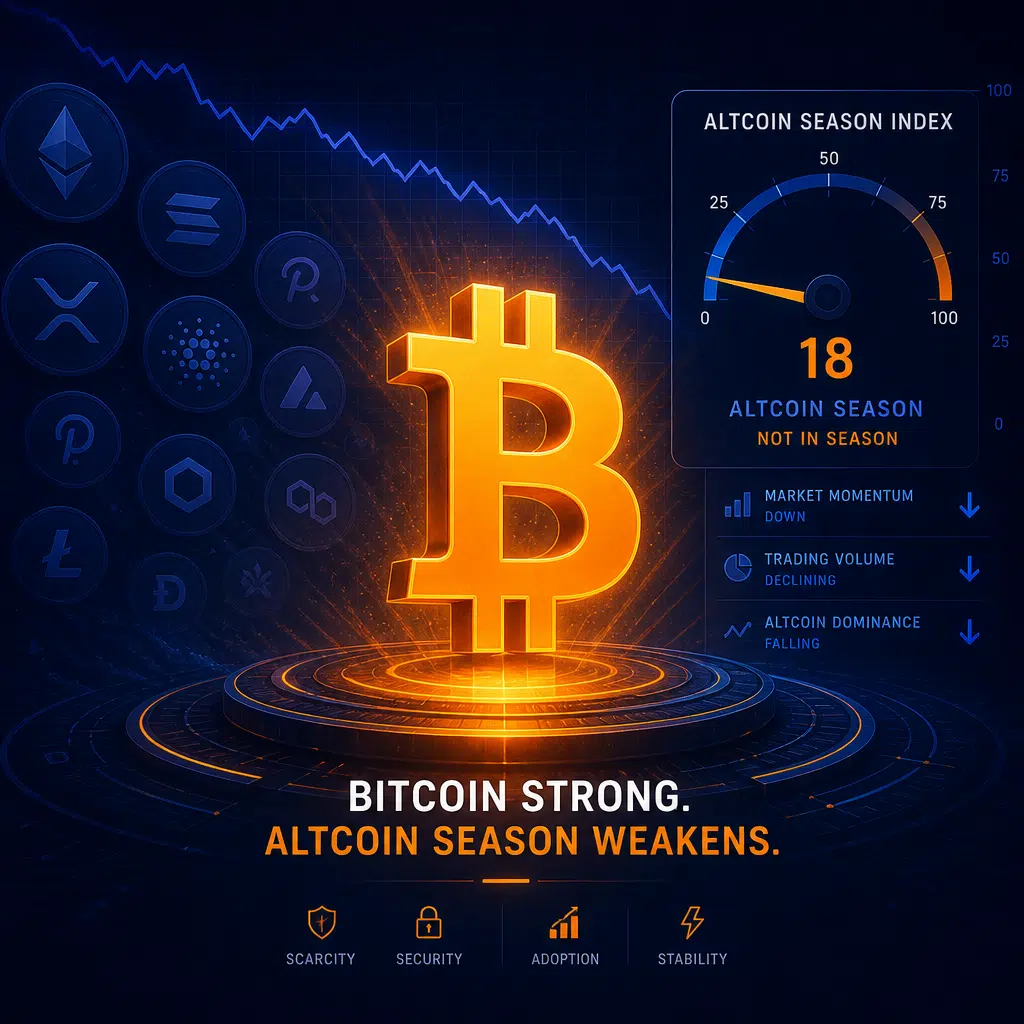
CoinMarketCap’s Altcoin Season Index has recently taken a notable dip, falling to 45 on the most recent reporting date. This marks a decrease of seven points from the previous day, signaling an intensified shift in favor of Bitcoin dominance across the cryptocurrency landscape. The declining index is a critical indicator for investors, as it reflects changing market sentiment and provides insight into the relative strength of Bitcoin compared to the broader altcoin market.
Understanding the Altcoin Season Index
The Altcoin Season Index has emerged as a popular and practical tool for crypto enthusiasts and institutional investors alike. It offers a quantitative method of assessing whether market participants are favoring altcoins or the king of crypto, Bitcoin.
At its core, the index compares the 90-day price performance of Bitcoin with that of the top 100 largest cryptocurrencies by market capitalization, excluding stablecoins and wrapped tokens. The calculation is straightforward: when 75% of these altcoins outperform Bitcoin within the defined period, the market is defined as being in “altcoin season.” Should the index read below this threshold, it favors Bitcoin, often labeled as “Bitcoin season.” The closer the index is to 100, the stronger the momentum and signal for altcoins, while numbers near zero highlight Bitcoin’s dominance.
When the index sits at 45, as seen currently, it points to less than half of those leading cryptocurrencies managing to deliver higher returns than Bitcoin over the past three months. This is a notable reversal from earlier phases in the year, when a temporary altcoin rally managed to push the index above 60. At that time, investor sentiment saw altcoins appearing as attractive alternatives given their high-growth potential. The current mid-range figure paints a different landscape—one that suggests investors are now seeking refuge in Bitcoin’s relative stability in response to broader financial uncertainties.
The Shift Toward Bitcoin Dominance
The recent decrease in the Altcoin Season Index does not occur in a vacuum. It aligns closely with Bitcoin’s strengthening grip on overall crypto market capitalization. As of the latest figures, Bitcoin commands approximately 55% market dominance, reinforcing its position as the anchor of the digital asset world.
This trend typically appears during phases of market consolidation or when “risk-off” sentiment dominates the environment. In such periods, investors are more inclined to pull their capital out of riskier, smaller-cap digital assets, consolidating their holdings in the tried-and-tested security of Bitcoin. It’s a pattern echoed in previous cycles: capital rotation away from volatility and towards perceived safety during uncertain times.
Importantly, the macroeconomic landscape plays an outsized role in this phenomenon. Regulatory developments, particularly those coming out of major markets like the United States and Europe, are prompting investors to favor assets with clearer guidelines and more robust institutional involvement. One headline-grabbing topic has been the ongoing debate and anticipation for the launch of spot Bitcoin exchange-traded funds (ETFs) in the US. These regulated products are poised to attract greater institutional interest, further cementing Bitcoin’s position as the gateway to mainstream adoption.
Another major catalyst is the forthcoming Bitcoin halving event, expected in April 2024. This quadrennial mechanism reduces the rate at which new Bitcoins are released into circulation, increasing its scarcity. Historically, events surrounding Bitcoin halving have catalyzed significant surges in both investor interest and price appreciation, often preceding a period in which Bitcoin vastly outperforms altcoins. Many market watchers believe the anticipation of this event is driving increased accumulation of Bitcoin, leading to its heightened dominance.
Altcoin Performance and Volatility
Altcoins have always been associated with significantly higher volatility compared to Bitcoin. These digital assets, often representing next-generation blockchain innovations or various niche use cases, amplify both the possibilities of massive gains and steep losses. While “altcoin season” frequently delivers headline-grabbing rallies—sometimes with triple-digit percentage growth within months—it can also expose investors to downward whipsaws when euphoria fades.
When the Altcoin Season Index lingers below 50, as it does now, it suggests that traders and asset allocators are rotating away from speculative bets. The comparative stability of Bitcoin, especially in down or uncertain markets, makes it a preferred option for those seeking protection and consistent returns.
That said, the dynamics of the altcoin market should not be dismissed. In past cycles, periods of Bitcoin dominance have often laid the groundwork for the resurgence of altcoin performance. Once investors perceive stability and positive sentiment returning to the broader crypto market, capital often flows toward altcoins, looking for the next wave of outsized gains. Thus, a sub-50 reading on the index should be understood as a phase within a larger cyclical journey, rather than as a definitive endpoint.
Implications for Investors and Portfolio Strategies
For both retail and institutional investors, the Altcoin Season Index serves as a practical guide in crafting portfolio allocation strategies. It helps answer a fundamental question for crypto market participants: should one lean into the comparative safety and resilience of Bitcoin, or risk greater exposure for potentially higher returns in altcoins?
A reading below 50 on the index, such as the current 45, is a clear indication that Bitcoin is enjoying a period of outperformance. For risk-averse investors or those with a shorter investment horizon, this environment typically suggests maintaining or even increasing Bitcoin allocation. Not only does this strategy align with historical patterns during periods of regulatory and market uncertainty, but it also buffers against the sometimes extreme volatility endemic to altcoin markets.


On the other hand, for adventurous traders willing to endure higher swings, this period could present opportunities to accumulate altcoin positions at attractive valuations, anticipating the eventual return of “altcoin season.” However, it is crucial to remember that the Altcoin Season Index is a lagging indicator. It looks at past performance rather than forecasting where the market is headed. Investors should use it in conjunction with other data points, technical analysis tools, and macroeconomic indicators.
Risk management becomes especially important in these conditions. Historically, altcoin seasons have brought both fortunes and cautionary tales. Diversification, proper position sizing, and a keen eye on liquidity are best practices that can help mitigate exposure during volatile market swings.
Market Context: Regulatory and Macroeconomic Factors
The transition in market sentiment toward Bitcoin is also influenced by shifting macroeconomic and regulatory winds. High-profile regulatory enforcement actions, ongoing debates regarding the status of various crypto tokens as securities, and evolving frameworks around crypto taxation are all contributing to a risk-off tilt among investors.
Moreover, the anticipation of regulatory-approved investment vehicles, such as spot Bitcoin ETFs, promises to bring a wave of institutional capital into the ecosystem. These products could further elevate Bitcoin’s status as a “safe haven” asset within the digital currency world, possibly at the expense of more speculative altcoins.
Economic uncertainty on a global scale, marked by inflation concerns, rising interest rates, and geopolitical turmoil, is adding to the cautious sentiment. Institutional investors, in particular, are drawn to assets with historical performance, deep liquidity, and regulatory clarity—criteria that Bitcoin increasingly meets compared to the vast field of altcoins.
Keeping Up with the Crypto Market With Reliable Metrics
In such an unpredictable and rapidly evolving environment, reliable, easy-to-understand metrics like the Altcoin Season Index are more valuable than ever. They offer a snapshot of where the market has been and where it may be trending, helping both seasoned investors and newcomers make smarter, data-driven decisions.
Yet, it’s essential to utilize these tools as part of a broader toolkit. No single metric should determine allocation or risk strategies in isolation. Combining the Altcoin Season Index with on-chain analysis, sentiment indicators, macroeconomic trends, and personalized risk assessments provides the most holistic investment approach.
Conclusion
The current reading of 45 on CoinMarketCap’s Altcoin Season Index highlights a clear and strengthening dominance of Bitcoin in the cryptocurrency markets. As investors grapple with regulatory shifts, macroeconomic headwinds, and anticipation surrounding critical industry events like the Bitcoin halving, the prevailing trend favors Bitcoin over more speculative altcoins.
While altcoin seasons—with their rapid rallies and innovation-fueled narratives—will undoubtedly return, the present cycle serves as a reminder of Bitcoin’s enduring appeal as a crypto market bellwether. Staying informed through robust metrics like the Altcoin Season Index empowers investors to chart their course strategically, balancing risk and reward in a constantly shifting financial frontier.
Frequently Asked Questions
What is the Altcoin Season Index?
The Altcoin Season Index is a specialized metric developed by CoinMarketCap to monitor the comparative performance of the top 100 cryptocurrencies (excluding stablecoins and wrapped coins) against Bitcoin over a rolling 90-day period. A score of 75 or over signals that most altcoins are outperforming Bitcoin, ushering in an “altcoin season.” Lower values, conversely, signal Bitcoin’s market leadership.
Why is a reading of 45 significant?
An index value of 45 indicates that less than half of the major altcoins have managed to surpass Bitcoin’s gains over the last three months. This underscores a period of Bitcoin dominance, influencing both short-term investor strategy and overall market sentiment toward the largest cryptocurrency.
How frequently is the Altcoin Season Index updated?
The index is updated daily by CoinMarketCap. This timely updating provides a near real-time perspective of shifting trends within crypto markets, enabling investors to stay ahead of developing moves in market leadership.