Daily Financial Market Update: Cisco, Cerebras, S&P 500, Oil, and Pershing Square Portfolio Moves
Financial markets have once again demonstrated their dynamic nature, as investors reacted to key earnings reports, macroeconomic data, and portfolio changes by major hedge funds. Highlighting the evolving landscape across technology, energy, and media sectors, this report dives into the driving forces shaping market sentiment, from margin scrutiny at leading AI companies to major investment pivots by top asset managers.
Cisco Posts Record Revenue but Faces Margin Headwinds
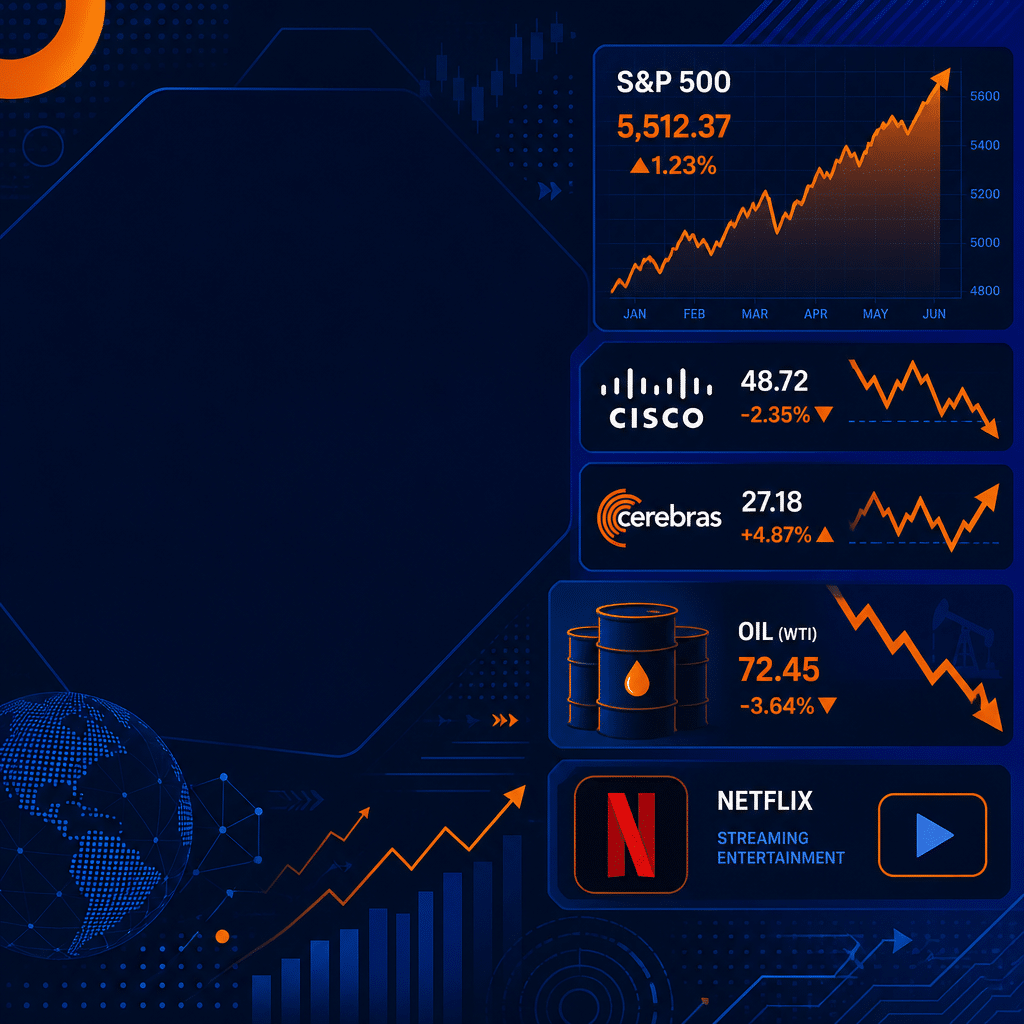
Cisco Systems, a stalwart in networking hardware and enterprise technology, reported quarterly results that surpassed revenue expectations and set a new company record. In the most recent quarter, Cisco achieved $17.3 billion in revenue, an 18% increase compared to the previous year. This surge was propelled largely by heightened demand for networking and data center equipment, particularly as hyperscale data centers invest heavily to build infrastructure powering artificial intelligence workloads.
Despite the historic revenue performance and a bullish long-term outlook—with fiscal 2027 revenue guidance of $72.2 billion to $73.4 billion, exceeding analyst forecasts—shares of Cisco dropped approximately 6-7% following the announcement. The negative reaction was attributed not to the top-line growth but to concerns over profitability. Cisco’s gross margin fell to 66.3%, down from 68.4% a year ago, and management’s forward-looking statements indicated continued pressure on margins.
This margin erosion is being driven in part by Cisco’s shift toward lower-margin AI-related hardware. AI infrastructure, while representing a major revenue opportunity, typically delivers slimmer margins due to fierce competition and high manufacturing costs. Investors, increasingly focused on the sustainability and quality of growth rather than raw numbers, see this shift as a potential challenge to Cisco’s longstanding status as a highly profitable hardware provider.
Cerebras Experiences Sharp Stock Decline Despite Strong Revenue Growth
Cerebras Systems, another player riding the AI wave, delivered impressive revenue growth in its second-quarter report. The company posted $180.1 million in Generally Accepted Accounting Principles (GAAP) revenue, representing a year-over-year surge of approximately 70%. Its core revenue, which excludes certain one-time items, totaled $209.9 million. Bolstered by these results, Cerebras raised its full-year core revenue guidance to between $880 million and $890 million, reflecting management’s continued confidence in its AI-focused business model.
However, in a strikingly similar fashion to Cisco, Cerebras shares plummeted 15-17% after the earnings release. The disappointment centered around the company’s profitability profile, as its core gross margin landed at just 41%. In addition, Cerebras reported that its roughly $25 billion order backlog remained flat during the quarter, indicating that while the company is fulfilling customer demand, it is not yet aggressively expanding its order pipeline.
Both Cisco and Cerebras illustrated a key market theme: impressive revenue growth alone no longer satisfies investors, especially in the hotly contested artificial intelligence sector. As the AI boom begins to mature, the focus is shifting toward margin resilience and profitability, which are increasingly seen as critical markers of sustainable success.
S&P 500 Hits Record High as Inflation Data Reveals Encouraging Trends
While individual high-profile companies weathered challenging reactions to their earnings, the broader stock market experienced a wave of optimism. The S&P 500, an index representing the 500 largest public companies in the United States, set a new intraday record. Investor sentiment was boosted by new data showing cooler-than-expected inflation at the producer level.
July’s Producer Price Index (PPI), which measures changes in selling prices received by domestic producers, came in flat month over month. This was better than market forecasts, which anticipated a 0.2% increase. On an annualized basis, PPI inflation decelerated to 4.7%, compared to 5.5% posted in June.
The improved inflation outlook eased concerns that the Federal Reserve would be forced to extend its cycle of interest rate hikes, making the environment more favorable for equities. Technology giants, including Nvidia, Microsoft, and Apple, led the charge higher, as investors once again sought safety and growth in large-cap tech stocks amid the encouraging macroeconomic developments.
Oil Prices Drop Amid Surging U.S. Inventories
The energy market also showed significant movement as oil prices retreated on the back of a massive buildup in U.S. crude inventories. Brent crude, the global benchmark, dropped by roughly 2.2% to settle near $87 per barrel, while West Texas Intermediate, the main U.S. marker, fell to about $81 per barrel.
The U.S. government reported a surprise crude inventory build of 17.4 million barrels—the largest weekly gain since January 2023. This unexpected surplus suggested slower demand growth and/or higher domestic production, both of which put downward pressure on prices. In tandem, OPEC revised its forecast for global oil demand growth in 2026, projecting a more modest consumption increase than previously estimated.


The drop in oil prices has broad market implications. Lower energy costs could serve to further dampen inflation, which remains a key concern for central banks and policymakers. A sustained decline in oil prices, if it materializes, may provide additional relief to consumers and support economic growth while also influencing the monetary policy outlook.
Bill Ackman’s Strategic Return to Netflix Marks Major Portfolio Overhaul
On the asset management front, one of the most closely-watched investors, Bill Ackman, founder and CEO of Pershing Square Capital Management, unveiled a significant shift in his firm’s portfolio. In a move that caught many on Wall Street by surprise, Pershing Square disclosed six new high-profile positions. These included Netflix, Visa, Mastercard, Alcon, Intercontinental Exchange, and S&P Global, indicating a broad-based bet on leading franchises across media, payments, vision care, financial infrastructure, and market data services.
Ackman’s return to Netflix is particularly notable. He first invested in the streaming giant in early 2022, only to sell a few months later after the company delivered a discouraging subscriber growth report, leading to a loss exceeding $400 million for Pershing Square. This latest move signals a dramatic reversal in his view of the digital entertainment landscape and Netflix’s business prospects.
Much has changed since Ackman’s earlier bet. Netflix has diversified its revenue streams by launching an advertising-supported tier, providing a new avenue for subscriber growth and monetization. Additionally, the company has ventured aggressively into live sports broadcasting, securing rights to high-profile events to expand its reach and boost viewer engagement. These strategic pivots have redefined Netflix’s competitive positioning and long-term earnings potential.
Ackman’s renewed conviction reflects a broader willingness to adapt investment strategies as business fundamentals shift. By betting on companies with resilient business models and multiple revenue channels, Pershing Square seeks to position itself for outperformance in a rapidly changing economic and competitive environment.
Investor Focus Shifting from Growth to Profitability
The themes emerging in this week’s headlines point to an inflection point for both the market and large-cap companies at the forefront of the AI and technology revolutions. In previous years, rapid top-line growth and aggressive capital deployment garnered the lion’s share of investor enthusiasm, often pushing profit considerations to the background. With tighter financing conditions and heightened market scrutiny, investors are now prioritizing earnings quality, margin stability, and the ability to generate cash flows over the long term.
This is exemplified by the reactions to Cisco and Cerebras’ earnings. Despite headline-grabbing revenue beats, both companies faced severe stock price declines when profitability disappointed relative to Wall Street’s heightened expectations. As artificial intelligence becomes a mainstream theme and competitive pressures mount, companies are being forced to strike a delicate balance between capturing market share and safeguarding their bottom lines.
Macroeconomic Backdrop: Cooler Inflation, Volatile Commodities
These corporate developments are unfolding against a backdrop of evolving macroeconomic signals. The cooling producer price index suggests inflation may be retreating, offering hope that central banks can avoid further tightening. Yet, volatility persists in energy and other commodity markets, challenging supply-demand balances and influencing consumer prices globally.
For technology and growth-sector equities, reduced inflation and the prospect of stable or lower interest rates serve as powerful tailwinds, reinvigorating risk appetite. However, volatile commodity markets and persistent geopolitical uncertainties underscore the need for diversification and risk management among investors and portfolio managers.
Conclusion: Navigating a Market in Transition
As the financial landscape evolves rapidly, investors must stay vigilant, adapting their strategies to account for changing corporate fundamentals and macroeconomic trends. High-profile companies, including Cisco and Cerebras, are confronting a new era where margin discipline and profitability take precedence, even amid blockbuster AI-fueled top-line gains. At the same time, major market players like Bill Ackman are retooling portfolios to capitalize on businesses positioned to thrive as technology, media, and finance continue to converge.
Looking ahead, successful investors will be those who balance the pursuit of innovation and growth with a clear-eyed focus on the underlying economics that drive sustainable value creation. By monitoring shifts in revenue quality, cost structures, and end-market dynamics, market participants can better navigate uncertainty and harness emerging opportunities in a landscape defined as much by rapid technological progress as by renewed attention to the fundamentals of business success.