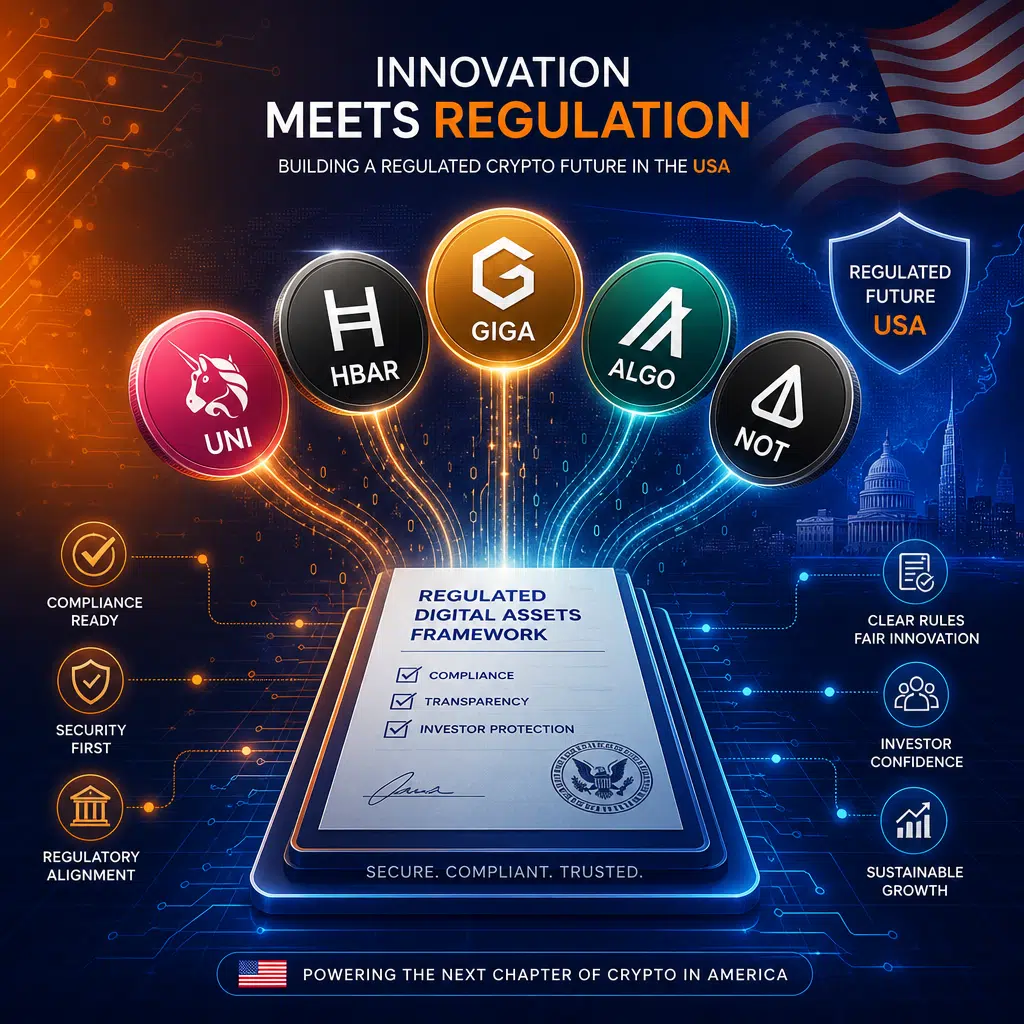
US Treasury Advances Stablecoin Rules: What It Means for UNI, HBAR, GIGA, ALGO, and NOT
The landscape of digital assets in the United States is undergoing a significant transformation with the Treasury Department’s proposal to formalize regulations around stablecoins. As these changes unfold, key players in the cryptocurrency space—Uniswap (UNI), Hedera (HBAR), Gigachad (GIGA), Algorand (ALGO), and Notcoin (NOT)—face varying degrees of exposure and opportunity. This in-depth analysis explores the critical implications of the new stablecoin rulebook, what it means for different altcoins, and why the move could become a cornerstone of cryptocurrency regulation in the years to come.
The GENIUS Act: A Landmark in Stablecoin Regulation
On August 17, the US Treasury Department published a formal proposal for implementing Section 3 of the GENIUS Act, kicking off a public comment period scheduled to run through October 19, 2026. The GENIUS Act—short for “General Enforcement for New US Stablecoins”—is the latest congressional push aimed at creating a comprehensive framework for payment stablecoins.
The newly proposed rules require all stablecoin issuers operating in the United States to hold dollar-for-dollar reserves for their tokens. This means for every stablecoin in circulation, the issuer must back it with a US dollar or an equivalent reserve asset. Beginning January 18, 2027, the regulation will make it mandatory for stablecoin issuers to obtain either a federal or state license in order to legally do business in the US. By July 2028, all digital asset platforms will be permitted to offer only those stablecoins that come from licensed issuers.
Notably, the proposal keeps stablecoins outside the jurisdiction of the US Securities and Exchange Commission (SEC), classifying them not as securities but as payment instruments. This shifts regulatory oversight to a framework focused on payments and consumer protection, rather than securities trading and investment contracts.
Treasury Secretary Scott Bessent highlighted that the department aims to quickly finalize the framework. Alongside this, Congress is still weighing the CLARITY Act, legislation that could further alter the regulatory landscape for stablecoins and digital assets before the final rules are enacted.
Market Impact: Reduced Uncertainty, Renewed Altcoin Interest
Historically, regulatory clarity has served as a catalyst for renewed market interest and activity, particularly in altcoins connected to payments infrastructure, decentralized applications, and cross-chain solutions. By addressing a major source of uncertainty, these new stablecoin rules could encourage traders, investors, and projects to re-enter a market previously hesitant due to legal ambiguities.
While the new framework does not guarantee a bull run, it does eliminate a critical barrier to institutional adoption and mainstream usage of stablecoins and related cryptocurrencies. This regulatory clarity is poised to reshape the strategic plans of both established and emerging digital asset networks.
Uniswap (UNI): Decentralized Trading at a Regulatory Crossroads
Uniswap is among the largest decentralized exchanges (DEXs) in the world. It allows users to trade a myriad of tokens directly from their own wallets in a peer-to-peer fashion, without relying on centralized intermediaries. Uniswap uses an automated market maker (AMM) system, forgoing the traditional order books used by centralized exchanges.
Since its launch in 2018, Uniswap has consistently accounted for a significant portion of on-chain trading volume. Regulatory definition concerning the legal status and exchangeability of stablecoins will have a direct and meaningful impact on Uniswap’s core business.
The GENIUS Act’s requirement for platforms to only offer stablecoins from licensed issuers by mid-2028 could influence which tokens Uniswap and its users will be able to access. In practical terms, it means that developers behind decentralized applications, including those building on Uniswap, will need to re-evaluate their compliance strategies. Since Uniswap relies on a proliferation of token pairs—many involving stablecoins—the ability to seamlessly trade US dollar-backed tokens under clear legal guidance could foster expanded adoption and unlock new liquidity pools.
For the UNI token, the governance asset of the Uniswap protocol, these changes may boost utility and growth as trading volume increases and regulatory legitimacy attracts a wider user base, including institutions and fintech partners.
Hedera (HBAR): A Ledger Built for Enterprises
Hedera offers an alternative to conventional blockchains with its unique hashgraph consensus system. This architecture enables faster finality on transactions and significantly reduces energy consumption compared to traditional proof-of-work networks. Hedera’s focus is squarely on enterprise solutions, with extensive collaborations spanning banking, supply chain management, and digital identity initiatives.
Unlike most crypto networks governed by one team or a small group of developers, Hedera is managed by a council comprising major global corporations. This structurally diverse governance model is designed to offer long-term stability and appeal for large enterprises needing robust, predictable infrastructure.


Within the context of the new federal stablecoin rules, Hedera (and its native token HBAR) could stand to benefit from increased institutional interest. As businesses seek compliance-ready platforms for digital assets and tokenized representations of real-world value, Hedera’s well-established framework and enterprise partnerships place it in a favorable position.
Gigachad (GIGA): The Highs and Lows of Meme-Driven Trading
In contrast to enterprise-minded networks, Gigachad (GIGA) exemplifies the spirit of community-driven meme coins. Its branding is tied to a popular internet meme (“Gigachad”), relying on viral energy more than on a concrete product or industrial use case. Like many meme tokens, GIGA’s price action is primarily dictated by community engagement, social media virality, and speculative trading—characteristics that can result in dramatic, short-term swings of value.
Regulatory changes can have amplified effects on tokens like GIGA. When market sentiment is positive and traders anticipate future compliance with new rules, meme coins often enjoy surges of attention and price appreciation. Conversely, signals of restrictive oversight or uncertain legal treatment can lead to equally steep declines. While GIGA may be less directly affected by stablecoin-specific rules, a more stable and regulated digital asset ecosystem could provide platforms and legitimacy that indirectly benefit meme tokens by drawing in mainstream interest.
Algorand (ALGO): Innovations in Payments and Settlement
Algorand is a layer-one blockchain engineered for speed, low transaction fees, and energy efficiency. Its pioneering pure proof-of-stake protocol bypasses the energy-intensive methods used by earlier blockchain models, making it attractive for payment solutions and fintech innovation.
Over the past several years, Algorand has been closely associated with pilot projects for real-world asset tokenization, cross-border payments, and even central bank digital currency (CBDC) initiatives in multiple countries. Its payment-centric design and partnerships with fintech firms place it at the intersection of regulatory shifts and practical adoption.
For Algorand, compliance with the GENIUS Act’s stablecoin requirements is especially critical. Many of its partners and users are directly involved in payment and settlement use cases, so assurance of legal clarity around stablecoins—often the “on-off ramp” for digital asset transactions—could catalyze growth and innovation, further differentiating Algorand as a top-tier infrastructure provider.
Notcoin (NOT): Community-driven Origins on Telegram
Notcoin emerged in late 2023 on the Telegram messaging app, initially as a tap-to-earn game. Users would simply tap a digital coin within the app to accumulate points, which could later be redeemed for NOT tokens at launch. The game’s simplicity and Telegram’s built-in social network allowed it to go viral quickly, attracting millions of users, many of whom were new to cryptocurrency.
Following its initial rollout, Notcoin began evolving an ecosystem around the TON blockchain, which underpins Telegram’s broader cryptocurrency features. To date, NOT remains primarily focused on retail adoption and community-driven trading behaviors, contrasting with institutionally-focused tokens.
As regulators create a more stable and predictable environment, community-led projects like Notcoin can benefit from the removal of legal ambiguities that often deter new users. However, the token’s continued association with casual, speculative trading activity means its future will likely remain closely tied to crypto market sentiment and the ongoing development of its Telegram-based ecosystem.
Looking Ahead: The Age of Regulated Stablecoins
With the Treasury’s proposed formalization of the GENIUS Act and related legislation like the CLARITY Act under consideration, the US is on a path towards a robust digital asset regulatory framework. The timetable is clear: stablecoin issuers must be licensed by early 2027, with platforms ordered to ensure full compliance by July 2028.
For projects like Uniswap, Hedera, Gigachad, Algorand, and Notcoin, the shift signals a decisive new era. Each must adapt to the changing regulatory climate, but each also stands to benefit from newly clarified rules that could open the doors for broader adoption, new partnerships, and mainstream integration of cryptocurrencies into the global financial system.
The next few years are likely to determine which platforms prosper as leaders in the transparent, compliant, and scalable future of crypto. The path forward is more certain, ushering in maturity for an industry long marked by both innovation and regulatory uncertainty.