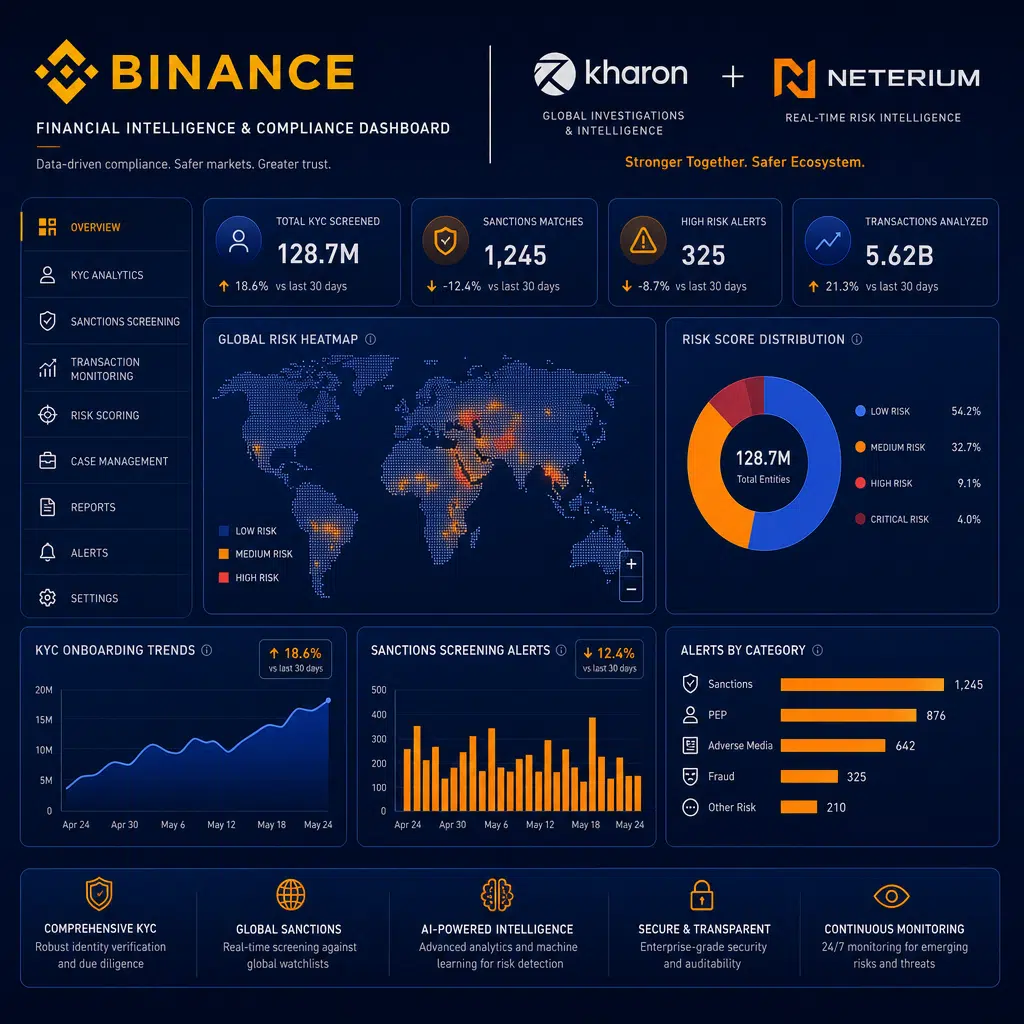
Enhancing Measures: Binance’s Partnership with Kharon and Neterium
Following an announcement earlier this week, Binance, the world’s largest crypto exchange by trade volume, has decided to amplify its know-your-customer (KYC) regulations and compliance with sanctions. For this purpose, Binance has joined forces with a renowned financial analytics firm, Kharon, and Neterium, a leading provider of API-native screening services.
Binance’s Plan for Compliance Enhancement
It has been reported that as part of their joint venture, Binance’s objective is to leverage this partnership to access first-rate data and analytics that enhance its existing system for sanctions screening. Consequently, this will strengthen its KYC procedures, providing a more robust system that will be able to meet the ever-evolving regulatory expectations more effectively. Interestingly, this development comes as the crypto space continues to attract more scrutiny from traditional financial regulatory bodies globally.
Contributions of Kharon and Neterium
Kharon’s commitment in this new partnership involves delivering their data into Binance’s transaction screening environment, a process in which Neterium will play a supportive and collaborative role. The objective is clear: To develop data solutions that significantly advance how cryptocurrency trading platforms can detect and prevent activities by unscrupulous actors. Ultimately, this integration will ensure that the industry remains competent in its ability to combat deceptive practices and activities.
Binance Comments on the Upcoming Partnership
Commenting on the new partnership, Chagri Poyraz, Global Head of Sanctions at Binance, emphasized that as they strive to maintain their status as the world’s largest crypto exchange, they are also resolute in their commitment to building an industry-leading compliance program.
He further stated that collaborating with Kharon and Neterium allows Binance to utilize Kharon’s best-in-class data concurrent with Neterium’s innovative technology to manage their risk appropriately. Additionally, the partnership conveys a strong message about Binance’s commitment to upholding the integrity of its platform, especially following the various allegations hurled against the cryptosystem as a whole.
Kharon Expresses its Expectation from the Partnership
Howard Mendelsohn, Chief Client Officer at Kharon, also expressed great optimism about this development. According to him, service providers in the virtual asset space require top-quality data and technology to support their compliance programs effectively.


By partnering with Binance to provide the necessary data and analytics tools, he believes that they are playing a crucial role in meeting the fast-expanding regulatory expectations and risk mitigation in an industry that has seen rapid growth and expansion.
Binance and Sanctions Against Russian Users
This partnership comes after the recent controversy where Changpeng Zhao (CZ), Binance CEO, initially resisted the idea of enforcing sanctions against Russian users due to the Ukraine crisis. He argued in March that blocking Russians from crypto exchanges was an unethical measure and that it was not specific to cryptocurrencies to evade economic sanctions.
However, the world’s largest crypto exchange subsequently declared further sanctions-related restrictions on its platform, presumably succumbing to government pressure. Following the roll-out of the European Union’s fifth package of restrictive measures against Russia, Binance found it necessary to curb certain services for Russian nationals and legal entities in Russia whose crypto assets exceed the value of €10,000.
Conclusion
In conclusion, Binance’s assertion that it must continue to lead the industry in implementing sanctions emphasizes their commitment. They have also expressed the sentiment that other major exchanges will likely have to follow the same rules soon. This recent development is a testament to the increasing blurring lines between traditional finance and crypto, and as this becomes more apparent, the need for robust regulatory compliance becomes more apparent.