Binance Collaborates with Kharon and Neterium to Strengthen KYC Protocols
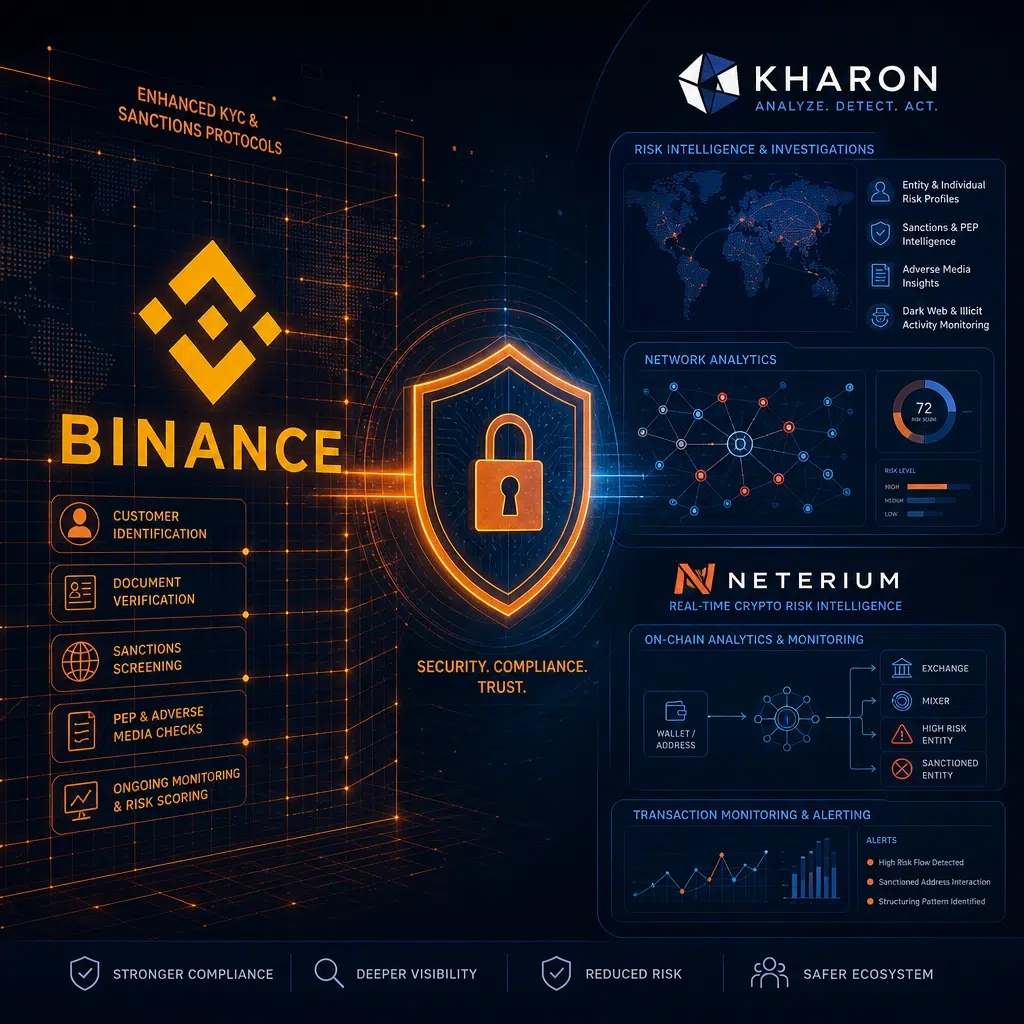
In a move geared towards robust security and improved customer protection, global cryptocurrency trading powerhouse Binance has unveiled a strategic partnership with Kharon, the financial analytics firm, along with API-dependent screening provider, Neterium. These alliances are aimed at strengthening Binance’s existing Know-Your-Customer (KYC) and sanctions protocols.
Sharpening Sanctions Screening and KYC Procedures through Partnership
In the crypto trading landscape, customer identity verification, commonly known as Know-Your-Customer or KYC, is an essential element to intensify security measures. Further reinforcing this concept, Binance seeks to utilise the data solutions and analytics offered by Kharon and Neterium through this partnership, hence enhancing its KYC regime.
Moreover, the collaboration aims to significantly augment Binance’s transaction screening landscape through integrating Kharon’s data, with assistance from Neterium. The partners anticipate that this business alliance will stimulate the development and execution of superior data solutions targeted at broadening the detection and prevention capabilities against illicit activities on the cryptocurrency trading platforms.
Commitment to Establishing Industry-leading Compliance Program
Chagri Poyraz, serving as the Global Head of Sanctions at Binance, illustrated the company’s fervour and dedication towards establishing unparalleled compliance measures. He expressed that collaborations with Kharon and Neterium expedite in integrating best-in-class data from Kharon with Neterium’s innovative technological solutions to curtail risk.
Insights from Kharon: Meeting Regulatory Expectations and Mitigating Risks
Kharon’s Chief Client Officer, Howard Mendelsohn, also shared insights on the partnership, accentuating the high-grade data and technology requirement for virtual asset service providers. Collaborating with Binance serves as a critical milestone in deploying data and analytical tools to satiate the evolving regulatory needs, thereby reducing potential risks.


Binance CEO’s Stance on the Sanctions Against Russian Users
Initially, Binance’s CEO Changpeng Zhao a.k.a CZ voiced his disapproval regarding the usage of sanctions against Russian users, following the Ukrainian crisis. He perceived barring the Russian population from crypto exchanges as an unethical move, suggesting that the circumvention of economic sanctions wasn’t specific to cryptocurrencies.
However, presumably due to escalated government pressure, Binance resorted to a different strategy, introducing further restrictions tied to sanctions on its platform.
Ensuing Adherence to the EU’s Restrictive Measures Against Russia
In the wake of the EU’s fifth round of restrictive measures executed against Russia, Binance announced requisite limitations on services provided to Russian nationals or individuals stationed in Russia, or legal entities established within Russia. Concretely, these limitations were binding for entities possessing cryptocurrency assets surpassing the value of 10,000 EUR.
Ensuring Compliance to Global Sanctions: An Expected Norm in the Crypto Industry
In retrospect, it seems apparent that Binance must persistently lead the crypto industry in adopting and implementing global sanctions. Consequently, a growing belief is emerging within the industry that similar rules should shortly be followed by all other major exchanges.