Samsung Electronics Unveils Record-Breaking Shareholder Return Plan Amid Booming AI Chip Demand
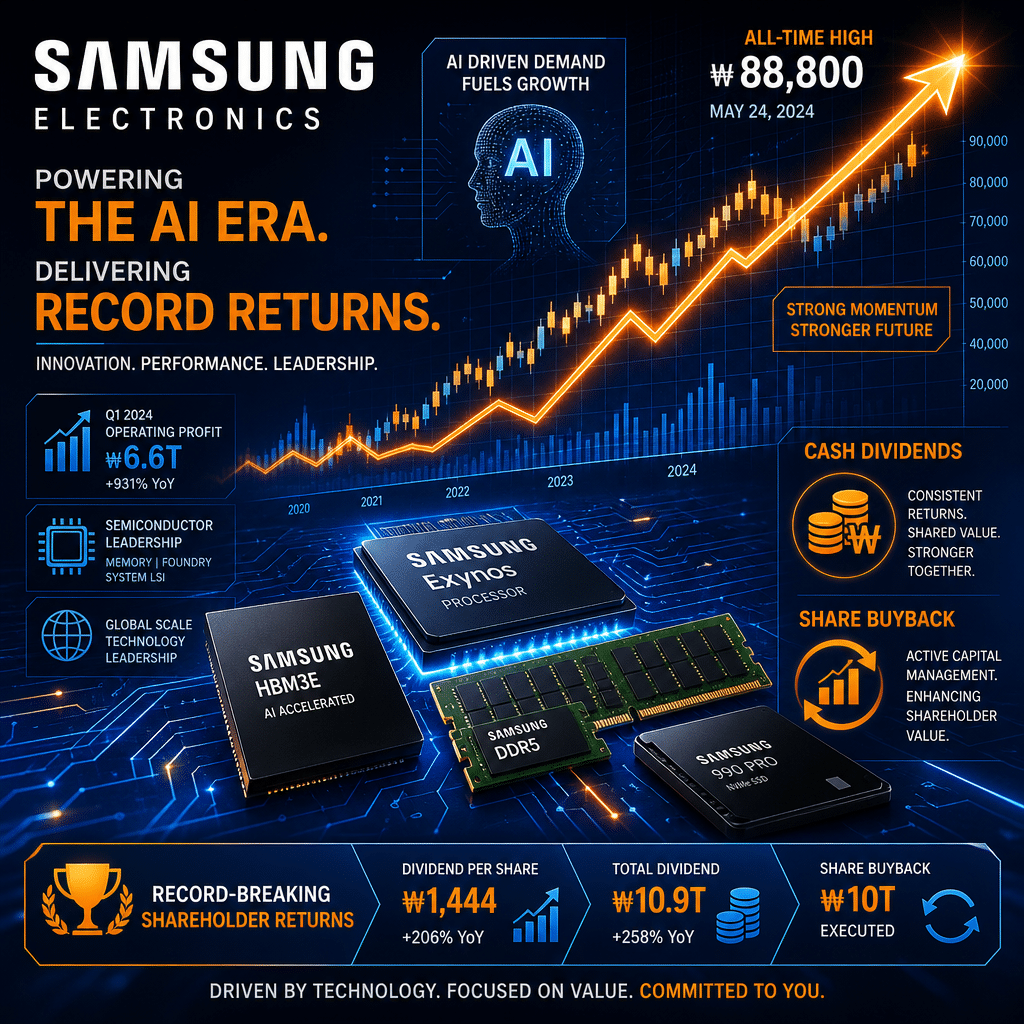
Samsung Electronics made headlines on Friday as its stock soared by 3.87%, closing at ₩281,500 following the announcement of its ambitious and record-breaking shareholder return plan. The South Korean tech giant’s bold strategy, which aims to distribute up to 110 trillion won (approximately $80 billion) back to shareholders by 2026, marks the largest value return package ever proposed by a Korean company. This announcement comes on the heels of intense competition in the semiconductor industry, notably after rival SK Hynix’s substantial 40 trillion won share buyback plan.
Samsung’s Shareholder Return Plan: Scope and Strategy
The core of Samsung’s strategic move is its commitment to returning between 90 trillion won and 110 trillion won over the current shareholder return cycle. This includes a notable third-quarter cash dividend of around 30 trillion won, further demonstrating the company’s confidence in its financial position and future outlook. Samsung’s program consists of a blend of regular quarterly dividends, supplemental cash dividends, share buybacks, and share cancellations. The board of directors is set to finalize the specific dividend details in a late October meeting, with the remaining structure and payout mechanisms slated for discussion and confirmation in January 2027.
In addition to direct shareholder distributions, Samsung has earmarked 15 trillion won for share purchases related to employee stock compensation. While these shares are categorized as incentives for employees rather than for public shareholders, they highlight Samsung’s dedication to retaining talent and aligning workforce incentives with organizational performance.
Industry Pressure Mounts Following SK Hynix’s Aggressive Buyback
Samsung’s announcement arrives amidst elevated pressure in Korea’s semiconductor industry, sparked by SK Hynix’s proclamation of a 40 trillion won share buyback, with plans to retire all repurchased shares post-buyback. This aggressive move has intensified expectations across the sector for companies, especially those with increasing cash reserves, to step up their shareholder rewards. It has also reignited the conversation about optimal capital allocation, dividend policies, and the balance between reinvestment and returns to shareholders.
Unlike SK Hynix, Samsung’s current payout policy allocates 50% of accumulated free cash flow from 2024 through 2026, compared to SK Hynix’s plan to earmark over half its free cash flow from 2025 to 2027 for buybacks. Samsung also maintains a consistent annual dividend of 9.8 trillion won, providing stability and predictability for income-focused investors.
Robust AI Memory Demand Propels Samsung’s Performance
One of the primary drivers behind Samsung’s aggressive shareholder returns is the unprecedented surge in demand for memory chips, particularly those used in artificial intelligence (AI) applications and data center infrastructure. Global investments in AI have triggered a sharp upswing in advanced memory product sales, ensuring strong profit growth for Samsung’s semiconductor division.
In the second quarter alone, Samsung’s chip profits skyrocketed more than 250-fold compared to the previous period, underlining the transformative impact that the AI-driven tech cycle is having on the company’s bottom line. With exponential increases in both cash flow and profit, Samsung now finds itself in a commanding position to reinvest in technological advancement while simultaneously rewarding shareholders.
Samsung and SK Hynix: Accumulating Massive Cash Positions
Industry analysts estimate that together, Samsung and SK Hynix could amass a combined net cash total of around $263 billion by the end of the year. This chest would eclipse even industry giants such as Nvidia and several leading American technology companies, emphasizing the extraordinary capital-generation capabilities of modern semiconductor companies amidst a booming AI market.
This war chest positions both companies to weather market volatility, fund research and development into next-generation technologies, and maintain sizable rewards for shareholders. It also draws a line under the ongoing competition between Samsung and SK Hynix, not just in terms of market share but in their capacity to deliver tangible value to their investors. Such capital strength emboldens companies to make aggressive expansion plays while sustaining industry-leading dividend and buyback programs that help support shares in times of uncertainty.
Staying Ahead in the AI Memory Race
While Samsung currently enjoys the upper hand in the volume and scale of its shareholder rewards, the competition with SK Hynix is intensifying, particularly in the realm of high-bandwidth memory (HBM) — a critical component in AI hardware solutions for hyperscaler data centers and AI model training platforms. As both companies vie to establish dominance in advanced memory technologies, their financial strategies become an increasingly important factor in attracting investment and strengthening stakeholder loyalty.


Samsung’s larger return program is expected to be a key differentiator supporting its share price over the near and medium term. However, the ultimate success of these plans may hinge on how transparently and efficiently the company executes its buybacks, dividend distributions, and capital cancellations. Investors and analysts will closely monitor the structure and timing of Samsung’s future payouts as the company’s board reconvenes during the October and January meetings.
Implications for the Broader Korean and Global Tech Sectors
Samsung’s record-breaking shareholder returns stand as a bellwether for the broader Korean equity market, reflecting not only the health of its largest corporate champions but also the growing maturity of shareholder value culture in Asia’s third-largest economy. The move sets a new standard for capital returns among industry peers, and market participants anticipate further action from other Korean conglomerates and global tech leaders seeking to keep pace with Samsung’s boldness.
Technology investors worldwide are watching closely as the stakes in the semiconductor arms race rise. The current memory chip cycle has already fueled outsize returns and created immense value for those holding shares in leading chipmakers. As AI advancements continue to spur infrastructure upgrades and demand for high-performance memory solutions, South Korea’s top technology companies appear poised to remain at the vanguard of innovation, cash generation, and investor rewards.
Balancing Reinvestment with Shareholder Value
Even as Samsung returns vast sums to investors, the company remains committed to prioritizing reinvestment in research, new production facilities, and next-generation chip technologies. This dual strategy allows Samsung to retain the technological edge necessary for long-term competitiveness in a fast-evolving industry while grounding investor confidence with recurring rewards.
The ongoing debate between reinvesting in innovation versus maximizing short-term shareholder returns continues to shape the strategies of global technology leaders. Samsung’s approach, characterized by aggressive cash return policies alongside robust R&D commitments, could serve as a blueprint for others as the semiconductor and broader tech landscapes evolve.
Looking Ahead: The Road to 2026 and Beyond
As Samsung Electronics charts an ambitious course toward 2026, investors are optimistic that the company’s record-breaking shareholder return program will help sustain confidence and drive continued share price appreciation. The combination of surging AI-related chip demand, outsized cash flows, and disciplined capital allocation positions Samsung at the forefront of both technological and financial performance in the global market.
With continued innovation in high-performance memory products and an expanding suite of investor-focused initiatives, Samsung seems well-placed to navigate the challenges ahead, outpace competitors, and deliver enduring value to shareholders. The true impact of this historic return plan will ultimately be measured not just in dividend checks and completed buybacks, but in how effectively Samsung marries its growth ambitions with the evolving expectations of its global investor base.
Conclusion
Samsung Electronics’ decision to roll out the largest shareholder return package in Korean history underscores both its financial power and its determination to set the benchmark for corporate capital policy in Asia. In an era defined by technological revolution and heated competition, the company’s blend of high-yield investor returns and relentless reinvestment in innovation forms a compelling narrative for stakeholders worldwide.
As the company’s board meets in the coming months to finalize dividend and buyback details, and as the chip industry continues to surge under the weight of AI-driven demand, all eyes will remain on Samsung — not just as a global technology innovator, but as a leader in delivering enduring value to its shareholders.