The BNB Chain network is on the verge of a pivotal transformation as the community gears up for the Pasteur hard fork, scheduled to be activated on the BNB Smart Chain (BSC) mainnet at 02:30 AM UTC on August 25, 2026. This highly anticipated upgrade is just two days away from launch and is poised to significantly improve the BSC ecosystem’s security, scalability, and efficiency. As developers finalize preparations, here’s an in-depth look at what users, developers, and node operators can expect from this critical upgrade to one of the industry’s most robust decentralized blockchains.
Introduction to the Pasteur Hard Fork
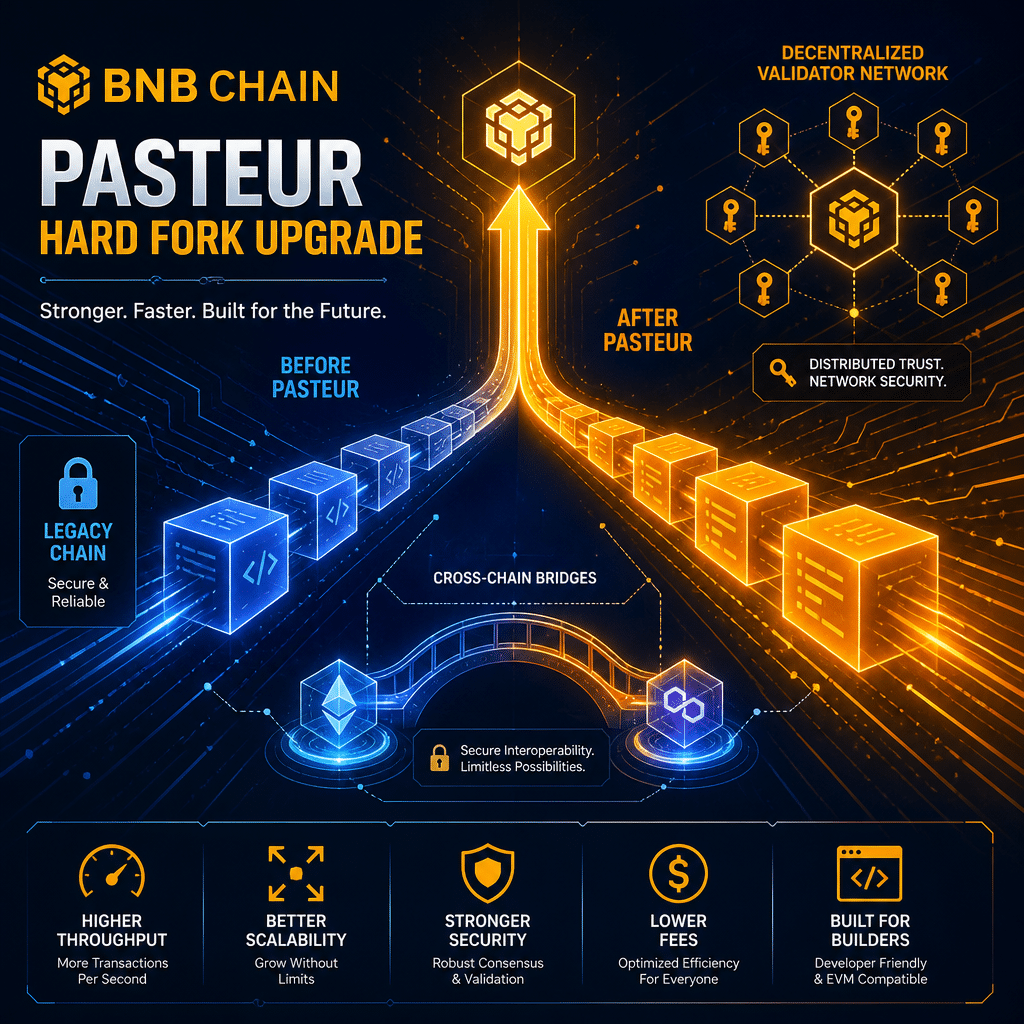
The Pasteur hard fork represents the latest chapter in the ongoing evolution of BNB Smart Chain. Named after the renowned scientist Louis Pasteur, this upgrade shifts the network’s focus from pure speed improvements to innovations that enhance the overall structure, security, and capacity of the chain. The fork introduces substantial protocol enhancements through a group of tightly integrated proposals designed to address emerging challenges in the areas of bridge verification, validator governance, and efficient block utilization.
Key Features and Innovations of the Pasteur Upgrade
At the heart of the Pasteur hard fork are three main BNB Evolution Proposals (BEPs) that collectively aim to advance the BNB Chain’s ability to support higher throughput, stronger network consensus, and better governance for validators. The key enhancements are as follows:
-
BEP-682: Enhanced Bridge Verification Protocols
This proposal directly addresses the growing complexity and importance of cross-chain functionality. By implementing more robust bridge verification methods, BEP-682 strengthens the network’s resistance to exploits and hacks often associated with blockchain interoperability. With efficient and secure bridge checks, the trustless movement of assets between BNB Chain and other blockchains becomes more reliable, supporting the expansion of decentralized finance (DeFi) and web3 applications. -
BEP-695: Secure Retirement of Validator Keys
Governance and security measures for validators are critical in maintaining a healthy blockchain. BEP-695 introduces a formal process for securely retiring validator keys, which upholds consensus integrity and reduces the risk of compromised keys being misused. This upgrade ensures that validator roles can be transferred or safely exited, closing loopholes that malicious actors might exploit. -
BEP-675: Fuller Transaction Blocks at Consistent Speeds
A major innovation of the upgrade, BEP-675 allows block builders to submit “pre-executed” blocks. Validators then cross-check these blocks against consensus rules before signing and broadcasting. This novel mechanism enables the network to fill blocks more comprehensively, thus maximizing transaction throughput. Testnet data reveals that BEP-675 nearly doubled transaction processing speeds from 1,237 to 2,324 transactions per second (TPS) without weakening network security or stability.
Pasting It All Together: Comparing Recent Upgrades
The Pasteur hard fork builds on a series of recent, high-impact upgrades on BNB Smart Chain. For context, here is a summary of the chain’s journey over the past year:
| Upgrade | Main Feature | Impact |
|---|---|---|
| Fermi | Faster block times | 0.45 sec/block |
| Osaka/Mendel | Stabilized speed | Consistent performance |
| Pasteur (BEP-673) | Bridge, key rotation, fuller blocks | 1,237 to 2,324 TPS (testnet) |
While Fermi and Osaka/Mendel pushed the limits on block production speed and network stabilization, the Pasteur upgrade shifts emphasis to making this speed count—by filling more of each block and making validator governance and bridge connections more secure.
Security and Governance Enhancements
Security lies at the core of the Pasteur hard fork. The introduction of BEP-682 and BEP-695 provides another layer of protection over cross-chain asset transfers and validator management. These changes were made in direct response to lessons learned from previous threats and incidents across the blockchain industry, as hackers increasingly target cross-chain bridges and validator infrastructure.
By fortifying these key elements, the BNB Chain’s developers are taking a proactive stance to prevent attacks and promote healthy, trustless operations across DeFi protocols and beyond.
Transaction Throughput and Network Capacity: Benchmarks and Impact
The ability to handle ever-increasing transaction volumes is a critical metric for any blockchain. BNB Chain’s improved transaction throughput—from 1,237 to 2,324 TPS in testnet benchmarks thanks to BEP-675—demonstrates a leap in efficiency. Combined with prior optimizations that reduced block intervals to just 0.45 seconds, this creates an ecosystem capable of supporting massive growth in DeFi, gaming, NFT minting, and web3 infrastructure.
With these changes, the BNB Chain has positioned itself as a leader in the race to provide scalable, decentralized infrastructure at a global scale, offering an appealing platform for high-volume applications and enterprises.
Activation Schedule and Instructions for Node Operators
The journey toward seamless activation of the Pasteur hard fork began with its rollout on the BSC testnet on July 21, 2026. The official mainnet activation is precisely scheduled for 02:30 AM UTC on August 25, 2026. In preparation, all node operators and validators are strongly advised to upgrade their software to version 1.7.7 before the deadline to avoid service disruptions.
Failure to upgrade in time could result in nodes being unable to validate transactions or maintain consensus with the network, jeopardizing both rewards and the security of user funds. Developers have provided comprehensive guides and documentation to ensure a smooth transition for all participants.


BNB Chain’s Broader Mission: Operational Excellence and Ecosystem Growth
As an open-source blockchain renowned for fast, low-cost transactions, BNB Chain supports a vibrant ecosystem spanning decentralized finance, NFTs, and next-generation web3 protocols. The Pasteur fork is only the latest step in a carefully charted road map focused on continuous improvement. Alongside core infrastructure upgrades, the BNB Chain community is investing in tools, grants, and collaborative partnerships to attract developers and innovators worldwide.
This ongoing commitment to research, development, and transparency cements BNB Chain’s status as a preferred platform for both grassroots projects and large-scale enterprise deployments.
Looking Ahead: The Future Path to Scaling
The first half of 2026 already saw significant measures implemented to boost the BNB Chain’s scalability, such as slashing block intervals to an ultra-fast 450 milliseconds and enabling in-memory finality within 650 ms. These changes, coupled with ongoing optimizations, have propelled the chain’s maximum benchmark throughput to nearly 5,200 TPS under favorable conditions.
With the Pasteur upgrade, BNB Chain developers are now setting their sights even higher. The “capacity workstream” anchored by BEP-675 is central to driving efficient block usage and handling spikes in transaction demand with ease. The end goal, as outlined in the network’s second-half 2026 roadmap, is another doubling of mainnet throughput—on a trajectory that ultimately targets a tenfold boost in transaction capacity.
This ambitious strategy ensures the BNB Chain will remain competitive amid growing competition and the rising requirements of decentralized apps handling millions of users. By focusing on filling blocks thoroughly and optimizing validator participation, BNB Chain is laying the foundation for even greater mainstream adoption and high-throughput innovation.
Glossary: Understanding BEPs and Their Role on BNB Chain
For those new to BNB Chain’s technical landscape, BEP stands for BNB Evolution Proposal. These are formal documents that propose and describe improvements or upgrades to the BNB Chain protocol. Each BEP undergoes rigorous review by core developers, community stakeholders, and ecosystem partners. Only BEPs with demonstrable benefits and technical soundness are implemented, as seen with BEP-673 (Pasteur), BEP-682, BEP-695, and BEP-675.
Conclusion: The Significance of Pasteur for BNB Chain and the Broader Crypto Ecosystem
The Pasteur hard fork marks a critical milestone in BNB Chain’s evolution, highlighting a shift from raw transaction speed toward refined, sustainable scalability. By introducing more efficient blocks, stronger bridge verification protocols, and improved validator governance, the Pasteur upgrade ensures that BNB Chain remains a secure, reliable, and high-capacity backbone for the decentralized web.
As the blockchain space grows increasingly complex, these advancements position the BNB Chain network to meet the needs of tomorrow’s decentralized applications—and the millions of users, traders, and developers building the future of finance, content, and community.
With its proven ability to adapt and innovate, BNB Chain stands at the forefront of blockchain progress, ready to scale new heights in performance and adoption throughout 2026 and beyond.