Matt Hougan’s Vision: Could Bitcoin Reach $1.3 Million?
In the ever-evolving world of cryptocurrencies, bold predictions regularly make headlines. Yet, some forecasts capture the imagination of both bullish investors and skeptical analysts alike. One such forecast comes from Matt Hougan, the Chief Investment Officer at Bitwise, who recently projected a remarkable future for Bitcoin. According to Hougan, Bitcoin could reach about $1.3 million per coin if it successfully captures a third of the global value storage market over the next decade. This analysis not only sets a new paradigm for Bitcoin’s potential, but it also invites a deeper exploration into how the global markets for value storage are transforming.
The Global Value Storage Market: An $80 Trillion Opportunity
The current global market for value storage is estimated at around $80 trillion. This sum encapsulates several assets, including gold, central bank reserves, government securities, and various forms of savings instruments. Traditionally, gold has enjoyed the lion’s share as a trusted store of value, with central banks and institutional investors treating it as a hedge against inflation and economic instability. Recently, however, changing dynamics, digital transformation, and a growing lack of trust in centralized systems have begun shifting attention toward decentralized alternatives like Bitcoin.
If Bitcoin were to secure even a third of this massive value storage market—that is, around $26 trillion—each coin could theoretically be valued at approximately $1.3 million. For Bitcoin to make this leap, it would need to transition from being viewed primarily as a speculative asset to being recognized as a credible competitor to gold and state-backed securities. Hougan’s analysis presents not just a financial projection, but a potential sea change in how economic value is stored, transferred, and preserved across generations.
Institutional Adoption: Driving the Next Phase of Growth
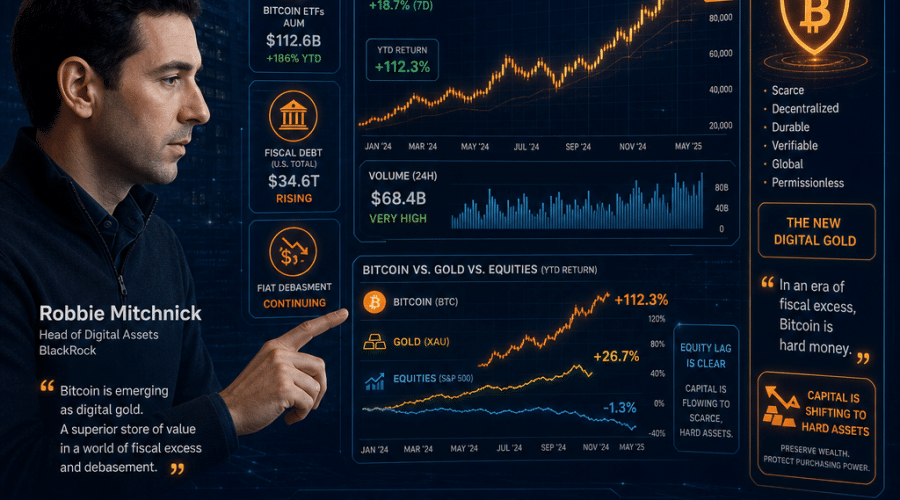
One of the most pertinent developments in the realm of digital assets is the rapid rise of institutional interest in Bitcoin. Since the beginning of 2024, the introduction and growing acceptance of spot Bitcoin Exchange Traded Funds (ETFs) in the United States have underlined the growing trust in Bitcoin as a long-term asset. Net inflows into these ETFs have already surpassed $50 billion within months—a testament to Bitcoin’s growing legitimacy among large-scale investors.
This influx is not limited to a few key players such as MicroStrategy, known for its robust Bitcoin holdings. According to analytics from Arkham Intelligence, a broader base of corporate treasuries, asset managers, and even some pension funds have started to allocate portions of their wealth into Bitcoin. This diversification is often driven by strategies to hedge against traditional market risks and to capture alpha from a diversifying asset class that is increasingly uncorrelated with mainstream financial markets.
Technological Innovations and Market Dynamics
Beyond institutional adoption, advances in technology and market infrastructure are also rapidly reshaping the Bitcoin landscape. Platforms offering holistic portfolio management, real-time analytics, and privacy-centric solutions are making it easier than ever for both individuals and institutions to interact with cryptocurrencies. Comprehensive tools lower the bar for participation and provide deeper insights into price dynamics, liquidity, and risk management.
Moreover, Bitcoin’s interaction with Layer 2 protocols like the Lightning Network and Stacks is further expanding its utility by offering faster, cheaper transactions and broader smart contract capabilities. This greater versatility is essential for achieving the global scale and institutional reliability necessary for displacing entrenched value storage systems like gold.
Potential Obstacles: Headwinds on the Road to a Million-Dollar Bitcoin
Despite the bullish outlook, there are several significant obstacles that could impede Bitcoin’s path to market dominance and a seven-figure valuation:


- Rising U.S. Debt: The United States’ national debt has surmounted $35 trillion, leading to increasing interest in tokenized reserves as a digital alternative to government-issued debt instruments. The experiments with digital dollar reserves could compete with Bitcoin’s role as a decentralized store of value.
- Regulatory Uncertainty: The Securities and Exchange Commission’s (SEC) mixed signals regarding what constitutes a security, alongside uncertainties around future regulation, pose risks to widespread adoption. Concurrently, emerging competitors such as tokenized gold could divert institutional interests away from Bitcoin.
- Volatility Concerns: Although Bitcoin’s volatility thrills traders, it remains a potential deterrent for mainstream investors seeking long-term value storage. High price swings may prevent Bitcoin from being embraced as a primary store of value by risk-averse institutions and governments.
These challenges are not merely technical; they are deeply structural. For Bitcoin to transform into a mainstream reserve asset, it must address concerns involving its scalability, regulatory clarity, security, and user accessibility. Entities building around Bitcoin—such as exchanges, custodians, and protocol developers—will need to adapt to a rapidly changing set of market demands, possibly revising liquidity protocols, custodial practices, and even fee structures.
Regulatory Scrutiny: The Coming Wave of Oversight
If Bitcoin does embark on this dramatic trajectory of growth, regulatory scrutiny will almost certainly follow. As institutional adoption widens, calls for the creation of coherent regulatory frameworks will intensify. Financial watchdogs and policymakers will be under increasing pressure to define Bitcoin’s status and integrate it within existing legal and fiscal systems.
For Bitcoin to earn its place in the coffers of global pension funds, sovereign wealth funds, and cross-border banks, it must achieve not only technological maturity but also regulatory legitimacy. Advocates argue that well-defined regulation could help mitigate risks related to fraud, market manipulation, and illicit activity, further cementing Bitcoin’s reputation as a trustworthy asset.
Regulatory clarity could also open the floodgates for trillions of dollars in institutional investment currently sitting on the sidelines due to compliance concerns and fiduciary limitations. This influx would further reinforce the positive feedback loop driving Bitcoin’s valuation higher, potentially making the $1.3 million target a reality.
The Road Ahead: Transformation or Speculation?
Matt Hougan’s thesis projects a radical shift in the way society conceptualizes and interacts with financial value. Bitcoin’s journey to a $1.3 million valuation is dependent not just on speculative fervor, but on real, structural changes in both technology and global finance. To achieve this future, Bitcoin must continue to evolve in line with expectations for security, transparency, speed, and accessibility.
The next decade may well determine whether Bitcoin solidifies its role as digital gold or remains an intriguing but volatile component of a diversified portfolio. The rise of competing technologies, regulatory evolution, and macroeconomic uncertainty will write the next chapters in this dynamic saga. As the world watches and investors appraise their positions, one thing becomes increasingly clear: Bitcoin is no longer a fringe experiment. It stands at the crossroads of institutional finance, regulatory oversight, and fundamental economic change—poised, perhaps, for a historic ascent.
Conclusion
The forecast that Bitcoin could reach $1.3 million per coin encapsulates the broader momentum behind digital assets. Whether or not this valuation is ultimately reached, the demographic and institutional tides are shifting. The once speculative experiment of decentralized money is maturing into a key player on the world stage. The coming years will see intense debate, rapid innovation, and perhaps the redefinition of how humanity stores and preserves wealth.