Robinhood Chain Surpasses Ethereum In Revenue Generation
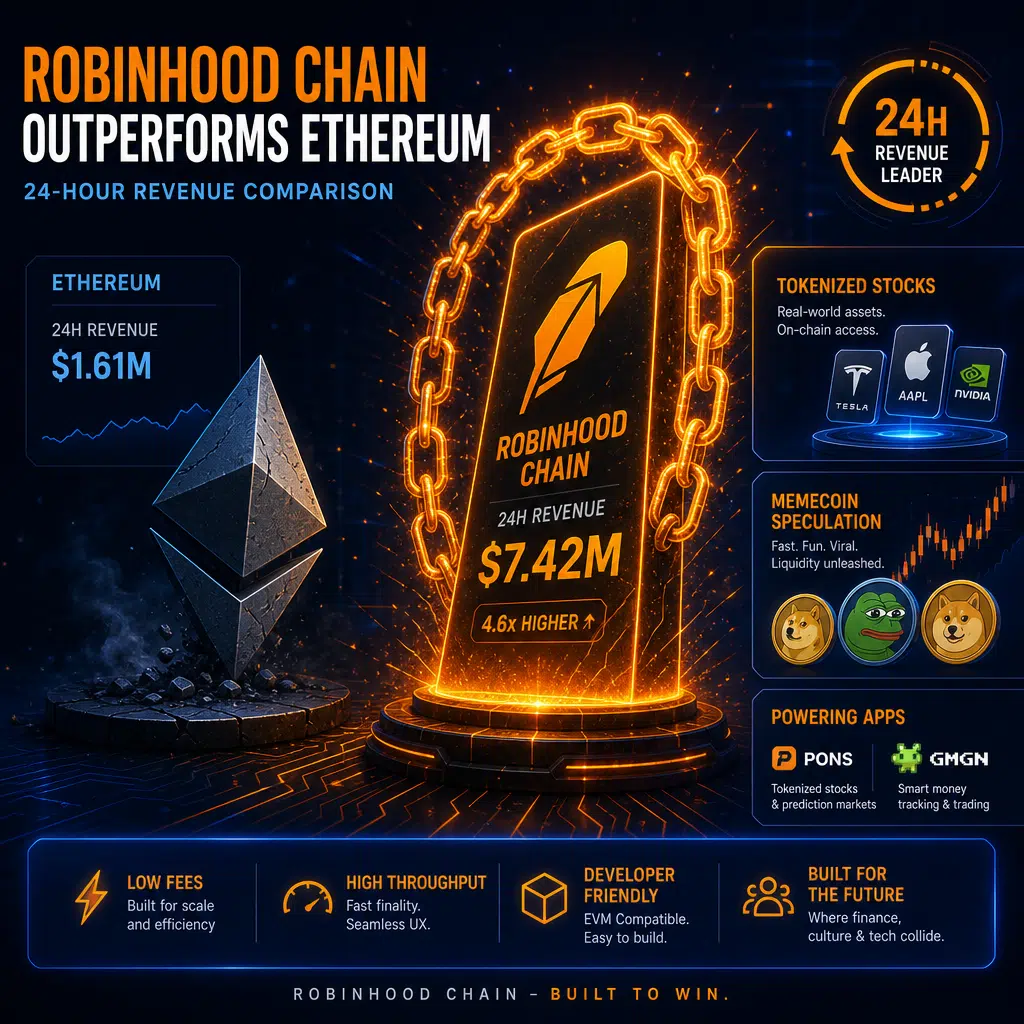
In the world of cryptocurrency and blockchain technology, many have come as competitors, but none have seemed to demonstrate as steady a rise as Robinhood Chain has over the past two months. The new token trading platform has managed to outperform Ethereum in terms of app revenue after only two months from its launch. The Robinhood Chain has been snapping at Ethereum’s heels, bolstering its place in the market with steady revenue growth, most of which comes from memecoin speculation.
The Revenue Metrics
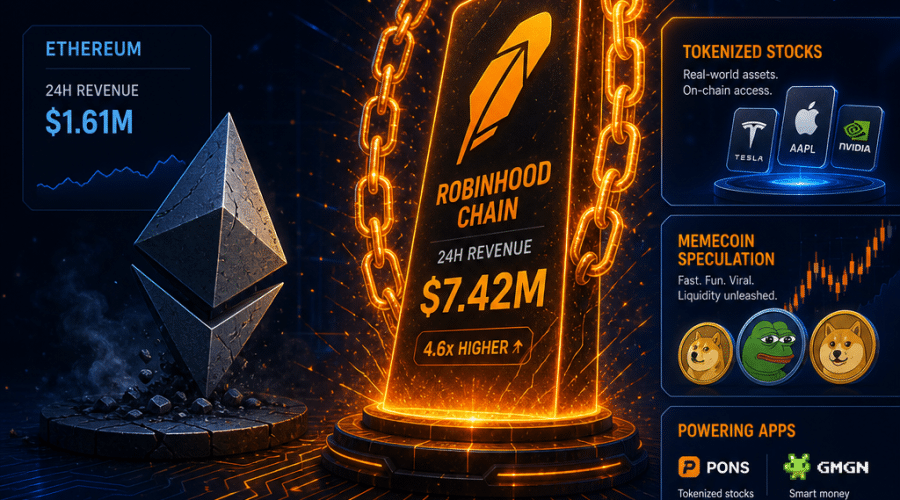
Let’s delve into the numbers: the Robinhood Chain’s app revenue clocked in at $2.66 million during a 24-hour period as of 18:30 UTC on Monday. This significant number sharply contrasted with Ethereum’s $1.28 million. However, leading the pack was Solana, with an impressive $5.07 million in revenue in the same 24-hour time frame.
Meanwhile, standing slightly below Robinhood Chain were Hyperliquid, BNB Chain, and Base, generating $1.7 million, $886,126, and $438,882 respectively.
Keep in mind that these rankings are based on a metric that choose to exclude stablecoin issuers, liquid staking, and gas fees — categories that constitute the bulk of Ethereum’s on-chain revenue. Still, Robinhood Chain is proving to be a significant player in the field.
Highly Performing Tokens On Robinhood Chain
The success of the Robinhood Chain can be attributed, in part, to one standout player: Pons. Pons, an exclusive token launchpad on Robinhood Chain, racked up $5.34 million in fees in 24 hours and an impressive $16.77 million over a seven-day span. Pons’ V2 contracts are planned to keep 30% of curve and Uniswap V4 swap fees for most pools, charging a 0.0005 ETH per token launched, with the remaining proceeds belonging to token creators.
The PONS token itself performed admirably on Monday, its value hiking up 13.7% over 24 hours and a staggering 313.6% over 7 seven days. It achieved a market capitalization of $230 million.
Robinhood Chain’s Performance
Trading bot GMGN also held its own, managing to collect $956,450 in fees during the same 24-hour period. At the same time, Uniswaps’ V4 and V3 deployments collected $2.68 million and $1.45 million, respectively.
Robinhood Chain processed $1.03 billion in decentralized exchange volume over just 24 hours, a 12.1% increase from the prior day. Such momentum certainly underscores the promise and potential of the Robinhood Chain in the digital assets market.
A Closer Look at Pons And Other Performers
Pons did not corner the launchpad market for itself. Uniswap’s own launchpad made a hefty first impression on the chain back in August. Pump.fun, too, has been vying for greater share of launchpad fees since July.


However, when it comes to application revenue as defined by DefiLlama, it is clear that Pons has the upper hand. In this schema, application revenue involves what applications retain, excluding stablecoins, liquid staking apps, and gas fees. Accordingly, Ethereum’s Tether, Circle, and Lido are exempted from comparison.
Such metrics provide a snapshot capturing diversity in the digital assets market. Over a longer duration, Ethereum still show resilience, with $11.91 million in seven-day app revenue, against Robinhood Chain’s $9.34 million, and $45.8 million over 30 days, pitted against Robinhood Chain’s $23.23 million.
Robinhood Chain’s Double Edge Sword: Memecoin And Equity Tokens
The force behind Robinhood Chain’s revenue generation is twofold. It effectively combines memecoin trading – which made its debut just a week after Robinhood Chain was launched – with the trading of tokenized equities. Robinhood Chain started off by enabling tokenized stock trading, which was soon linked with memecoin pairs. This effective blend has led to the platform carrying more tokenized stock volume than Solana’s venues combined, with $29.7 million a day, largely a byproduct of memecoin trades.
In less than a month after its launch, Robinhood Chain leap-frogged over Base in daily active users.
A Look To The Future
While the up-and-coming Robinhood Chain has shown promise and outpaced Ethereum in terms of 24-hour app revenue, the future still holds many opportunities and uncertainties. All the same, these figures demonstrate the increasing momentum and interest in Robinhood Chain, poising it as a strong contender in the field of blockchain technology and digital assets.
However, it is crucial to note that none of the app revenue accrues to Robinhood. The company itself nets profits from transaction gas fees, which have been recorded separately as $963,612 over a 24-hour period and $4.04 million over a 30-day span.
As the world of digital assets continues to evolve, the competition will undoubtedly stiffen and new players will emerge, making it a thrilling arena to watch and participate.