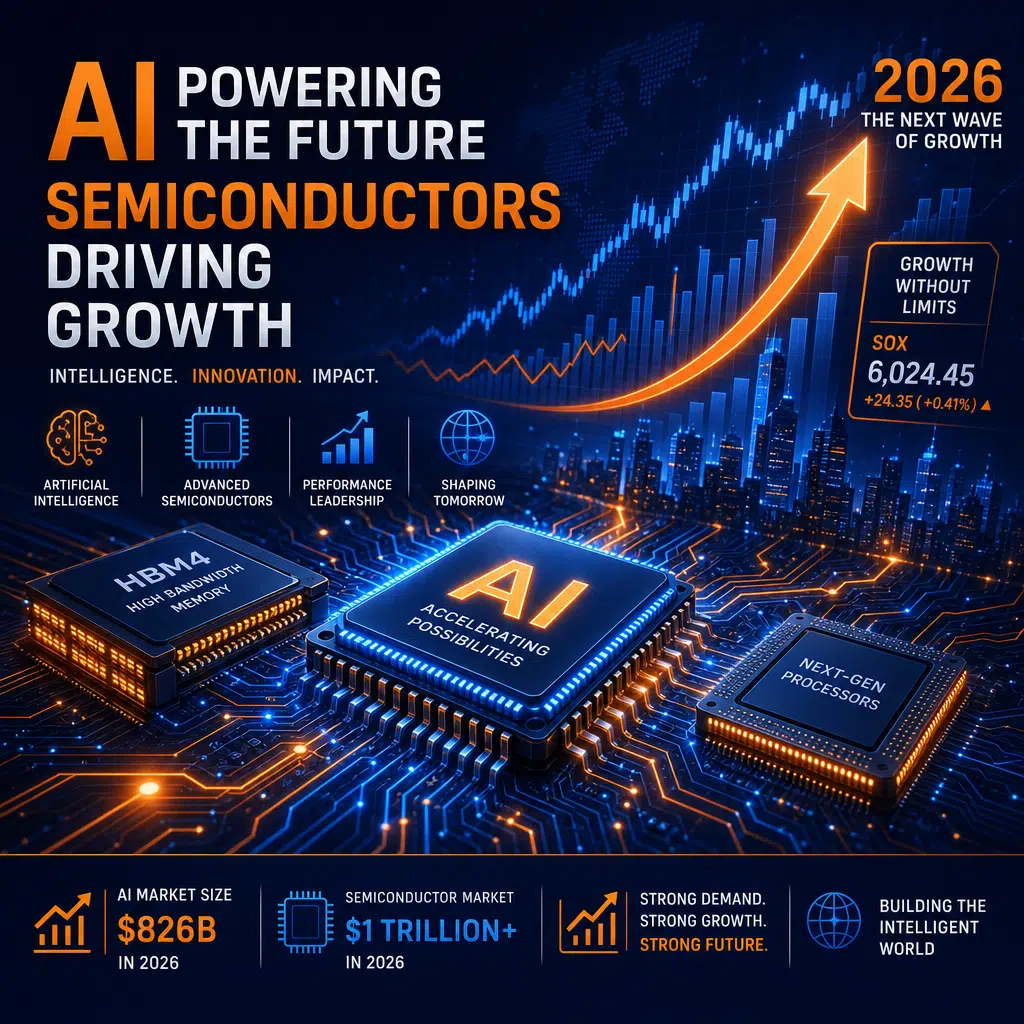
Artificial intelligence (AI) and semiconductors once again took center stage on Wall Street, as industry giants and emerging players alike posted critical earnings and made major announcements. The day’s events underscored not just the dominance of AI in shaping tech investment, but also revealed important developments in the ongoing arms race to build the world’s next generation of computing infrastructure. In this comprehensive report, we break down how today’s news cycle reaffirmed AI’s central role in financial markets and where the semiconductor industry stands as 2026 unfolds.
Micron’s Earnings: A Key Test for AI Infrastructure Demand
All eyes were on Micron Technology as the company released its latest quarterly earnings—a bellwether event for the broader technology and semiconductor sectors. Micron’s memory chips are critical to data centers and AI servers, forming the backbone for much of the ongoing AI revolution. Investors and analysts alike scrutinized the results for signals on whether the current wave of AI-driven enterprise spending remains as robust as previously anticipated.
Going into the report, expectations were high. Micron’s stock performance throughout 2026 had been impressive, reflecting investor faith in the continuation of the AI demand surge. The company’s high-bandwidth memory technology is particularly sought-after, with hyperscale cloud providers relying on this hardware to keep up with explosive growth in AI workloads such as machine learning, large language models, and neural networks.
The significance of Micron’s earnings stretched far beyond the company itself. Strong results would signal not just that Micron is thriving, but that the larger AI hardware ecosystem remains vibrant, validating hundreds of billions in planned investments. Conversely, any weakness could have cast doubt on the pace and intensity of AI infrastructure expansion—a concern that could ripple through the capitalization of every major chip maker.
Semiconductor Stocks Bounce Back
After a tumultuous few days that saw semiconductor stocks endure sharp selloffs, a notable recovery took hold. Leading the comeback were industry stalwarts like Nvidia, Broadcom, and Intel. Their shares rebounded as investors interpreted earlier declines as an opportunity to buy quality names at more attractive prices, rather than as an omen of deeper trouble in the tech sector.
This renewed confidence stems from one simple fact: AI infrastructure spending is still one of the most powerful secular tailwinds in the market. Cloud giants such as Amazon, Microsoft, and Google are showing no signs of slowing their investments in data centers loaded with the latest processors, networking gear, and memory technologies.
The day’s rally among chipmakers highlighted the resilience of the sector, even as market volatility increases. It was a reminder that investors remain keenly focused on AI as the defining theme, treating pullbacks as temporary rather than structural. This support bodes well for continued innovation and expansion by semiconductor leaders who are racing to supply the hardware of tomorrow’s digital economy.
SK Hynix Announces Ambitious $29 Billion U.S. Listing
Among the day’s most consequential announcements was South Korean DRAM and NAND specialist SK Hynix revealing plans for a U.S. stock listing that could raise a staggering $29 billion. If successfully completed, the offering would become one of the largest public share offerings globally, further cementing the company’s position among memory chip leaders.
SK Hynix’s role in the AI ecosystem cannot be overstated. The company is a global powerhouse in high-bandwidth memory, technology that enables fast, energy-efficient data transfer essential for top-tier AI system performance. By seeking a U.S. listing, SK Hynix is positioning itself to attract a broader base of investors and further entrench itself in the most lucrative segment of the semiconductor value chain.
The decision also reflects the overwhelming appetite global investors have for AI-exposed stocks. As AI’s influence on business models and technology architectures intensifies, more capital is searching for direct access to this critical supply chain. SK Hynix’s bold move will provide investors with a new, prominent avenue to gain exposure to the high-growth AI memory market.
Nasdaq Finds Its Footing as Tech Stocks Rebound
The Nasdaq Composite, often considered the pulse of America’s technology sector, staged a recovery after several sessions of weakness led by profit-taking and uncertainty around interest rates and inflation. It was the surging tech and semiconductor firms that pulled the index higher, highlighting a persistent willingness among investors to accumulate leading technology shares whenever the broader market wobbles.


This rebound demonstrated two important trends. First, fundamental concerns around inflation and rising interest rates have not completely upended the risk appetite for innovative, fundamentally strong companies. Second, the recent correction was seen by many as a chance to reset stretched valuations and rotate back into quality technology franchises with resilient earnings power.
As the first half of 2026 nears its end, sectors most closely aligned with advanced infrastructure—semiconductors, cloud computing platforms, and AI—continue to outperform, validating the dominant narrative that technology remains the primary driver of market returns.
Cerebras: Shedding Light on Specialized AI Hardware Demand
Beyond the household names, investors are paying growing attention to upstart firms racing to carve out new niches in AI hardware. Cerebras, a company renowned for its purpose-built AI chips, released its own earnings update, giving markets a rare peek into customer demand that exists outside of Nvidia’s traditional stronghold.
Cerebras develops processors that are custom-designed for AI training and inference tasks. Its unique “wafer-scale” engine approach sets it apart in a rapidly shifting landscape where organizations need hardware capable of running increasingly complex neural models at scale. Though the company is substantially smaller compared to its established peers, its results offer valuable evidence on whether AI hardware spending is becoming more distributed across a broader spectrum of suppliers.
Investors welcomed Cerebras’ report, as it reinforced the notion that the AI build-out is not only accelerating, but also diversifying. The company’s performance suggests robust end-market demand for specialized solutions, broadening the base of players benefitting from the rise of intelligence-driven computing infrastructure.
The Broader Picture: AI Remains the Driving Force in Technology Investment
Today’s confluence of news—from Micron’s pivotal earnings, to SK Hynix’s multi-billion-dollar listing ambition, to smaller players like Cerebras entering the spotlight—highlights a single, overarching reality: artificial intelligence is the engine powering technology markets. Far from being a trend driven solely by a handful of large-cap names, the appetite for AI infrastructure encompasses a vast network of chip designers, manufacturers, and system integrators.
The resilience of semiconductor stocks amidst volatility, the scale of capital flowing into U.S. markets, and the steady drumbeat of reported corporate investment collectively anchor the thesis that AI spending will dominate capital allocation decisions for the foreseeable future. For investors and industry participants alike, keeping a close watch on earnings, product roadmaps, and listing announcements remains crucial to staying ahead in an industry defined by speed, scale, and innovation.
Looking Ahead: Opportunities and Risks in the AI and Semiconductor Sectors
While today’s performance points to continued optimism, industry observers caution that competition, regulation, and macroeconomic factors could yet introduce bouts of turbulence. Supply chain reliability, geopolitical tensions around technology exports, and the rising cost of manufacturing next-generation chips will all play a part in shaping the narrative over the rest of 2026 and beyond.
For now, however, the strong showing by AI-infrastructure-focused companies and the unwavering support from capital markets indicates that the transformation toward intelligence-enabled computing is not just underway—it is accelerating. The semiconductor industry, fueled by AI, is poised for further growth, innovation, and global significance in the years to come.