Federal Reserve Maintains Rates Steady Amid Market Uncertainty: A Close Look at the FOMC Decision and Its Impact on Bitcoin
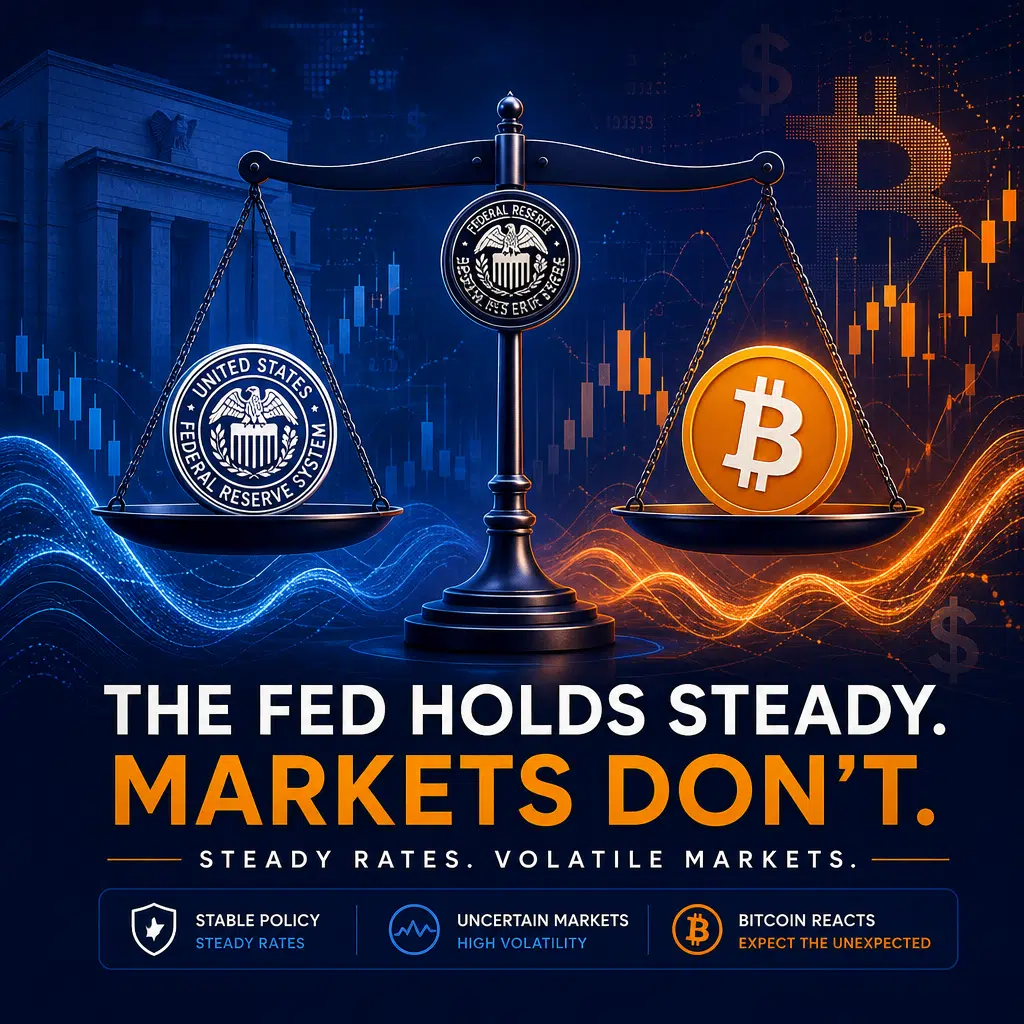
The recent decision by the United States Federal Reserve to maintain its federal funds rate between 3.50% and 3.75%, following the July Federal Open Market Committee (FOMC) meeting, has sent ripples through both traditional financial markets and the burgeoning cryptocurrency sector. The move comes amidst significant market speculation and investor unease, with particular attention focused on Bitcoin’s reaction amid wider economic uncertainties and changing leadership at the Fed.
The Decision: Steady Rates Amid Economic Uncertainty
In a widely anticipated yet unpredictable meeting, the Federal Reserve’s Board of Governors voted 9-3 to keep interest rates unchanged. According to the official statement, “The Committee decided to maintain the target range for the federal funds rate at 3-1/2 to 3-3/4 percent, in support of the Federal Reserve’s dual mandate. The Committee is continuing its policy of maintaining ample reserves in the banking system.” This decision underscores the central bank’s cautious approach as it balances the dual goals of maximum employment and stable prices in a complex global context.
What made this meeting stand out was its level of unpredictability. Since the global COVID-19 pandemic in March 2020, most FOMC meetings concluded with an overwhelming consensus regarding their decisions on monetary policy direction. However, this time, futures markets and prediction platforms had been signaling considerable uncertainty, assigning a 30%-38% probability that the Fed might opt for a rate hike instead of holding steady.
Market Reaction: Volatility and De-Risking Ahead of the Event
Leading up to the announcement, both traditional and digital asset markets showcased heightened volatility. Many investors preemptively moved away from higher-risk assets, such as Bitcoin, in anticipation of potential surprises from the central bank. The flagship cryptocurrency experienced a sharp decline, dropping by $3,000 the day before the FOMC meeting. However, by the day of the announcement, Bitcoin had managed to rebound to around $64,500 before facing rejection and slipping back below $63,800 just prior to the decision.
This reaction highlights a common trend where investors hedge against potential shocks by liquidating positions in volatile assets. The movement in Bitcoin prices was not merely due to the FOMC’s decision itself, but resulted equally from the market uncertainty that preceded it. The cryptocurrency markets, known for their sensitivity to macroeconomic shifts, tend to amplify both the risk and potential returns in response to monetary policy news.
Immediate Aftermath: Signs of Volatility Persist
After the Fed’s decision to maintain steady interest rates was made public, Bitcoin’s minor volatility quickly returned. The price surged again, climbing above $64,000 immediately following the announcement. This spike is indicative of the market’s relief at the absence of an unexpected rate hike, but also demonstrates the degree to which traders remain attentive to even the smallest hints of monetary policy adjustments.
The focus now turns to the new Federal Reserve Chair, Kevin Warsh. His upcoming press conference has become the focal point for market participants, many of whom are eager for clues regarding the central bank’s upcoming moves. As the Fed’s public face, Warsh’s tone, language, and stated priorities are likely to exert significant influence on both equity and cryptocurrency markets.
Decoding the Federal Reserve’s Rationale
The Fed’s decision to hold rates steady reflects its assessment of ongoing economic conditions. With inflation showing signs of moderating yet not fully subdued, and the broader economy expanding at a pace described as “modest,” policymakers face a delicate balancing act. Raising rates too quickly could risk derailing economic recovery or triggering instability in debt markets, while keeping them too low for too long might reignite inflationary pressures.
In recent months, the Fed has made clear its commitment to a data-driven approach, waiting for further evidence that inflation is sustainably decreasing before considering further monetary tightening. This pause aligns with the stated objective of supporting continued labor market strength while ensuring that inflation trends remain on target.
The Broader Context: What This Means for Financial Markets
The FOMC’s actions hold wide-ranging implications across the entire financial landscape. For traditional markets, the decision to maintain rates supports ongoing access to relatively affordable credit, benefiting both households and businesses. Stock markets tend to respond favorably when rate hikes are paused—particularly growth stocks and other risk-sensitive assets—as lower borrowing costs typically translate into higher profitability and investment activity.
In the realm of digital assets, however, the calculus is more nuanced. Bitcoin, often seen as both a high-volatility risk asset and a potential hedge against inflation, tends to amplify reactions to Fed announcements. The recent sell-off followed by a swift rebound is reflective of crypto speculators’ reflexive trading in response to macro events.


It’s important to note that cryptocurrency markets are not isolated from global financial trends. Rather, they are integrated into the broader ecosystem, with policy moves from major central banks exerting outsized influences on trading dynamics, price discovery, and overall sentiment.
Bitcoin’s Unique Position: Risk Asset or Inflation Hedge?
Bitcoin’s reaction to the FOMC decision sheds light on its evolving role in investor portfolios. Many traditional investors continue to view Bitcoin as a speculative asset, particularly sensitive to shifts in liquidity and investor sentiment. When uncertainty increases around interest rates and global macro policy, Bitcoin is often among the first assets to experience significant price swings.
However, some in the crypto community emphasize Bitcoin’s properties as a hedge against fiat currency debasement and long-term inflation. From this perspective, any decision by the Fed to pause rate hikes may be interpreted as a sign that monetary policy is becoming less restrictive—a development that could ultimately favor Bitcoin’s value proposition, particularly if inflation remains stubbornly above target.
This ongoing debate is likely to intensify as the global economy continues to navigate an environment marked by slow growth, persistently high debt levels, and uncertain inflation trends.
The Role of Fed Chair Kevin Warsh: What’s Next?
With the spotlight now on Federal Reserve Chair Kevin Warsh’s press conference, investors across asset classes are eager for signals regarding future policy directions. Warsh, who took office amid a highly volatile period, has thus far emphasized the importance of data-driven decisions—something markets have taken to heart.
Any hints from Warsh regarding the conditions under which the Fed might resume tightening, or conversely, pause further, will be closely analyzed. Language indicating continued caution on inflation could spur renewed volatility in Bitcoin and equity markets alike. Alternatively, signs that the Fed may be leaning toward loosening policy later this year could catalyze renewed interest in riskier assets, including cryptocurrencies.
Looking Forward: What Investors Should Watch
As the dust settles from the July FOMC decision, investors should remain attuned to several key developments:
- Upcoming Economic Data: Inflation prints, employment numbers, and economic growth figures will all influence the next steps for both the Fed and market participants.
- Fed Communication: Remarks from Chair Warsh and other FOMC members will be scrutinized for any deviation from the current stance.
- Market Sentiment: Short-term volatility in both traditional and crypto markets is likely as traders continue to digest the implications of monetary policy uncertainty.
- Global Considerations: Movements in other central banks’ policies, especially in Europe and Asia, will add further complexity to the global risk environment.
Conclusion: Navigating Uncertainty in Volatile Times
The Federal Reserve’s decision to maintain interest rates steady after the July FOMC meeting highlights the challenging cross-currents facing global policymakers. Amid persistent uncertainty over inflation and growth, financial markets—including Bitcoin and other cryptocurrencies—are responding with characteristic volatility.
For investors, the current environment underscores the importance of vigilance, diversification, and a clear understanding of macroeconomic drivers. As markets await further guidance from Chair Warsh and the Fed’s leadership, the next few months promise continued uncertainty, with both risks and opportunities presenting themselves across all corners of the investment landscape.
“`