Global Tech Stocks Shake as Alibaba, Nvidia, and Samsung Drive Market Volatility
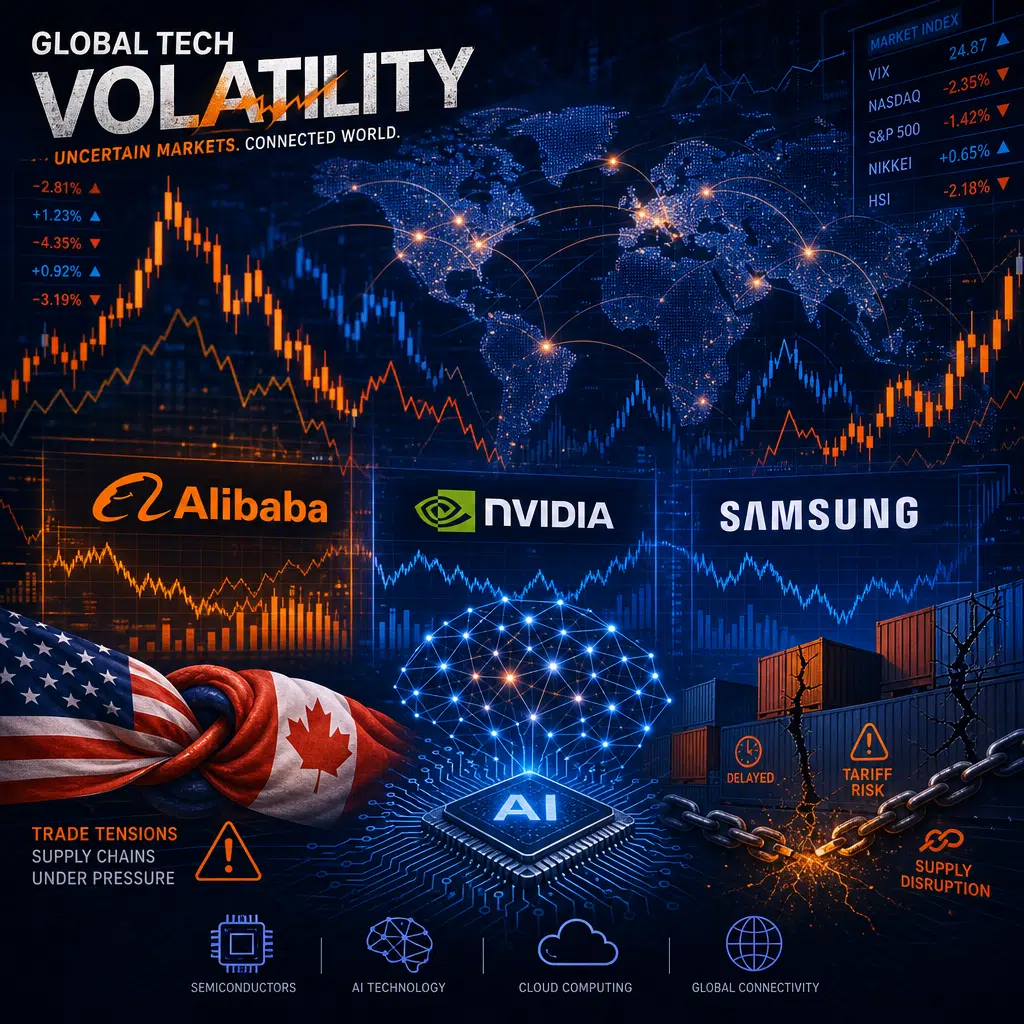
The global technology market experienced extreme volatility this week, with major companies such as Alibaba, Nvidia, and Samsung making headlines for bold moves and earnings concerns. Meanwhile, mounting trade tensions between the United States and Canada threatened to reshape supply chains, casting uncertainty over key sectors in both nations. In this comprehensive article, we explore the critical drivers behind the recent shake-up in the tech sector, unpacking what investors and industry watchers need to know about these pivotal developments.
Alibaba’s $10.2 Billion Share Placement Roils Markets
One of the most significant moves in the Asian financial markets was Alibaba’s announcement of a $10.2 billion Hong Kong share placement, which marked the largest primary follow-on share sale in the history of the Hong Kong stock exchange. This capital-raising initiative is targeted at propelling Alibaba’s ambitions in artificial intelligence (AI), with the company’s leadership signaling that funds will be invested in areas ranging from advanced chip development to high-computing infrastructure and model innovation.
However, the market reaction was far from positive. Alibaba’s shares dropped by more than 8% as investors weighed the risks of share dilution and questioned the short-term return on such a significant, capital-intensive investment. This dramatic slide highlights deep-seated concerns among Alibaba’s shareholder base: after reporting a 75% decline in quarterly profit—a fall largely attributed to substantial AI investments—many are eager to see tangible results and clearer paths to profitability.
The Race for AI Dominance
Alibaba’s confidence in AI mirrors a wider trend in the tech sector, with global players betting big on next-generation technologies. The company’s commitment to building out its chip and computing infrastructure is part of an urgent push to catch up with western counterparts already making inroads in AI. But the capital requirements are considerable, and Alibaba must now convince the market that its approach will yield not only innovation but also improved shareholder value over the long term.
Nvidia Seeks to Broaden AI Ecosystem with Strategic Investment
Meanwhile, Nvidia continues to be a key driver in the AI revolution. The American chip giant is reportedly in late-stage talks to invest in Perplexity, an AI search company now valued at over $30 billion following a meteoric rise from a $20 billion valuation just one year prior. Perplexity’s explosive annualized revenue growth—from under $250 million at the start of 2026 to more than $750 million—illustrates how demand for AI-powered tools is surging.
If Nvidia completes this investment, it would signal a strategic extension beyond its traditional chip and hardware portfolio and into the rapidly expanding field of AI software and applications. This move would position Nvidia not just as a supplier for the backbone of AI infrastructure, but as a player with a stake in the algorithms and consumer-facing innovations of tomorrow. For investors, this diversification adds both opportunity and an additional layer of complexity to Nvidia’s future earnings profile.
Market Jitters Ahead of Nvidia’s Earnings Report
Despite its sector dominance, Nvidia’s own stock felt the heat ahead of its anticipated earnings announcement. Shares dropped by approximately 2.4% as cautious investors began trimming their positions, worried about how the company would perform after a period of intense hype around AI and semiconductors. Broader sentiment in the semiconductor sector soured as well, with companies like Marvell and Micron sliding over 6% and Sandisk dropping more than 10%.
Key Earnings Questions
Market analysts remain laser-focused on several aspects of Nvidia’s report: the sustainability of its data-center revenue, demand for its Blackwell chips (which are expected to lead a new generation of AI hardware), and, crucially, management’s forward guidance for the rest of the year. The importance of this report cannot be overstated—Nvidia is one of the largest companies in the S&P 500, and its results have the potential to ripple through the entire index, setting the tone for investor sentiment across multiple sectors.
U.S.-Canada Trade Dispute Escalates, Threatening Supply Chains
As if the tech sector’s turbulence weren’t enough, global markets were rocked by the breakdown of trade negotiations between the United States and Canada. In direct retaliation to U.S. tariffs, Canada announced that it would implement equivalent retaliatory tariffs beginning September 8. The new duties will match U.S. tariffs “dollar for dollar” and target a roster of key goods including steel, household appliances, agricultural equipment, and a host of industrial products.


This escalating trade dispute threatens to upend deeply interconnected supply chains, particularly in industries such as automotive manufacturing and machinery where bilateral trade has traditionally flourished. For cross-border companies, increased tariffs could mean higher input costs, supply delays, and a complicated regulatory environment—all of which could eventually be passed on to consumers in both nations.
The uncertainty caused by the standoff is especially acute for technology producers that depend on seamless global networks to source components and deliver finished products. Investors are bracing for potential ripple effects through a range of industries, from electronics to agritech, as global trade tensions show no sign of quick resolution.
Samsung Shares Slump Despite Ambitious Shareholder Return Program
South Korean tech leader Samsung became the latest company to feel the sting of investor expectation. Its shares plunged by more than 8% despite announcing an ambitious shareholder return program destined to return between 90 trillion and 110 trillion won (approximately $65 billion to $80 billion) to its investors. While the scale of this plan sounds impressive, the broader market had apparently priced in an even larger buyback or more aggressive commitment to capital distribution.
The contrast with rival SK Hynix was stark. Just days earlier, SK Hynix had announced a $28.6 billion buyback along with a pledge to return over half of its future free cash flow to shareholders, a move that was enthusiastically received. In comparison, Samsung’s plan seemed somewhat restrained and left stakeholders underwhelmed.
AI Market Pressures and Samsung’s Strategic Position
Samsung’s position as a key supplier to the fast-growing market for AI-enabled memory and processing components puts it at the forefront of innovation. However, the precipitous share drop demonstrates the pressures high-value tech companies face to continually raise the stakes in shareholder returns, especially as competition increases and disruptive trade or regulatory risks loom.
The Broader Impact: Investor Sentiment and Sector Outlook
The week’s developments underscore several core themes dominating today’s global technology markets:
- Capital Allocation and Risk: Major players like Alibaba and Samsung face continuous scrutiny over how they manage capital expenditure, debt, and shareholder rewards amid volatile returns.
- AI as the Next Frontier: News from Nvidia, Alibaba, and Samsung makes clear that the future of competition—and profitability—lies in cutting-edge AI capabilities, prompting heavy investment regardless of short-term profit drops.
- Trade Uncertainty: The U.S.-Canada dispute adds geopolitics into the mix, threatening to disrupt not just trade but also R&D and strategic alliances core to tech sector agility.
- Market Volatility: As companies battle to meet both innovation and shareholder demands, major indices and individual shares are experiencing heightened swings—an environment in which only the most nimble investors thrive.
Key Takeaways for Investors and Industry Watchers
For investors, the key message is clear: the future of technology investment will be shaped by two central forces—massive, forward-looking investments in artificial intelligence and the real-time volatility of global trade and regulatory relations. While bold capital moves by industry leaders may lead to short-term market jitters (and, in some cases, profit slumps), those willing to look past near-term turbulence may find unique opportunities in companies poised to define the next era of technology and economic growth.
The events of this week serve as a vivid reminder that in today’s hyper-connected, innovation-fueled marketplace, the only certainty is change. By monitoring strategic investments, regulatory shifts, and evolving shareholder demands, market participants can better position themselves to spot opportunities—and risks—in an increasingly complex global economy.