Nvidia’s Critical Earnings Report Looms: Tech and Markets on Edge
The US financial markets are closely watching a pivotal week ahead, as several key indicators and earnings reports have aligned to create a powerful cross-current shaping investor sentiment. At the center stands Nvidia, the AI chip powerhouse, whose quarterly earnings—set to be reported this Wednesday—could ripple through technology, equities, and the broader macroeconomic landscape.
The Stakes Intensify for Nvidia and Its Ecosystem
Investors are laser-focused on Nvidia’s upcoming second-quarter earnings. The company has delivered a string of impressive results over the past year, but the market’s reaction has been anything but predictable. Despite consistently beating analyst estimates, Nvidia’s stock has experienced sell-offs following its last three quarterly reports—a testament to the outsized expectations and volatility in the AI sector.
Last quarter, Nvidia stunned Wall Street with revenue soaring 85% year-over-year. The company’s data center sales, which reflect surging demand for AI-processing chips, nearly doubled. CEO Jensen Huang summed up the environment by stating that demand “has gone parabolic,” pointing to the near-insatiable appetite for advanced computing power.
The summer was packed with milestones: Huang unveiled new chips specifically engineered for on-device AI agents—a move intended to pivot beyond data centers and into the hands of millions of developers. Nvidia continued to push into the massive Chinese market and signed multiple agreements connected to the financing of next-generation AI data centers.
Financial analysts contend that Nvidia’s quarterly performance is a bellwether for the entire technology sector. According to Wedbush Securities, every $1 Nvidia earns translates to $8–$10 spent elsewhere in the ecosystem. This multiplier effect underscores the company’s influence, making its forward guidance essential for investors across industries.
There’s also speculation that Nvidia could position itself as the top contributor to open-source AI development. HSBC analyst Frank Lee suggested that a strategic shift toward open-source offerings could massively expand its customer base, reaching millions of developers and even entire sovereign nations eager to integrate state-of-the-art AI.
Wall Street’s Earnings Heavyweights: Technology and Retail in the Spotlight
Nvidia isn’t the sole giant on this week’s earnings docket. A roster of prominent technology companies—Marvell Technology, CrowdStrike, Salesforce—are reporting, each poised to take investors’ temperature on different parts of the tech universe. On the retail front, Dollar General, Ulta Beauty, and others will offer fresh insight into consumer spending against a backdrop of persistent inflation and economic uncertainty.
The collective results promise to reveal much about shifting consumer habits, enterprise technology investment, and the all-important question of where growth will come from next in a choppy global economy.
Bitcoin Rebounds: Crypto Markets Boosted by Policy and Liquidity
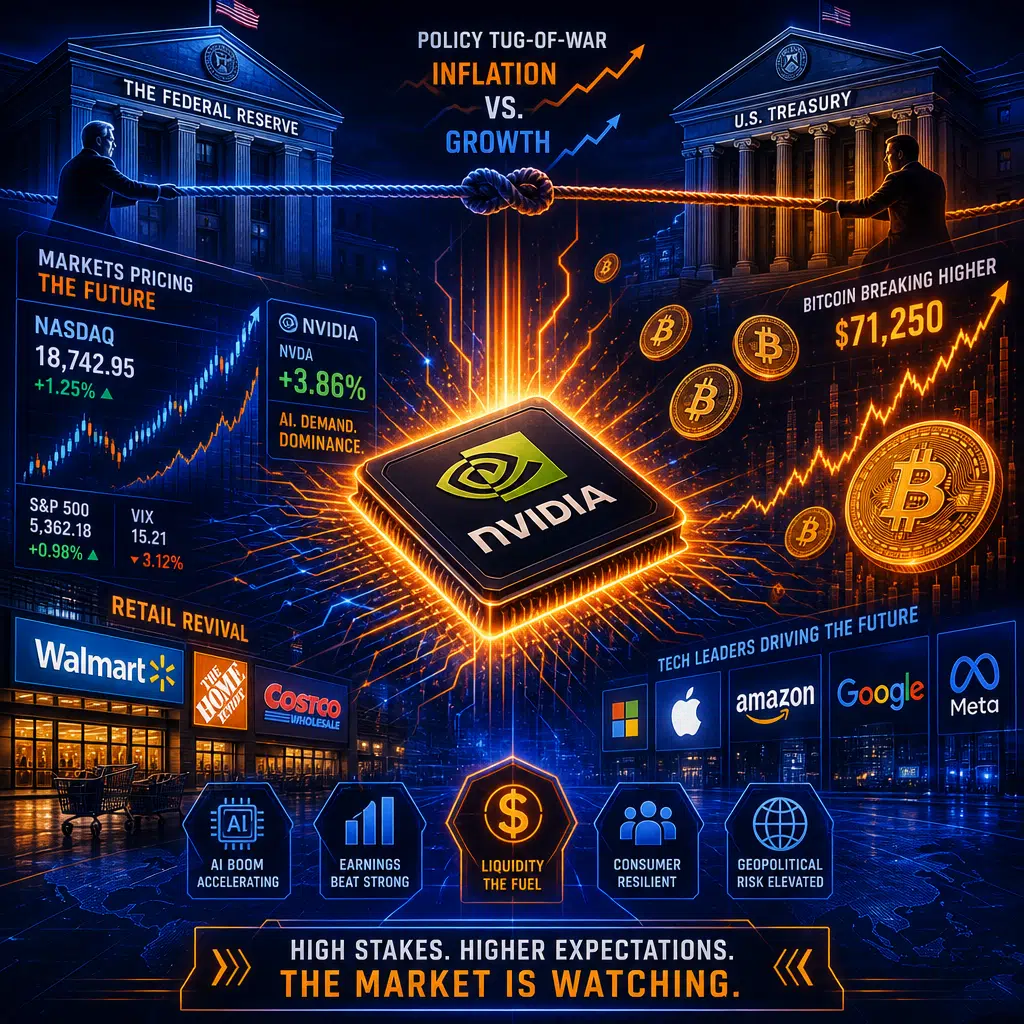
While stocks brace for volatility, the cryptocurrency market is experiencing a resurgence. Bitcoin’s price jumped back above $70,000 for the first time since late May after months of stagnant trading. Several catalysts have fueled this move, indicating a revival of risk appetite—and a potential shift in macroeconomic winds.
Key to Bitcoin’s rally has been the renewed push for crypto-friendly legislation in Washington. President Trump has taken up the cause, using his platform to spur a fresh legislative push. Market participants interpret this as a sign of increasing regulatory clarity and mainstream acceptance for digital assets.
At the same time, the US Treasury’s announcement that it would expand purchases of longer-term government bonds has bolstered investor confidence in risky assets. The reasoning is straightforward: More liquidity in the system often finds its way into assets like Bitcoin, which have historically benefited from periods of monetary easing.
Another driver is the ballooning US national debt, which recently surpassed $40 trillion. In times of fiscal uncertainty, Bitcoin and other so-called “hard assets” tend to attract capital as investors seek alternatives to government-issued currencies. “Bitcoin has historically reacted positively to liquidity expansion,” noted Bernstein strategist Gautam Chhugani. Still, whether this rally has legs remains an open question, hinging on both legislative developments and the trajectory of real yields.
Treasury and Fed at Odds: Yield Volatility and the Road Ahead
Beyond earnings and crypto, a subtle but important tug-of-war is unfolding between the US Treasury and the Federal Reserve. Last week, the Treasury surprised markets by accelerating its bond-buyback program—a move designed to inject liquidity and manage government debt issuance. This policy action sent ripples through the bond market, driving long-term yields lower.


However, this intervention runs counter to the Federal Reserve’s current posture. Fed officials, including Chair Kevin Warsh, have recently signaled a preference for tighter financial conditions, advocating for higher long-term yields as a means to cool inflation without further rate hikes. Bond buybacks work to lower these yields, setting up a situation where two critical arms of US economic policy are, in the words of Wilmington Trust’s Wil Stith, “basically working in sort of opposite directions.”
The impact was immediate. The yield on the 30-year Treasury bond, which had surged to levels unseen since 2007, quickly pulled back after the buyback announcement. Within 48 hours, however, yields rebounded to their prior highs as markets try to reconcile conflicting signals from the biggest players in monetary policy.
Inflation Watch: PCE Index in Focus Ahead of Jackson Hole
The lynchpin for much of the upcoming volatility may be the release of the Personal Consumption Expenditures (PCE) Price Index on Wednesday. This key inflation gauge remains the Federal Reserve’s preferred tool for measuring underlying price pressures in the US economy. In June, the index was already running at an annual pace of 3.7%—well above the Fed’s 2% target.
Should the new numbers come in hotter than expected, speculation about a possible rate hike at the Fed’s September meeting would intensify. The interplay between inflation, Treasury yields, and risk-asset performance may reach an inflection point, especially as Chair Warsh is set to deliver a closely watched speech at the Jackson Hole Symposium on Friday.
Investors are keenly awaiting any hints of a policy pivot, with some hoping that signs of cooling inflation could open the door to more accommodative monetary policy in the months ahead. Conversely, strong inflation data could convince markets the Fed’s tightening cycle isn’t over yet.
Retailers and Tech Earnings: A Pulse on the US Consumer
Among the upcoming earnings, retail giants like Dollar General, Dollar Tree, and Gap will shed light on the health of lower-income households and overall consumer demand. Their performance is an important cross-check on official economic data, particularly as higher inflation and interest rates have squeezed many American families.
Ulta Beauty and Marvell Technology round out the consumer and tech coverage, the latter being a key supplier of advanced chips for AI data centers. Analysts will be looking for signs that capital investment in data infrastructure remains strong—a vital clue for both Nvidia’s fortunes and the broader technology sector.
Stock Market Volatility: What’s Next?
With investors bracing for a slew of high-impact events—ranging from Nvidia’s earnings shockwaves, pivotal inflation data, and continued crypto volatility—financial markets could be entering a period of heightened turbulence. Earnings results, especially for major tech companies, could set the tone for the next phase of the bull market or signal a period of profit-taking after a record-setting run.
Meanwhile, the tug-of-war between the Federal Reserve and US Treasury complicates the outlook for interest rates and bond yields, affecting everything from mortgage rates to corporate borrowing costs. For now, traders and investors alike are watching every data release, policy announcement, and earnings call for clues on the path forward.
Conclusion: A Defining Week for Markets, Tech, and Crypto
This week stands as a crossroads for US and global markets. Investors face a deluge of information—corporate earnings, inflation numbers, and policy pronouncements—that could sway risk sentiment for weeks to come. All eyes are on Nvidia, whose results and guidance will echo far beyond silicon semiconductors, touching every corner of the technology investment universe.
As crypto markets regain momentum and policymakers wrestle with inflation and debt management, the stakes for individual investors and institutions alike have rarely been higher. Whether this inflection marks the beginning of a new rally or foreshadows a period of correction, the signals sent this week will set the tone for the remainder of the year.