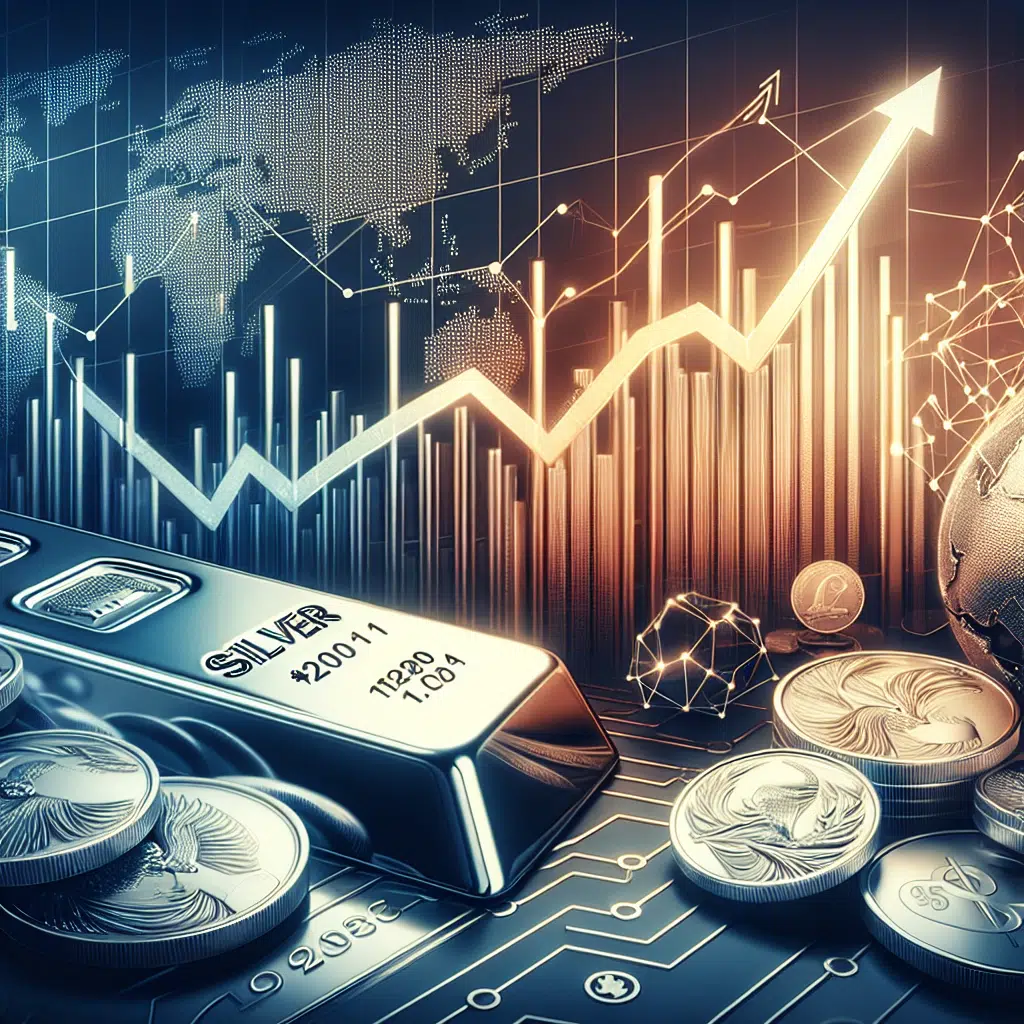
LONDON, April 10, 2025 – The global financial stage has shifted as silver surges past the $82 per ounce mark, propelled by escalating geopolitical tensions in the Middle East and a market braced for critical U.S. employment data due soon. This development has made waves across investment communities, marking a defining moment for bullion traders and signaling broader concerns about economic stability and risk sentiment.
Silver’s Breakout: A Pivotal Technical and Fundamental Shift
Silver’s most recent rally has set new benchmarks, both in price and in investor sentiment. The XAG/USD pair leaped above the crucial $82 threshold, breaking through the resistance level that had capped price movements for months. Historically, the $80 mark has been a formidable ceiling for silver, and its breach signals the possibility of a sustained move into a higher trading range.
Technical analysts highlight that not only did silver soar above a significant resistance level, but it did so amid a surge in trading volume — up more than 40% compared to the monthly average. This increase points to substantial institutional participation, as traders and funds recalibrate portfolios in light of recent world events. Such a sharp increase in interest often prefaces further volatility and larger trend shifts.
The confluence of the Iranian conflict and anticipation around U.S. macroeconomic policy has been central to this movement. As instability persists in the Middle East, investors are flocking to precious metals, viewing them as defensive assets in times of global risk. At the same time, the anticipated release of the U.S. Non-Farm Payrolls report looms large. Employment data remain a north star for interpreting Federal Reserve rate intentions—a key driver for all non-yielding assets, especially silver.
Geopolitical Turmoil: The Classic Safe-Haven Rush
Periods of geopolitical unrest often trigger a flight to safety. This time, the ongoing conflict involving Iran has introduced a significantly heightened risk premium to commodity markets, with silver and gold reaping the largest benefit. Historically, during crises, the correlation between silver and gold tightens as investors rush into tangible assets. Analysts note that during comparable past incidents, silver price volatility increased by an average of 25%.
This trend is evident once again, as not just prices but also demand for physical silver—bars, coins, and exchange-traded funds (ETFs)—has soared. There are widespread reports of bullion dealers registering higher sales volumes and ETFs seeing record inflows. These flows underscore growing global uncertainty and a collective hedging against both immediate conflict escalation and potential knock-on effects on energy prices, trade routes, and ultimately, inflation.
Market Psychology: The Duality of Silver
Unlike gold, silver has a unique role in the financial markets, acting as both a traditional monetary metal and a key industrial commodity. This duality ensures that its price responds to not just investment flows, but also to broader economic health and industrial demands. Right now, however, fear-driven flows into safe havens far outweigh any concerns about an industrial slowdown.
Major bullion banks and financial strategists cite a marked increase in physical bar and coin purchases. There are also substantial inflows into silver-backed ETFs, reflecting a surge in both retail and institutional demand. This momentum, according to market experts, may persist as the current political and economic climate shows few signs of immediate resolution.
| Driver | Impact on Silver | Evidence |
|---|---|---|
| Iran Conflict | High (Positive) | Increased ETF inflows, rising volatility index |
| US Dollar Strength | Medium (Negative) | DXY index movement inversely correlated |
| US Jobs Data | High (Variable) | Futures market positioning for rate implications |
| Industrial Demand | Low (Neutral) | Stable photovoltaic sector demand |
Focus on U.S. Economic Data
While geopolitics remains the spark in the silver market, forthcoming U.S. employment data represent another major inflection point. The Non-Farm Payrolls report is widely regarded as a proxy for overall economic health and a determinant of Federal Reserve monetary policy direction.
Strong labor market readings typically support the U.S. dollar and raise expectations for higher interest rates—moves that often cap rallies in non-yielding assets like silver. Comparatively, weaker jobs data would reinforce market expectations for a dovish policy stance, potentially unleashing further upward momentum in precious metals.
Key metrics to monitor in the jobs report include:
- Non-Farm Payrolls: The principal measure of new job creation and labor market momentum.
- Unemployment Rate: A critical gauge signaling slack or tightness in the jobs market.
- Average Hourly Earnings: Monitored closely for signs of wage inflation, an important influence on broader price pressures and monetary policy.
Bloomberg economist consensus suggests moderation in job growth, but any significant deviation from expectations could prompt sharp volatility in both foreign exchange and commodity markets. With much geopolitical risk already priced in, traders see the labor data as the next decisive catalyst determining whether the silver rally can sustain itself or is due for a pause.
Technical Outlook: Where Can Silver Go from Here?
The technical chart profile for silver is currently robust. The breakout above $82 is a substantial bullish signal, and the next resistance zone is seen near $85.50, which represents highs set in late 2024. Support levels have similarly shifted upwards, now anchored between $80.00 and $80.50—a testament to the strength and conviction of the recent run.
Both the 50-day and 200-day moving averages are sloping upward, validating a continued bullish trend. Additionally, momentum indicators like the Relative Strength Index (RSI) are approaching overbought territory. While this can be a warning that prices have run too far, too fast, it is not uncommon for RSI to remain elevated for extended periods during significant market trends, particularly when supported by powerful macroeconomic and geopolitical themes.


The US Dollar Index (DXY): An Inverse Yet Complicated Relationship
Normally, the US Dollar and silver share an inverse relationship: a strengthening dollar often weighs on silver, as it becomes more expensive for holders of other currencies. Interestingly, despite relatively stable strength in the US Dollar Index (DXY) recently, silver prices have risen strongly. This decoupling points to an extraordinary period in the markets, where safe-haven flows into silver outweigh the dampening effect of a robust dollar. Such dislocations are typically a mark of extreme uncertainty and underlying investor anxiety.
Silver’s Broader Context Among Precious Metals
Silver’s rally is not occurring in isolation; it is part of a broader uptrend across the precious metals complex. Gold, too, has broken through key resistance levels and is trading near multi-year highs. The gold-to-silver ratio—a longstanding benchmark for comparing relative value—has narrowed slightly but remains at a historically high level. Analysts interpret this as an indication that, relatively speaking, silver could still have more room to run, especially if sentiment in gold remains bullish.
Other metals, such as platinum and palladium, have not experienced rallies as pronounced as those seen in silver or gold. This differential performance accentuates silver’s unique appeal: it offers crisis protection, potential undervaluation, and plays a critical role in several high-growth industrial sectors, including solar panel manufacturing.
What Investors Should Watch Next
Silver’s price outlook is thus dominated by a confluence of two forces: ongoing geopolitical instability and the anticipation of changes in U.S. monetary policy. The breakout above $82, should it hold, will likely encourage further inflows from momentum traders and risk-averse investors alike. Short-term volatility can be expected as market participants digest each new headline out of the Middle East and every economic data point released in the United States.
For those considering silver investment, this environment presents both opportunity and risk. On the one hand, continued instability could fuel a renewed and prolonged safe-haven bid, further lifting silver prices. On the other, a swift resolution to geopolitical tensions or unexpectedly strong U.S. economic data could see the market retrace some of its recent gains as risk appetite returns and the dollar strengthens.
Thus, vigilance and a balanced approach are recommended. Portfolio diversification, awareness of technical levels, and careful monitoring of both global politics and central bank commentary will be key to navigating the current cycle.
Frequently Asked Questions (FAQs)
Q1: Why did the silver price rise above $82?The principal reasons are heightened geopolitical tensions in the Middle East, especially involving Iran, which have sparked a wave of safe-haven buying among investors. Additionally, speculative positioning ahead of key U.S. economic data amplified volatility and upward momentum.
Q2: How are silver prices impacted by the US Dollar?Typically, silver prices and the US Dollar move in opposite directions. Since silver is priced in dollars, a stronger dollar can make it more expensive for foreign investors and tends to dampen demand. However, in times of elevated global anxiety or risk aversion, this inverse relationship can break down as both are sought out for their perceived safety.
Q3: In what way does US employment data affect silver prices?Strong employment numbers generally boost the US Dollar and make the case for higher interest rates, which is often negative for silver. Weaker jobs data may suggest a more accommodative stance from the Federal Reserve, encouraging investment in non-yielding assets like silver due to expected lower real interest rates.
Q4: Is silver a prudent investment during geopolitical crises?Historically, precious metals like silver have outperformed during times of financial or political instability. They offer a hedge against uncertainty and are uncorrelated with mainstream equity or bond markets, making them valuable portfolio diversifiers.
Q5: What are the technical levels to watch now for XAG/USD?After surpassing $82, the technical support now lies in the $80.00–$80.50 range, while the next resistance to watch is around $85.50. Sustained trading above the breakout level affirms the bullish trend, with higher price targets possible if momentum continues.
Summary
The silver market is at a defining crossroads, with prices surging on the back of international turmoil and heightened anticipation of macroeconomic data. The dynamics at play—risk-off sentiment, safe-haven flows, and the balancing act of U.S. economic strength—suggest continued volatility and opportunity ahead. As silver cements its role as a bellwether for global uncertainty and monetary policy, investors should remain vigilant, flexible, and attuned to the ever-evolving landscape shaping one of the world’s oldest and most trusted stores of value.