U.S. Markets Rattle as Trade Tensions Soar and Tech Earnings Loom
U.S. stocks started the week on a turbulent note as a cocktail of trade disputes, political maneuvering, and key tech earnings reports weighed on investor sentiment. Although the Dow Jones Industrial Average managed to climb, the S&P 500 and Nasdaq Composite both drifted lower. Amid a volatile backdrop, escalating trade tensions with Canada and fresh sanctions on Iran compounded Wall Street’s anxiety as traders braced for pivotal developments in the technology sector later this week.
Mixed Performance Across Major U.S. Indices
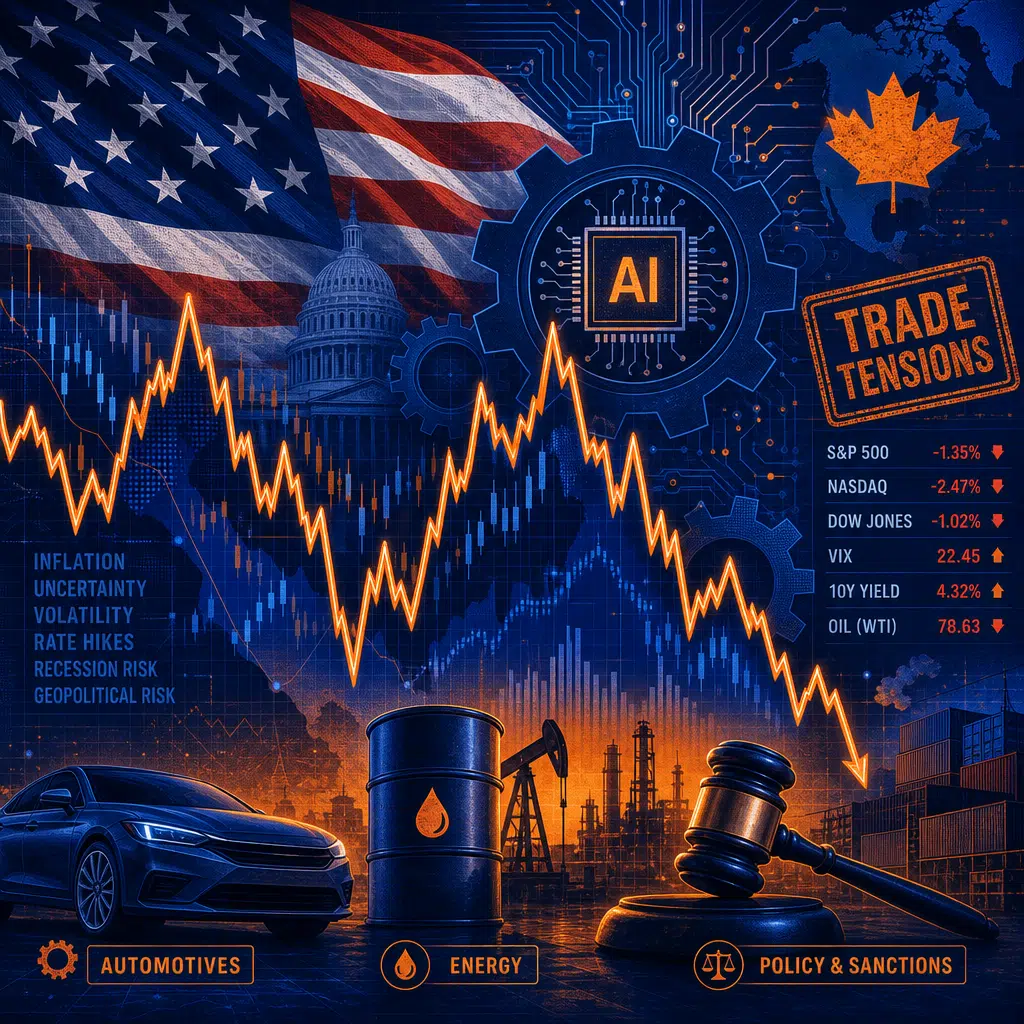
On Monday, the U.S. financial markets exhibited a notably mixed performance. The S&P 500, widely viewed as the broadest measure of American stock performance, declined by 0.3%. The technology-heavy Nasdaq Composite posted an even steeper loss, falling 0.8%, as chip and tech stocks came under particular pressure. Contrastingly, the Dow Jones Industrial Average—often considered a bellwether for blue-chip optimism—climbed a modest 0.3%, showing some resilience amid a rough trading session for riskier assets.
These moves underscored a market grappling with uncertainty on multiple fronts. Investors digested a barrage of policy statements, corporate actions, and looming earnings releases set to shape market direction in the week ahead.
Rising Trade Tensions: U.S.-Canada Negotiations Collapse
The most significant weight on sentiment emerged from the collapse of trade talks between the United States and Canada. Over the weekend, fresh tariffs imposed by the U.S. on a selection of Canadian goods prompted a swift and strong response from Canadian officials. Prime Minister Mark Carney announced an immediate suspension of negotiations and declared plans to retaliate, introducing matching tariffs on American imports.
In a press briefing, President Trump further escalated the standoff, declaring that the U.S. would raise tariffs to 50% on all Canadian automobiles, auto parts, and steel products. The new tariffs are slated to take effect beginning January 1, 2027. His rhetoric took an unyielding tone: “Canada will be treated like a state no longer,” the President asserted.
These developments rattled the automotive sector. Stocks of major American manufacturers, including General Motors and Ford, dipped as traders assessed the prospect of higher costs and supply chain disruptions. The automotive industry is deeply integrated across the U.S.-Canada border, with cross-border manufacturing a longstanding feature of North American industrial policy.
For investors, the tariff drama reverberated across equities known for global supply chains and export dependency, raising the prospect of broader consequences if the transnational spat intensifies further.
Semiconductor and Technology Stocks Face Nerves and Headwinds
Beyond tariffs, technology and semiconductor stocks emerged as focal points for selling pressure. The underlying source was twofold: anticipation of major corporate earnings, and fresh competition threatening American chipmakers.
Mounting anxiety was evident as markets awaited quarterly results from Nvidia, a bellwether for AI and semiconductor momentum, slated for release Wednesday. Any unexpected results from the silicon giant could set the tenor for broader trends in the artificial intelligence and technology spaces.
In the interim, trading in chip stocks proved volatile. Shares of Micron and SanDisk slid on reports that Apple is evaluating semiconductor products produced by China’s ChangXin Memory Technologies (CXMT), raising additional competitive concerns for leading American players. This follows a broader pattern of American tech companies exploring new avenues to diversify supply chains and lower costs, but such moves risk eroding the competitive edge enjoyed by established U.S. firms.
The iShares Semiconductor ETF, a popular vehicle for tracking the sector, declined again on Monday. This followed a strong bull run earlier in the month, which had stoked optimism among tech investors until the latest bout of selling reversed the index’s recent gains.
Alibaba’s AI Ambitions: A $10.2 Billion Share Sale
Adding a further twist for tech watchers was Alibaba’s announcement of a $10.2 billion stock sale. The capital raised will fund the company’s aggressive push into artificial intelligence, a space growing increasingly crowded with well-funded contenders. While the move reflects the accelerating pace of AI development worldwide, it also contributed to stalling momentum among U.S. semiconductor names as investors recalibrated expectations for future competition and growth.


U.S. Announces New Sanctions Against Iran
On the geopolitical front, the United States is set to launch a major new round of economic sanctions against Iran. Treasury Secretary Scott Bessent previewed the measures in a Financial Times opinion piece, describing them as “the largest financial offensive ever launched against an adversary.” Additional details are expected to emerge on Monday afternoon, with markets watching closely for clues on the exact scope and sectoral reach of the new restrictions.
Bond markets reacted mildly to the news, with the 10-year U.S. Treasury yield dipping to 4.72% and the 30-year yield falling to 5.24%. Investors interpreted the move as yet another layer of unpredictability in the global risk landscape, impacting the flow of international capital and trade.
Apart from immediate market implications, the sanctions are likely to have longer-term consequences for energy prices, supply chains, and commodity-sensitive sectors.
The Market Awaits: Nvidia Earnings and Fed Commentary
The drumbeat of corporate earnings continues to drive short-term sentiment on Wall Street, with special attention focused on Nvidia. As one of the principal beneficiaries of the artificial intelligence boom, Nvidia’s upcoming earnings are expected to offer critical insight into whether AI-driven optimism remains justified or requires recalibration.
According to Chris Larkin, managing director at E*TRADE from Morgan Stanley, “Nvidia and other tech earnings are positioned to be a major weight on the market’s momentum scale.” A strong or weak report could have outsized ripple effects across the technology sector and broader indices alike.
The week doesn’t stop with tech earnings. Market eyes will also turn toward Friday’s remarks by Federal Reserve Chairman Kevin Warsh at the Jackson Hole symposium. Any new language surrounding interest rates or inflation management could send bond and equity markets moving as participants adjust their expectations for monetary policy in the second half of the year.
Investors are especially attuned to the nexus of inflation, interest rates, and economic growth, keenly aware that the Fed’s guidance remains the single biggest driver of global capital markets.
Market Outlook: Volatility and Key Catalysts
The current environment presents a daunting set of challenges for global investors. Mounting trade disputes threaten established patterns of economic integration, particularly between the U.S. and erstwhile allies such as Canada. Meanwhile, economic sanctions against Iran inject a new source of uncertainty into commodity and currency markets.
Tech sector developments, especially those involving major players like Nvidia and Alibaba, underscore how rapidly the economic future is being reshaped by innovations in AI and semiconductors. These forces, combined with shifting central bank policy, leave markets poised for further turbulence—and opportunity—for those able to correctly interpret the evolving landscape.
With so many moving parts, from aggressive tariff talk to pivotal earnings and central bank statements, traders and investors alike are buckling in for a week that could shape sentiment and strategy well into the final quarter of the year. As always, diversification, vigilance, and a firm grasp of macroeconomic trends will be key for navigating the unsettled waters of today’s markets.
Key Takeaways for Investors
- U.S. stock indexes exhibited mixed performance as escalating trade tensions, new sanctions, and imminent tech earnings fostered caution.
- The breakdown of U.S.-Canada trade negotiations and threats of sweeping new tariffs resulted in sector-specific weakness, especially among automakers.
- Technology and semiconductor stocks faced heightened scrutiny as investors awaited crucial results from Nvidia, while new competitive pressures emerged from China and AI-focused peers.
- The announcement of further Iran sanctions injected another dose of geopolitical uncertainty, with implications for financial and commodity markets.
- Friday’s Jackson Hole address by Fed Chairman Kevin Warsh and major tech earnings reports are seen as powerful catalysts likely to dictate the market’s near-term course.
For now, market participants remain on high alert, bracing for developments that could redefine the risk landscape across asset classes in 2026 and beyond.