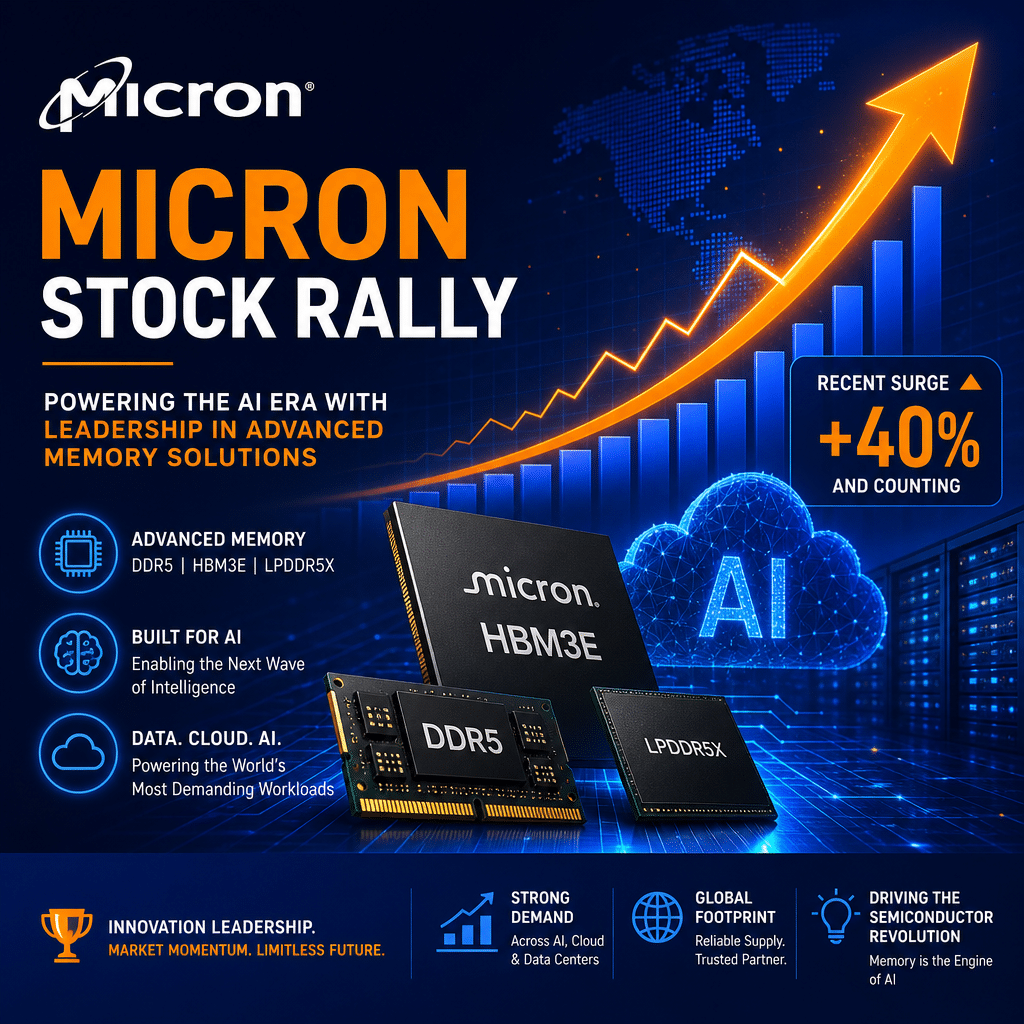
Micron Technology’s Four-Day Rally: What’s Behind the Surge?
Micron Technology (MU), one of the world’s preeminent memory chip manufacturers, has captured Wall Street’s attention with a powerful resurgence in its stock price. Closing at $970.20 on Friday — up 2.3% for the day and marking its fourth consecutive session of gains — Micron has taken center stage as a leading beneficiary of rising memory demand and positive sentiment across the semiconductor sector. In this article, we explore the drivers behind the latest rally, analyze the company’s blockbuster financial results, and assess the outlook based on Wall Street’s consensus and recent analyst upgrades.
The Recent Run-Up: Micron’s Stock Performance and Market Context
Over the past month, Micron Technology stock has advanced by 12%, although it still trades below the heights reached in late June, when shares briefly soared over $1,200. Currently, the stock sits at a market capitalization of approximately $1.10 trillion, reflecting investors’ bullishness on its growth prospects and the broader revival in the memory market.
Friday’s strong open at $971.66 and close at $970.20 capped off a streak of gains that have outpaced the tech-heavy NASDAQ index. The 52-week trading range is significant, from a low of $113.46 to a high water mark of $1,255.00, underscoring the extraordinary shift in sentiment toward the sector. Additional momentum has come as institutional investors and rivals, such as SK Hynix, have also seen rising share prices after a favorable long-term outlook from SanDisk injected further optimism into the memory chip space.
Memory Price Dynamics: The Heart of the Bullish Thesis
At the crux of Micron’s resurgence is the outlook for memory pricing — especially DRAM (dynamic random-access memory) and NAND flash, which are essential components for data storage in everything from smartphones to data centers and AI infrastructure. According to KeyBanc, a leading financial research firm, DRAM prices are projected to get a lift of 15% to 20% in the third quarter compared to the second quarter. Even more impressively, NAND flash prices are forecasted to surge 30% to 40% in Q3, signaling a sharp recovery from the cyclical downturn that battered the industry in recent years. KeyBanc expects another 15% gain in DRAM and NAND prices in the fourth quarter, illustrating the depth and persistence of this uptrend.
These robust price increases are being driven by tight supply, renewed demand for AI-enabled applications, and a resurgence in consumer and enterprise workstation spending. The positive pricing environment is especially beneficial for Micron, which historically has seen earnings rise dramatically during such upcycles.
Earnings Beat: Blockbuster Third Quarter Results
The fuel behind much of Wall Street’s renewed confidence was Micron’s spectacular recently announced third quarter (Q3) results. On June 24, the company reported earnings per share (EPS) of $25.11, significantly outpacing the consensus estimate of $21.39. This $3.72 beat underscored not only superior execution but also validated the bullish projections for memory pricing.
Revenue came in at $41.46 billion, far eclipsing expectations of $35.91 billion — a colossal 346% increase year over year. Beyond headline numbers, Micron posted a return on equity of 71.13% and a net profit margin of 55.91%, both exceptionally strong figures. Looking forward, Micron guided for Q4 2026 EPS in the range of $30 to $32, suggesting continued operational strength and a favorable pricing backdrop well into next year.
Wall Street Upgrades: Bullish Analyst Forecasts and Price Targets
Reflecting the company’s financial momentum and the industry’s positive trajectory, a cascade of analysts have raised their price targets for Micron stock in recent weeks.
- UBS: Analyst Timothy Arcuri set a bold price target of $1,625, employing a forward price/earnings multiple of 11 times his 2029 EPS forecast — a methodology that underlines confidence in Micron’s through-cycle earnings power, especially as long-term supply agreements bring greater revenue predictability.
- Wells Fargo: The firm lifted its target from $1,220 to $1,525 and reiterated an “overweight” rating, citing improved visibility and durable demand trends in memory markets.
- Raymond James and Cantor Fitzgerald: Both have set price targets at $1,500 with “outperform” and “overweight” ratings, respectively, reflecting conviction in Micron’s ability to capitalize on AI-driven demand.
- New Street: The firm upgraded its rating to “Buy” from “Neutral,” projecting an average price target of $1,250 and emphasizing the decreasing cyclicality of memory demand thanks to AI. New Street went even further, positing that Micron could see its valuation soar to $2–$3 trillion by the end of the decade.
The current analyst consensus among 38 tracked by leading financial institutions is a resounding “Buy,” with an average price target of $1,259.97. The breakdown from these analysts is overwhelmingly positive: four rate the stock as a “Strong Buy,” 32 give it a “Buy” rating, and two recommend “Hold.”
Strategic AI Initiatives and Institutional Moves
Further igniting optimism, Micron announced the launch of the $250 million “Micron Ventures Paradigm Fund.” This new initiative is set to catalyze innovation across the AI technology stack, focusing on investments spanning model development, computing infrastructure, and enterprise software applications. These investments not only cement Micron’s pivotal role in the AI revolution, but also position it to benefit from the virtuous cycle of rising compute and storage needs driven by advanced machine learning, big data, and cloud adoption.


Institutional investors have shown their support through substantial increases in holdings. For instance, Accurate Wealth Management nearly doubled its position in Micron during the second quarter, amassing 7,452 shares valued at about $8.6 million — a 98% increase. As a testament to the stock’s stability and widespread appeal, institutional investors now own 80.84% of the total float, providing a bedrock of confidence for retail holders.
Risks and Headwinds: Market Share Battles and Insider Actions
While the backdrop is overwhelmingly positive, certain risks loom. Notably, Chinese competitor YMTC has overtaken Micron in NAND shipments, raising concerns about long-term competitive pressure in critical markets. Additionally, Micron’s much-anticipated new fabrication facility—a $9.3 billion investment—is not scheduled to become operational until 2028, leaving a multi-year window where capacity constraints or technological shifts could threaten market share.
On the investor front, well-known contrarian Michael Burry has increased bearish bets tied to Micron, signaling that not all institutional voices are in harmony about the stock’s near-term direction.
Of further note is the wave of insider selling. CEO Sanjay Mehrotra sold 31,285 shares on July 24 at an average price of $926.83, reducing his stake by 9.08%. In total, insiders have unloaded 162,179 shares worth just under $168 million over the past three months. While insider selling is not always a predictive indicator of long-term fundamentals (as executives often offload shares for personal reasons), it does warrant careful scrutiny by investors, especially in the face of rapidly rising share prices.
Technical analysis highlights resistance at approximately $1,012, a near-term price level closely watched by traders. A sustained breakout above this could trigger fresh momentum; conversely, failure to breach this ceiling could prompt a consolidation or modest pullback.
Micron’s Outlook: Positioned for Long-Term Growth
Despite the risks and near-term volatility, Micron Technology appears exceptionally well-positioned to benefit from secular tailwinds in AI, cloud computing, data storage, and high-performance computing. Rising memory prices, booming demand for DRAM and NAND across consumer and enterprise markets, and strategic investments in the AI economy suggest robust revenue and profit growth for years to come.
Wall Street’s rising price targets, astounding year-over-year growth, and strong institutional support underscore widespread conviction. While competition, insider selling, and execution risks should remain on the radar, the prevailing narrative is that Micron is no longer merely a cyclical play. Instead, it looks poised to become a foundational pillar of a data-driven economy — with the potential to elevate its market capitalization into the $2–$3 trillion range by the decade’s end.
Investors should continue to monitor industry dynamics, analyst commentary, and the stock’s technical levels, but even with inevitable oscillations, Micron Technology stands tall as a flagship name in the ongoing semiconductor and AI revolution.