


Cryptocurrency predictions are only useful when they help you make better decisions. If a forecast sounds certain, it is usually selling confidence rather than offering analysis.
A better approach is to split the market into two lenses. In the short term, crypto prices react to momentum, liquidity, sentiment, and headlines. Over longer periods, adoption, regulation, infrastructure, and macro conditions matter more. Put those together and you get something practical: a way to frame risk instead of guessing.
If you want the broader basics first, start with our crypto trading guide. If you already trade actively and want live market coverage, AltSignals trading signals can be a useful next step.
What cryptocurrency predictions actually mean
Crypto predictions are probability-based views on where price may go next. They are built from evidence such as chart structure, volume, volatility, sentiment, on-chain activity, macro conditions, and project-specific developments.
That matters because many traders use the word prediction too loosely. A serious forecast is not “Bitcoin will definitely rally next week.” It is closer to: “If BTC reclaims resistance with rising volume and risk appetite stays firm, continuation becomes more likely. If it loses support, the bullish case weakens.”
That may sound less exciting, but it is far more useful in real trading.
Short-term predictions usually focus on days or weeks. Long-term predictions look at whether an asset or sector is becoming more relevant over months and years. Both have value, but they answer different questions:
- Short term: what is the market likely to do next?
- Long term: what is still worth paying attention to if the market matures further?
The best forecasts improve entries, exits, invalidation levels, and position sizing. They should never replace risk management.
How crypto prices are usually predicted

Most reliable crypto forecasting combines several methods rather than leaning on one magic indicator.
1. Technical analysis
This is the short-term workhorse. Traders study trend direction, support and resistance, moving averages, RSI, MACD, and volume to judge whether momentum is strengthening or fading.
Technical analysis works best when it is used for scenarios, not certainty. A breakout above resistance on strong participation means more than a random candle spike in thin liquidity.
For traders who want more live chart context rather than static theory, regular market breakdowns and technical commentary can help confirm whether a forecast still matches current structure.
2. Fundamental analysis
For longer-term cryptocurrency predictions, fundamentals matter more. Traders and investors look at network utility, developer activity, ecosystem growth, token design, user adoption, and whether a project solves a real problem.
This is especially important in crypto because plenty of assets can trend hard for a while without building anything durable underneath.
3. Sentiment analysis
Crypto is highly reactive to mood. Social media, ETF headlines, exchange news, legal developments, and macro narratives can all move prices quickly.
Sentiment is useful, but only when paired with confirmation. Hype without volume often fades fast. Panic that fails to break support can be a sign the market is stronger than it looks.
In practice, sentiment analysis usually means tracking how traders are reacting across news flow, social channels, and market participation. It can help explain why a move is accelerating, but it should not be treated as proof on its own.
4. Macro and policy analysis
Crypto does not trade in a vacuum. Interest rates, inflation expectations, dollar strength, liquidity conditions, and broader risk appetite all influence capital flows into digital assets.
Regulation matters too. Guidance from bodies such as the U.S. Securities and Exchange Commission and market frameworks in major jurisdictions can shift sentiment, access, and institutional participation.
That is why regulatory changes can cut both ways. In the short term, they often create volatility and headline-driven repricing. Over longer periods, clearer rules can improve market confidence, access, and institutional involvement.
5. Quant and model-based forecasting
Some analysts use machine learning, statistical models, or ensemble forecasting methods to estimate future price behaviour. Research in this area has grown, but the practical takeaway is simple: models can help identify patterns, yet they still struggle when the market is hit by sudden news, liquidity shocks, or regime changes.
That is why even sophisticated forecasting should be treated as one input, not a crystal ball.
Factors that influence cryptocurrency predictions
No single variable drives crypto. Good forecasts usually weigh several forces at once.
- Trend and market structure: Is price trending, ranging, or breaking out of consolidation?
- Volume and liquidity: Strong moves with healthy participation tend to be more reliable than thin, erratic spikes.
- News flow: Regulation, exchange developments, security incidents, and institutional announcements can all trigger fast repricing.
- Technology and ecosystem growth: Upgrades, scaling improvements, and developer traction can shape medium and long-term expectations.
- Macro conditions: Crypto often responds to changes in rates, inflation expectations, and overall appetite for risk assets.
- Relative strength: Some assets hold up better than others during weak market conditions. That often tells you where attention is building.
Two factors deserve a closer look because they often get oversimplified: sentiment and blockchain development. Sentiment can move price faster than fundamentals in the short term, especially when traders are reacting to ETF headlines, exchange news, or sudden shifts in risk appetite. Blockchain development matters more over time. Improvements such as scaling upgrades, interoperability, and lower transaction costs can strengthen the case for a network, but they still need real usage to matter.
If you want a closer breakdown of these drivers, see Key Factors Influencing Cryptocurrency Prices and Emerging Trends in Cryptocurrency Market Analysis.
Short-term crypto predictions: what matters most this week
When people search for crypto predictions, many of them really mean one thing: what could happen next in the market?
For short-term trading, the most useful inputs are usually:
- Price structure: trend continuation, range breakdowns, failed breakouts, and reclaim levels
- Momentum: whether indicators and price action agree
- Volume: whether buyers or sellers are actually showing up
- Catalysts: macro releases, ETF-related developments, exchange news, legal updates, or token-specific events
- Bitcoin leadership: BTC still sets the tone for much of the market
A practical example: if Bitcoin breaks above a major resistance zone with rising volume and altcoins begin outperforming on the same day, that supports a bullish short-term view. If BTC loses support after a hawkish macro surprise, traders often expect broader weakness and reduce exposure.
Short-term predictions are most useful when they lead to a clear plan. That usually means defining the trigger, the invalidation level, and the amount of risk you are willing to take before the trade is live.
The key is to build scenarios before the move, not after it. That keeps you from chasing candles and calling it analysis.
Key cryptocurrencies to watch in the short term
Short-term forecasts are usually strongest when they focus on liquid, widely followed assets rather than every coin on the homepage of an exchange.
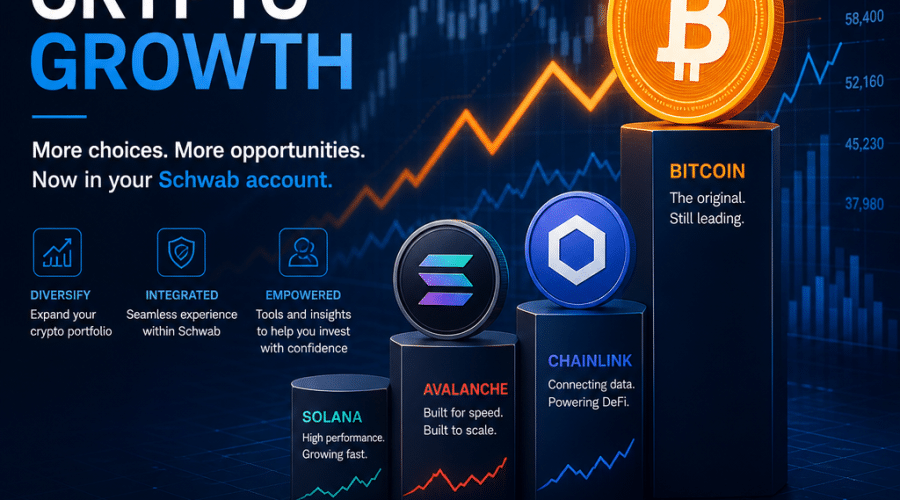
- Bitcoin (BTC): still the main market bellwether. Major support and resistance levels here often shape the rest of the market.
- Ethereum (ETH): central to smart contracts, DeFi, and broader ecosystem activity. It often reacts to shifts in on-chain usage and sector rotation.
- Solana (SOL): tends to attract attention when traders rotate into higher-beta ecosystems with strong momentum.
- XRP: remains highly sensitive to legal and regulatory developments.
- Cardano (ADA): often comes back into focus during broader altcoin rotation or development-driven narratives.
These are not automatic trade ideas. They are simply the assets most traders watch because they combine liquidity, visibility, and identifiable catalysts.
Long-term cryptocurrency predictions: what matters over years
Long-term cryptocurrency predictions are less about exact price targets and more about whether an asset, network, or sector is becoming more useful, more accessible, and more durable.
The strongest long-term frameworks usually look at:


- Adoption: are users, developers, and institutions actually participating?
- Utility: does the network support meaningful activity?
- Regulatory clarity: is the legal environment becoming easier to navigate?
- Infrastructure: are custody, payments, scaling, and interoperability improving?
- Capital flows: is the market attracting deeper and more stable participation?
This is why long-term investors often focus on Bitcoin’s role as a macro-sensitive digital asset, Ethereum’s position in smart contracts, and whether newer ecosystems can sustain real usage rather than just attention.
Long-term forecasting also helps with portfolio construction. Instead of trying to predict every swing, investors can use broader market views to decide which assets deserve a place on the watchlist, which ones justify gradual accumulation, and which narratives still look too fragile.
Another useful filter is to separate durable development from temporary excitement. A network can attract attention for weeks on narrative alone, but long-term strength usually depends on adoption, developer activity, infrastructure quality, and whether the ecosystem keeps growing after speculation cools.
If your focus is the bigger picture, continue with Long-Term Cryptocurrency Predictions: Planning for the Future.
Crypto predictions for 2026 and beyond
By 2026, the conversation has moved beyond simple “will crypto survive?” debates. The more useful question is which parts of the market are becoming more credible as the industry matures.
Looking ahead, a few themes still matter most:
- Institutional participation: deeper involvement can improve liquidity, market structure, and legitimacy, though it does not remove volatility.
- Regulatory progress: clearer rules can reduce uncertainty, while fragmented or restrictive policy can still weigh on sentiment.
- Better infrastructure: improvements in custody, settlement, scaling, and user experience make adoption easier.
- Project separation: stronger networks may keep attracting capital, while weaker tokens struggle once speculation cools.
- Macro sensitivity: crypto remains influenced by global liquidity and risk appetite, even when sector-specific narratives are strong.
Some themes that were widely discussed as 2025 predictions now work better as ongoing market filters. DeFi remains relevant where it delivers real utility, AI-assisted trading tools continue to improve market monitoring, and energy-efficient networks still attract attention where sustainability and operating costs matter. None of these themes guarantees performance, but they do help explain where capital and attention may keep concentrating.
That is a healthier way to think about forecasts than chasing dramatic price targets. Conditions matter more than bold numbers.
Short-term vs long-term predictions
Short-term and long-term predictions are not competing ideas. They solve different problems.
- Short-term predictions help with timing, entries, exits, and trade management.
- Long-term predictions help with positioning, watchlists, and deciding what deserves attention over time.
Short-term forecasting gives faster feedback, but it also comes with more noise and emotional pressure. Long-term forecasting reduces some of that noise, but it requires patience and tolerance for drawdowns.
Many traders combine both. They use long-term analysis to decide what is worth tracking, then use short-term analysis to decide when to act.
That blend is often more realistic than choosing one side. A trader might stay constructive on a major asset over the next year while still avoiding a poor entry this week if momentum and liquidity do not support it.
Pros and cons of relying on crypto predictions
Predictions can improve decision-making, but only when they are treated as probability tools.
Pros
- They help structure decisions around evidence instead of emotion.
- They make it easier to plan scenarios before volatility hits.
- They support risk management by defining invalidation levels and likely catalysts.
- They narrow your focus to the assets and setups that matter most.
Cons
- No model or analyst is consistently right in every market regime.
- Overconfidence can lead to oversized positions and poor discipline.
- Short-term forecasts can fail quickly when liquidity disappears or news hits.
- Long-term narratives can stay popular long after the underlying thesis weakens.
The safest mindset is simple: use predictions to prepare, not to assume.
Tools that can help with crypto predictions
The quality of your forecast depends heavily on the quality of your inputs.
- TradingView: useful for charting, indicators, and scenario planning.
- CryptoCompare: useful for comparing assets and market data.
- Major exchanges: useful for monitoring live liquidity, funding conditions, and price behaviour.
- Event calendars: useful for tracking token unlocks, network upgrades, macro releases, and other catalysts that can shift short-term expectations.
- AltAlgo indicator: useful if you want structured buy and sell signals alongside chart analysis.
For active traders, alerts, indicators, and signal services can reduce reaction time. They work best when paired with a process: identify trend, mark key levels, confirm with volume or momentum, then define risk before entering.
If you want to see how AltSignals presents past performance, you can review the trading results page.
How to use predictions without getting trapped by them
A forecast becomes useful when it is tied to a plan.
Instead of asking, “Will crypto go up?” ask:
- What would confirm strength?
- What would invalidate the setup?
- How much risk makes sense if I am wrong?
- Is this move supported by volume, liquidity, and context?
That keeps analysis grounded. A bullish view on Bitcoin means little if price cannot hold the level that is supposed to confirm it. A bearish view is weak if the market absorbs bad news and refuses to break down.
It also helps to review how similar setups behaved recently. If bullish headlines keep failing to produce follow-through, demand may be weaker than it looks. If a coin keeps holding support despite negative news, that resilience matters.
Signals and indicators can help, but they should confirm a plan rather than replace one. Position sizing, stop placement, and discipline still do the heavy lifting.
Final thoughts
Good cryptocurrency predictions do not remove uncertainty. They help you handle it better.
Short-term forecasts are useful for timing trades around momentum, volatility, and news. Long-term forecasts are useful for understanding where the market may still be heading as adoption, regulation, and infrastructure evolve.
The edge comes from staying flexible, using reliable inputs, and avoiding the temptation to treat any forecast as guaranteed. If you want help turning analysis into tradeable setups, AltSignals offers live signals and tools built for active traders without pretending risk disappears.
FAQ
How accurate are cryptocurrency predictions?
What is the best way to predict crypto prices?
Usually by combining methods. Technical analysis helps with timing, while fundamentals, sentiment, and macro context help explain why a move may continue or fail.
Are short-term crypto predictions better than long-term ones?
Not better, just different. Short-term predictions help with entries and exits. Long-term predictions help you decide which assets and themes are worth following over time.
Can AI predict cryptocurrency prices?
AI can help analyse patterns, scan markets, and surface setups faster than manual monitoring alone. It still cannot reliably predict every move, especially when markets react to unexpected news or sudden liquidity shifts.
How should investors use cryptocurrency predictions in a portfolio strategy?
Use predictions as a planning tool, not a promise. Short-term forecasts can help with timing and risk control, while long-term forecasts can help decide which assets are worth tracking, accumulating gradually, or avoiding altogether.
What factors influence cryptocurrency predictions the most?
Usually a mix of market structure, volume, sentiment, regulation, macro conditions, and project-level development. The weight of each factor changes depending on whether you are trading a short-term move or assessing a longer-term thesis.










They are never perfectly accurate. The best predictions improve probabilities by combining technical, fundamental, sentiment, and macro analysis. They should guide planning, not create certainty.