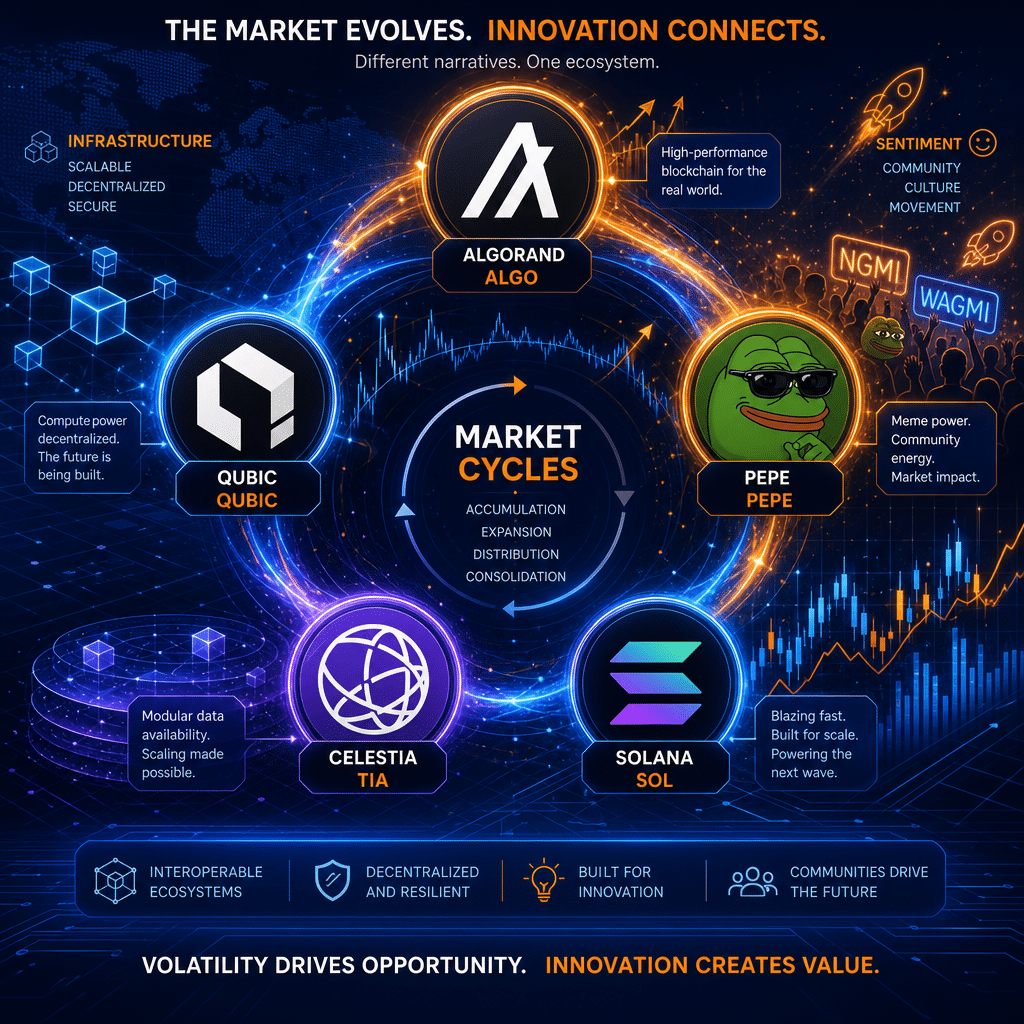
The cryptocurrency market is poised for heightened volatility over the coming six months as global liquidity conditions evolve and attention shifts toward key mid-cap and large-cap tokens. Major assets at the center of this discussion include Algorand (ALGO), Pepe (PEPE), Qubic (QUBIC), Celestia (TIA), and Solana (SOL). These tokens are not simply experiencing speculative surges but are demonstrating pronounced structural price reactions tied to broader infrastructure and development trends. Understanding the unique factors driving each of these assets is crucial for traders, investors, and observers as the industry braces for its next market cycle.
Crypto Market Dynamics and Outlook
Cryptocurrency cycles have historically exhibited familiar patterns—consolidation phases followed by periods of expansion fueled by new capital and user adoption. However, analysts caution that historical resemblance does not guarantee future outcomes. The results in forthcoming cycles will depend heavily on the broader macroeconomic environment, liquidity flows, and regulatory shifts.
One key metric being closely monitored is Bitcoin dominance, which serves as a bellwether for potential altcoin rotations. As Bitcoin’s share of total market capitalization ebbs and flows, capital may increasingly rotate into select altcoins, fueling new waves of demand. Yet, it is not just intra-market forces at play. The larger macroeconomic backdrop—including interest rates, inflation expectations, and institutional capital allocation—may have a significant impact on crypto asset demand, potentially shaping industry trends through 2026 and beyond.
Algorand (ALGO): Infrastructure-Focused Blockchain
Algorand has long positioned itself as a leading layer-1 blockchain focused on scalability, efficiency, and robust transaction throughput. Rather than being driven solely by speculative fervor, Algorand’s market activity is increasingly influenced by the adoption of its fundamental infrastructure—especially in the enterprise and institutional sectors.
Industry commentary highlights a consistent pace of development within Algorand’s ecosystem. Ongoing enhancements to the protocol are aimed at improving network performance, expanding utility, and enabling more ambitious use cases. Unlike meme coins and highly speculative tokens, Algorand’s price dynamics are more likely to mirror the broader altcoin market cycles, responding to waves of innovation and institutional interest rather than a single trigger or rapid hype.
Developers remain focused on integrating new functionalities, fostering greater interoperability, and attracting developers to build on the network. Still, Algorand faces structural challenges from other competitive layer-1 blockchains, including both established players and newer entrants innovating in scalability, speed, and cost efficiency.
Pepe (PEPE): Volatility Fueled by Meme Sector Sentiment
Pepe stands out within the crypto landscape as a clear reflection of retail sentiment and social momentum. Dubbed by some as the “meme king,” PEPE operates less on fundamental utility and more as a vessel for speculative trading, trend-following, and online culture.
The performance of Pepe and similar meme tokens is acutely sensitive to changes in overall crypto market liquidity and the appetite for risk within digital asset communities. During periods of heightened optimism, Pepe is a favored token among retail traders seeking swift gains. Conversely, when sentiment sours and liquidity tightens, the sector—led by meme coins—often experiences sharper and more unpredictable declines than infrastructure-driven assets.
Despite this, the meme coin genre maintains a significant role in broadening retail participation and driving narratives that attract new users to crypto. The unpredictable price swings and viral surges capture the imagination of many, reinforcing the cyclical nature of speculative interest. Yet, prospective investors should recognize the inherent volatility and be mindful of rapid sentiment shifts that characterize meme-based assets.
Qubic (QUBIC): Early-Stage Experimental Blockchain Concepts
Qubic presents a less familiar—but increasingly discussed—alternative in the crypto space, focusing on decentralized computing and experimental network frameworks. Rooted in computational design and distributed system architectures, Qubic is emblematic of projects at the frontier of blockchain technology that seek to redefine how computation and consensus are achieved on-chain.
Unlike established layer-1 networks with considerable visibility and adoption, Qubic remains an early-stage, high-uncertainty endeavor. Its ecosystem and user base are still developing, and its tokens exhibit limited liquidity—resulting in greater price volatility and sensitivity to even modest market movements.
Market analysts see early-stage infrastructure projects like Qubic as potentially offering outsized rewards due to their exposure to groundbreaking technical innovation. However, they also emphasize that such projects carry correspondingly higher risks. The ultimate trajectory for Qubic will depend on the continued execution of development milestones, progress in expanding its community, and the capacity to attract usage outside a narrow set of early adopters.


Celestia (TIA): Modular Blockchain for Scalable Infrastructure
Celestia has carved out a distinct technological identity by advancing the concept of modular blockchain architecture. Its approach separates data availability layers from transaction execution, directly addressing inherent congestion and scaling issues that have affected monolithic networks such as Ethereum and early-generation blockchains.
This architectural innovation has become a central topic in blockchain research circles, with proponents arguing it enables far greater efficiency and scalability for future decentralized applications. By focusing on modularity, Celestia allows networks and developers to build specialized chains—often known as rollups—on top of its data availability layer, unlocking new potential for ecosystem growth and interoperability.
Market participants are closely watching ongoing integrations of Celestia’s protocol with rollup technologies, developer engagement, and ecosystem expansion. Price action for the TIA token tends to align with innovation-driven market cycles, reflecting broader interest in disruptive infrastructure strategies. Success for Celestia will hinge on achieving widespread adoption among developers, effective integrations, and maintaining a stable and secure base layer for decentralized application growth.
Solana (SOL): High-Throughput Ecosystem Expansion
Solana has established itself as a premier high-performance layer-1 network, well-regarded for its exceptional transaction throughput and minimal transaction costs. The network’s technical advantages have translated into rapid ecosystem growth, spanning decentralized finance (DeFi), non-fungible tokens (NFTs), and blockchain gaming.
Solana’s strong developer community and continual application launches reinforce its relevance as a network of choice for developers seeking scalability and low friction for users. User demand cycles often coincide with surges in network activity, boosting interest in the SOL token both from retail and institutional investors.
As with other major layer-1 protocols, Solana’s price tends to be highly correlated with the general ebb and flow of the crypto macro cycle. Periods of aggressive expansion see institutional and retail interest peak, resulting in higher trading volumes and broader engagement throughout the Solana ecosystem. That said, network reliability and stability remain critical considerations amid past performance and outages, with market analysts emphasizing these points as ongoing risks and opportunities for improvement.
Broader Market Context and Risk Management
The current and prospective performance of highlighted assets—whether infrastructure-driven blockchains or meme-based tokens—are largely contingent on macroeconomic conditions, liquidity availability, and the evolution of regulatory frameworks. As diverse as these projects are in fundamentals, their correlation with global risk appetite and capital flows remains strong.
Each asset and project brings distinct value propositions and risk profiles to the broader crypto landscape. Infrastructure networks like Algorand, Celestia, and Solana derive their strength from ongoing developer engagement, scalability, and meaningful use cases, often responding to industry-wide innovation cycles. By contrast, assets like Pepe are shaped by sentiment, community engagement, and the viral nature of online culture, leading to explosive runs and equally rapid corrections.
There is no consistently outperforming asset class across all market cycles, reinforcing the importance of diversification and ongoing risk assessment. Informed investors and traders are encouraged to avoid the pitfalls of over-concentration, maintain a broad outlook on structural and narrative shifts, and remain adaptable to the rapidly changing crypto market.
As the next phase of industry growth unfolds, monitoring both dominant and emerging projects will be key to understanding where value, innovation, and adoption will concentrate. While uncertainty and volatility are an inevitable part of the landscape, so too are the opportunities for those who can navigate the structural trends shaping the future of decentralized technology.