Signal apps can sharpen your process — if you use them properly
A good signal app can save time, surface setups you might have missed, and bring more structure to your trading routine. A bad habit with signal apps does the opposite: it turns trading into blind copying.
The difference is not the app. It is how you use it.
If you treat signals as prompts to investigate, they can improve speed and consistency. If you treat them as guaranteed trade instructions, they usually expose weak risk management, poor discipline, and overconfidence very quickly.
This guide shows how to integrate signal apps into your trading strategy without letting them replace your own judgement.
What signal apps actually do
Signal apps scan markets for potential setups based on predefined rules, technical indicators, price structure, momentum, or model-driven analysis. Depending on the provider, a signal may include:
- the market or asset
- an entry zone
- a stop-loss level
- one or more take-profit targets
- a short explanation of the setup
That can be useful in fast markets like crypto and forex, where opportunities can appear and disappear quickly. But a signal is still just an input. It does not know your account size, your open exposure, your tolerance for drawdown, or whether major news is about to hit the market.
If your focus is digital assets, it helps to place signals inside a broader crypto trading guide rather than building your whole approach around alerts alone.
How to choose a signal app that fits your strategy
Most traders look at claimed accuracy first. Fair enough. But accuracy on its own is not enough to judge whether a signal app is usable in real trading conditions.
Look for a provider that gives you:
- Clear trade structure: entry, stop, targets, and invalidation should be easy to understand.
- Market fit: the app should cover the assets and timeframes you actually trade.
- Delivery speed: alerts need to arrive quickly enough to act on them.
- Transparency: avoid vague claims with no examples, no logic, and no reviewable history.
- Context: the best signals help you understand why the setup exists, not just where to click.
That last point matters more than many traders realise. If a signal app gives no reasoning at all, it is harder to learn from wins, losses, and skipped trades.
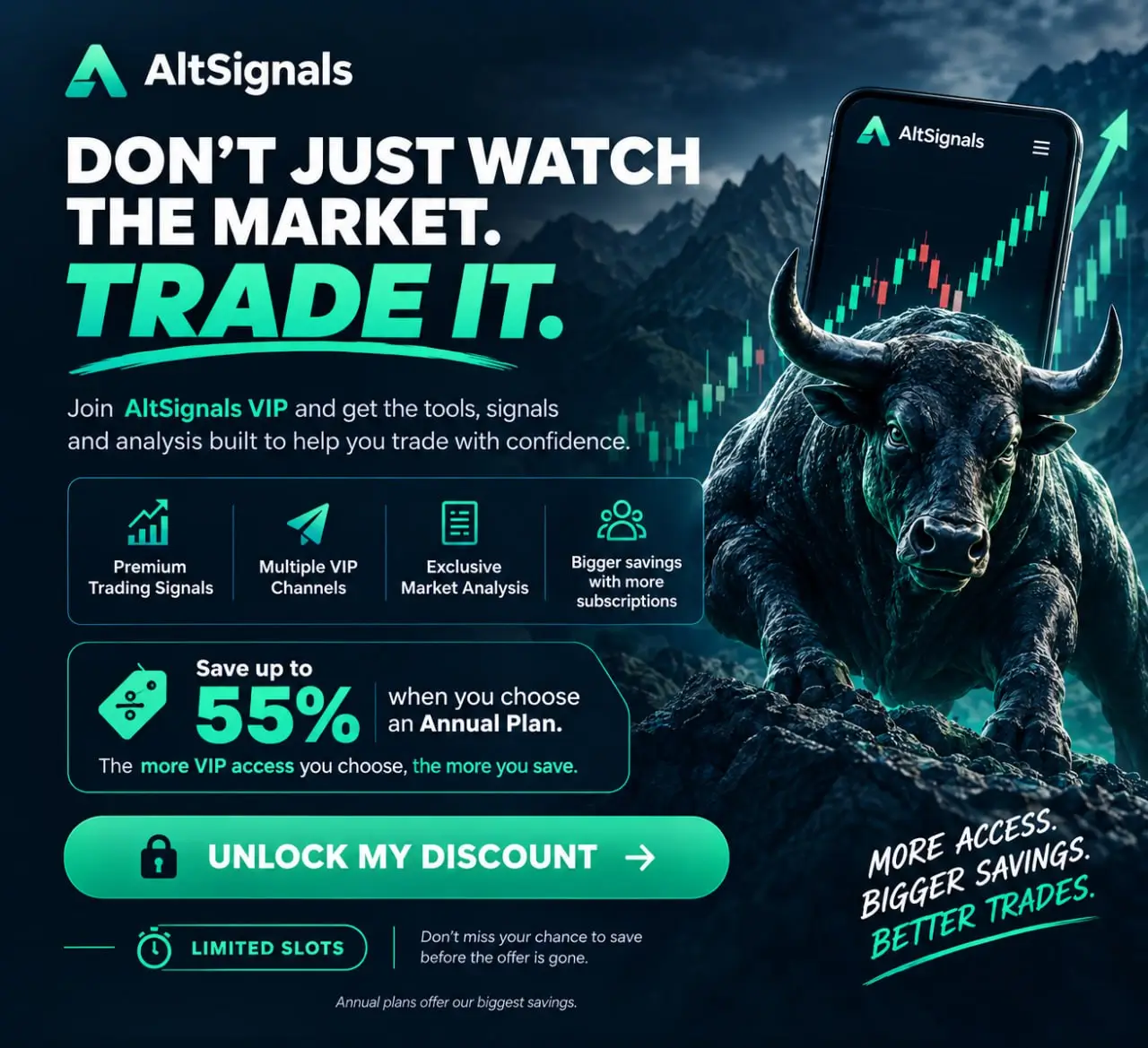
AltSignals trading signals follow that structured approach, so traders can review setups within their own rules instead of treating alerts like autopilot.
Build a simple signal filter before you place any trade
The easiest way to misuse signal apps is to take every alert that lands on your phone. A better approach is to create a short checklist that every signal must pass before you act on it.
Your filter can be simple:
- Does the signal match the market you trade?
- Does it fit your preferred timeframe?
- Is the setup aligned with the broader trend or market bias?
- Is the stop-loss distance reasonable for your account size?
- Are you already exposed to similar correlated positions?
- Is there major economic or crypto-specific news due soon?
If a signal fails two or three of those checks, skipping it is usually the smarter trade.
This is where many traders improve quickly. They stop asking, “Is this signal good?” and start asking, “Is this signal good for my plan?”
How to integrate signals into your trading routine
Signal apps work best as one layer of a repeatable process. That process does not need to be complicated.
A practical workflow looks like this:
- Receive the alert.
- Check the chart yourself.
- Confirm the setup still makes sense at the current price.
- Calculate position size based on your risk rules.
- Place the trade only if the reward-to-risk profile is still acceptable.
- Manage the trade according to your plan, not your mood.
This matters because even a technically solid signal can still be the wrong trade for you. Maybe the stop is too wide. Maybe the market is reacting to fresh news. Maybe you already have two positions open that rise and fall with the same theme.


Signals should speed up decision-making, not remove decision-making.
Use signals to improve analysis, not replace it
The strongest traders use signal apps as feedback loops. They do not just track whether a trade won or lost. They review why the setup worked, why it failed, and whether they executed it properly.
After each signal, ask:
- Was the setup aligned with the broader trend?
- Did volatility change after the alert was issued?
- Was the stop-loss realistic for that market?
- Did news or liquidity conditions weaken the setup?
- Would you have taken the trade without the signal?
That last question is especially useful. If the answer is always “no idea,” the app may be doing too much of the thinking for you.
For traders who want a more hands-on layer of confirmation, the AltAlgo indicator can help you compare app-based alerts with your own chart analysis.
Avoid the most common signal app mistakes
Most problems with signal apps are not technical. They are behavioural.
Common mistakes include:
- Taking every signal: more trades does not automatically mean better results.
- Ignoring position sizing: even a strong setup can damage an account if the risk is too large.
- Chasing late entries: if price has already moved too far, the original setup may no longer exist.
- Doubling down after losses: signal services still go through losing streaks.
- Skipping your own review: if you never study outcomes, you never improve.
A signal app should make you more organised, not more impulsive.
Risk management still matters more than the signal
No signal app removes market risk. Your results still depend on execution, slippage, position sizing, discipline, and the conditions around the trade.
Basic risk controls still do most of the heavy lifting:
- risk only a small portion of capital per trade
- use stop-loss levels consistently
- avoid stacking too many similar positions
- judge performance over a meaningful sample, not three trades
- treat historical results as context, not a promise
That last point is worth underlining. Past performance is not a reliable guarantee of future results, and traders should treat published results as context rather than a promise. If you want to review provider performance, use it as one input alongside your own execution records and risk controls.
For transparency, traders can compare published trading results with how those setups would have fit their own account rules.
Keep adapting as market conditions change
Signal apps are not static edges. Markets trend, chop, squeeze, and react to news differently over time. A setup that works well in clean momentum conditions may struggle badly in low-conviction ranges.
That is why review matters. Keep notes on:
- which markets respond best to signals
- which timeframes suit your style
- which setups you execute well
- which conditions lead to poor follow-through
Over time, this turns the app from a dependency into a tool. That is the real goal.
Final take
Integrating signal apps into your trading strategy makes sense when they improve speed, structure, and consistency. They are most useful when they help you filter opportunities, not when they become a substitute for analysis.
Use signals with clear rules, sensible risk limits, and regular trade reviews. Do that, and they can become a practical part of your workflow. Skip those basics, and even the best app will not save you from bad habits.