“`html
Institutional Bitcoin Investors Hold Firm Despite Market Fluctuations as Technical Signals Cause Confusion
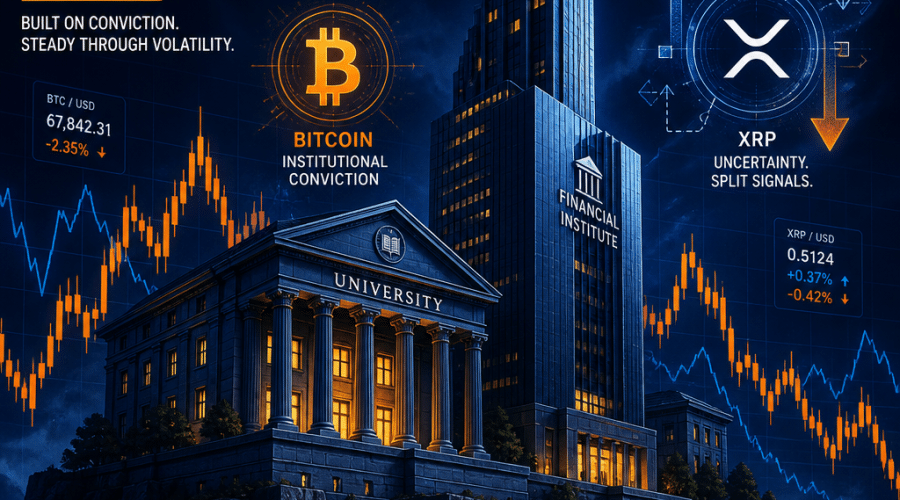
The world of cryptocurrency never sleeps, and the latest market data shows a clear separation between the behavior of institutional investors and the shifting indicators often favored by retail traders. As significant players like Harvard’s endowment and Morgan Stanley remain steadfast or even increase their Bitcoin exposure despite notable fluctuations in price, retail-focused technical analyses point to an unusually complex and divided outlook—particularly for major altcoins such as XRP.
Institutional Bitcoin Exposure Remains Steady Through Market Ups and Downs
Recent regulatory filings have revealed that Harvard University’s endowment fund has maintained its position in the BlackRock Bitcoin ETF throughout the second quarter. This comes after a significant 43% reduction in their holdings during the prior quarter, a move that clearly indicated a strategic shift. The decision to hold steady this time, rather than follow up with further reduction or re-expansion, should be interpreted as a deliberate choice based on longer-term strategy, not as a passive or default stance.
This holding pattern stands in contrast to the day-to-day volatility that characterizes much of the cryptocurrency market. Regulatory disclosures like these provide insights deeper than those gleaned from anonymous flow reports or informal sources, granting a stronger basis for interpreting institutional intent. Especially notable is that, despite Bitcoin’s recent price decline, Harvard showed no signs of panic-selling or opportunistic buying, demonstrating faith in the overall thesis behind their investment strategy.
Echoing this sentiment, fresh data from Morgan Stanley’s Bitcoin ETF highlighted the entrance of a significant $371 million in new contributions, even as Bitcoin’s price experienced a sharp drawdown erasing $66.8 million in portfolio value during the reporting period. The two data points, when viewed in concert, signal that leading financial institutions and endowments are not adjusting their strategies based primarily on short-term price action. Instead, they’re demonstrating conviction in their allocations—continuing to hold or even grow their cryptocurrency positions despite market headwinds.
What Institutional Activity Tells Us About the Current Market Environment
This activity from institutional investors serves as a crucial indicator for the broader market. Unlike retail traders, who may chase trends or attempt to time short-term price swings, major funds and financial powerhouses operate with different mandates. Their decisions frequently rest upon longer-term analyses and macroeconomic outlooks, rather than the minute-to-minute signals tracked by many individual traders.
The recent filings and flow data tell a clear story: price fluctuations, even those significant enough to cause alarm in public markets, are not currently strong enough to provoke dramatic shifts in institutional positioning. If Harvard, one of the world’s most closely watched and sophisticated investors, can ride out a multi-million-dollar decline without altering its strategy, it’s a signal worth noting for everyone from hedge fund managers to everyday crypto enthusiasts.
XRP: Technical Signals Pull Traders in Opposing Directions
While institutional flows provide some clarity, the retail trading space has been thrown into confusion by the latest technical analyses on XRP. Reports from three independent analysts and publications converge on an unusual consensus: the data is mixed, and no clear direction is emerging.
XRP’s current price is trading below key exponential moving averages, which is traditionally seen as a red flag for potential declines. However, the XRP/BTC trading pair offers a conflicting signal, with market indicators suggesting a possible upward movement. These opposing insights have been corroborated by reliable industry outlets, all of which stress that the technical chart presents a genuinely split picture—something rarely so broadly agreed upon within crypto reporting.
The important takeaway is not which specific technical indicator should be followed, but rather that credibility is reinforced by the consensus regarding the existence of this division. This honest appraisal is refreshing in a market often prone to overconfident predictions. For traders, it serves as a cautionary note: technical analysis can sometimes provide more questions than answers, and an ambiguous market structure requires careful position sizing and a nuanced approach to risk management.


The Debate Over Bitcoin’s True Supply Rekindled by CZ
Beyond price action and institutional flows, a parallel debate has sprung back to life about the underlying supply of Bitcoin. Changpeng Zhao, commonly known as CZ and the founder of Binance, reignited the topic by pointing out that while Bitcoin’s code limits the total supply to 21 million coins, the true number of “available” coins could be considerably smaller.
CZ’s argument is straightforward but thought-provoking: due to factors such as lost wallet keys and long-term holders who never plan to sell, the actual circulating supply of Bitcoin might be substantially lower than the headline figures indicate. This matters for traders and investors alike because the effective scarcity of Bitcoin impacts market dynamics and price theory in a fundamental way.
However, it’s critical to differentiate between filed institutional data and the kind of commentary or conjecture offered by industry insiders. CZ’s remarks, while rooted in commonly acknowledged issues around lost coins and inactive wallets, remain speculative until supported by hard data. Thus, while they serve to open a valuable dialogue about scarcity, they should not be confused with conclusive evidence or reporting.
Why the Institutional Data Has Lasting Implications
Among the various stories moving through the crypto news cycle, the sustained activity—or lack of knee-jerk reactions—from institutions like Harvard and Morgan Stanley stands out for its reliability and evidentiary strength. Unlike speculative commentary about supply or even the technically split signals found in XRP’s chart, institutional filing data carry a different, more grounded weight.
Long-term cryptocurrency observers are well aware of the so-called “diamond hands” mentality among sophisticated investors: the ability and willingness to hold through volatility rather than capitulate. This contrasts with “weak hands” who may sell at the first sign of trouble or jump in on momentum alone. Institutional players, equipped with both research resources and a mandate for portfolio durability, are showing once again that tactical moves are far less common than strategic patience. Such behavior can often have a stabilizing effect on the market as a whole, reducing the whiplash effects caused by sudden retail panic or exuberance.
The Broader Takeaway for Crypto Investors and Traders
For those tracking the cryptocurrency space, this divergence between the actions of institutional investors and the technical signals influencing retail markets holds several key lessons:
- Institutional investment moves carefully and deliberately. Daily or weekly fluctuations do not easily sway major funds; their mandates require resilience and forward-looking discipline.
- Technical analysis can sometimes offer more ambiguity than certainty. Especially in unpredictable markets like crypto, corroborated but divergent signals (as seen with XRP) highlight the need for prudent risk management and patience.
- Commentary about supply constraints, while intriguing, needs hard data for validation. Debates about Bitcoin’s effective circulating supply are important for long-term value calculations but should be viewed as conversations rather than trading signals.
- Long-term conviction is often rewarded in disruptive markets. The institutions maintaining or increasing their exposures, despite interim downturns, reflect the belief in cryptocurrency’s persistent relevance in modern portfolios.
Conclusion: Evidence-Based Insights Prevail Over Hype
The events of the past reporting period confirm an enduring reality of crypto markets: institutions move when strategy dictates, not when headlines turn negative. Amidst volatility and a backdrop of uncertain technical signals, particularly on assets like XRP, the strongest story is the calm exhibited by the world’s most sophisticated investors. Equally, while prominent industry voices like CZ can spark critical debates about supply and scarcity, the data-driven approach taken by major allocations should be the touchstone for broader market sentiment.
As the crypto market heads into its next phase, participants should take note of the difference in behavioral drivers between institutional and retail cohorts. Maintaining a focus on substantial, evidence-based developments provides the best route to well-informed, resilient participation in the digital asset space.
“`