

Looking for altcoins with real staying power rather than random hype-cycle picks? That’s the right question.
By 2026, the market has already shown that not every token with a strong narrative can hold attention, liquidity, or developer activity for long. If you’re building a watchlist, it makes more sense to focus on projects with clear use cases, active ecosystems, and a reason to stay relevant beyond one good month.
This guide looks at five altcoins that stood out heading into 2025 and still deserve attention now: Solana, Arbitrum, Injective, Render, and Kaspa. The goal here is not to promise returns. It’s to explain why traders and investors keep watching them, what could support future demand, and what risks could get in the way.
If you want a broader framework for evaluating coins beyond headlines, start with our crypto trading guide.
What makes an altcoin worth watching?
Before jumping into the list, it helps to define what “promising” actually means.
A coin is worth watching when it has some combination of:
- Real utility: it solves a problem users or developers actually care about
- Ecosystem traction: apps, integrations, or communities are building around it
- Liquidity and market attention: traders can access it and larger market participants are at least aware of it
- Technical differentiation: it offers something meaningfully different from competing networks
- Reasonable risk/reward: upside may exist, but the project is not relying purely on speculation
That still doesn’t make any altcoin “safe.” Crypto remains volatile, and regulators continue to warn that digital assets can involve sharp price swings, liquidity risk, and project-specific failure risk.
5 altcoins to watch after 2025
These are not ranked as guaranteed winners. Think of them as projects with enough relevance, adoption potential, or technical interest to justify a place on an active watchlist.
1. Solana (SOL)
Category: Smart contract infrastructure
Why traders still watch it: Solana remains one of the most closely followed alternative Layer 1 networks because it combines relatively fast execution with low transaction costs and a large retail-facing ecosystem.
It has stayed relevant across several market cycles thanks to activity in DeFi, NFTs, memecoins, payments experiments, and consumer-facing apps. That matters. In crypto, developer and user attention tends to cluster around chains where people are already building.
What supports the bull case:
- Strong brand recognition outside the Bitcoin and Ethereum crowd
- Broad ecosystem activity across multiple sectors
- A user experience that often feels simpler and cheaper than Ethereum mainnet
Main risk: Solana’s history means reliability and decentralization debates never fully disappear. If network stability or ecosystem quality weakens, sentiment can turn quickly.
2. Arbitrum (ARB)
Category: Ethereum Layer 2
Why traders still watch it: Arbitrum is tied to one of the biggest long-term themes in crypto: scaling Ethereum without abandoning its ecosystem.
Layer 2 networks exist because Ethereum’s base layer can become expensive and congested during periods of heavy demand. Arbitrum has remained one of the better-known scaling solutions for users who want access to Ethereum-based apps with lower fees and faster execution.
What supports the bull case:
- Strong alignment with Ethereum’s broader growth story
- Established presence in DeFi and on-chain trading
- A clear use case that is easy for the market to understand
Main risk: Layer 2 competition is intense. Arbitrum is not operating in a vacuum, and token performance does not always move in line with network usage. That distinction matters more than many traders expect.
3. Injective (INJ)
Category: DeFi and on-chain trading infrastructure
Why traders still watch it: Injective appeals to a more trading-focused audience because its positioning is closely tied to decentralized finance, derivatives, and cross-chain market infrastructure.
That gives it a clearer niche than many general-purpose chains. Instead of trying to be everything for everyone, it has often been discussed as a network built with financial applications in mind.
What supports the bull case:
- Clear relevance to DeFi traders and advanced crypto users
- Interoperability remains attractive in a multi-chain market
- More specialized positioning than many broad Layer 1 competitors
Main risk: Specialized projects can be compelling, but they also depend heavily on sustained ecosystem growth. If DeFi activity cools or competing venues capture attention, momentum can fade.
4. Render (RNDR)
Category: Decentralized compute and rendering
Why traders still watch it: Render sits at the intersection of crypto infrastructure and demand for graphics or compute-heavy workloads. That makes it one of the more interesting utility narratives outside pure payments or DeFi.
The project is often discussed in connection with 3D rendering, digital content creation, and adjacent AI-related demand. Markets love an AI narrative, sometimes a little too much, but Render at least has a use case people can understand without needing a 40-post thread to decode it.
What supports the bull case:
- Exposure to demand for rendering and compute resources
- A narrative linked to creative industries and AI-adjacent workflows
- Differentiation from standard smart contract platform competition
Main risk: Narrative strength can attract speculative flows faster than fundamentals justify. If the market cools on AI-linked tokens, RNDR can become more sentiment-driven than utility-driven in the short term.
5. Kaspa (KAS)
Category: Payments-focused infrastructure
Why traders still watch it: Kaspa stands out because of its blockDAG architecture, which is often cited as a way to improve throughput while preserving core decentralization goals.
That technical angle has helped it build a loyal following among traders who want exposure to projects that are not simply copying the standard Layer 1 playbook. It also benefits from a relatively straightforward narrative: fast, efficient transaction infrastructure.
What supports the bull case:
- Distinct technical identity compared with many competing coins
- Strong community interest
- A simple value proposition around speed and efficiency
Main risk: Technical elegance does not guarantee mainstream adoption. Payments-focused crypto projects still need users, integrations, and durable demand, not just a clever architecture.
How to compare altcoins without chasing hype
If you’re deciding which altcoins deserve a place on your watchlist, compare them using the same checklist each time:
- Use case: What problem does the project solve?
- Adoption: Are users, developers, or institutions actually engaging with it?
- Token role: Does the token have a clear function in the ecosystem?
- Competition: Is it meaningfully better than alternatives?
- Risk: What could break the thesis?
This is also where technical analysis can help. Fundamentals may tell you what to watch, but market structure helps with when to act. If you want help reading momentum and trend conditions, our AltAlgo indicator can help traders spot clearer entries and exits without relying on guesswork.
A practical note on risk
Altcoins can outperform during strong market phases, but they also tend to fall harder when sentiment turns. Correlation spikes, liquidity dries up, and narratives that looked unstoppable suddenly look very optional.
That’s why a watchlist is better than blind conviction. Track ecosystem updates, exchange support, on-chain activity, and broader market conditions. And if you trade rather than invest, use risk controls that assume volatility will be worse than you expect.
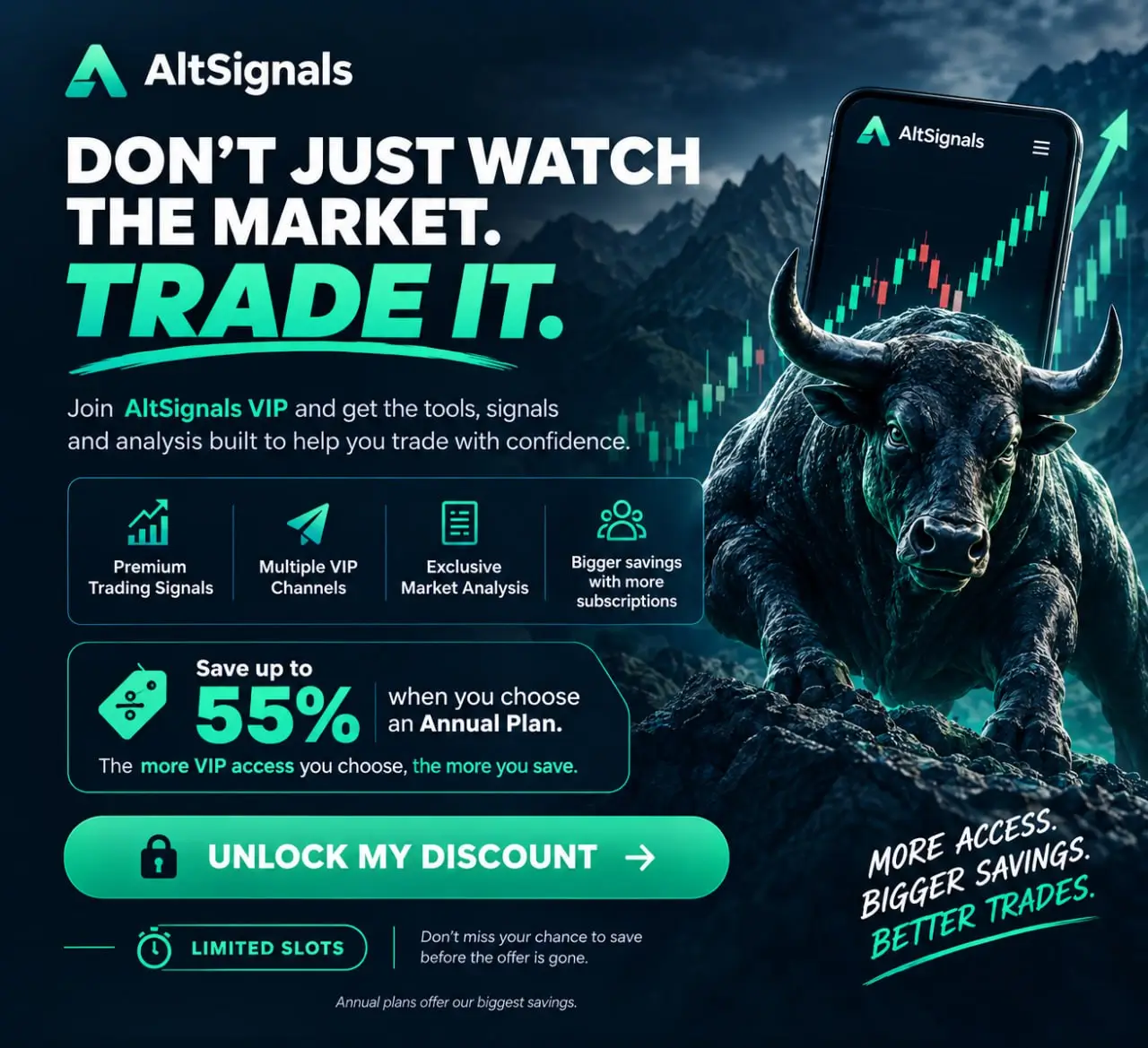
For traders who want market setups instead of endless scrolling, you can also explore AltSignals trading signals for crypto-focused opportunities.
Final take
Solana, Arbitrum, Injective, Render, and Kaspa each offer a different reason to stay on the radar. Some are ecosystem plays. Some are infrastructure bets. Some are narrative-driven but still grounded in a real use case.
None of that guarantees performance in 2026 or beyond. What it does give you is a more sensible starting point than chasing whichever ticker is trending for the next six hours.
Build a watchlist, compare projects consistently, and let the market prove the thesis before you size up.
FAQ
Are these the best altcoins to buy right now?
Why isn’t Ethereum on this list?
Ethereum is usually discussed separately because many traders treat it as a core crypto asset rather than a smaller altcoin opportunity. This article focuses on alternative projects that traders often compare for higher-risk, higher-upside exposure.
How should beginners research altcoins?
Start with the project’s use case, token utility, ecosystem activity, and competition. Then look at liquidity, exchange listings, and chart structure. If the thesis only works when social media is excited, that’s a warning sign.
Are altcoins riskier than Bitcoin?
In most cases, yes. Altcoins generally have lower liquidity, less institutional support, and higher volatility than Bitcoin. That can create more upside, but it also increases downside risk.









Not necessarily. This list is a watchlist, not a buy recommendation. A good altcoin for one trader may be a poor fit for another depending on time horizon, risk tolerance, and strategy.