

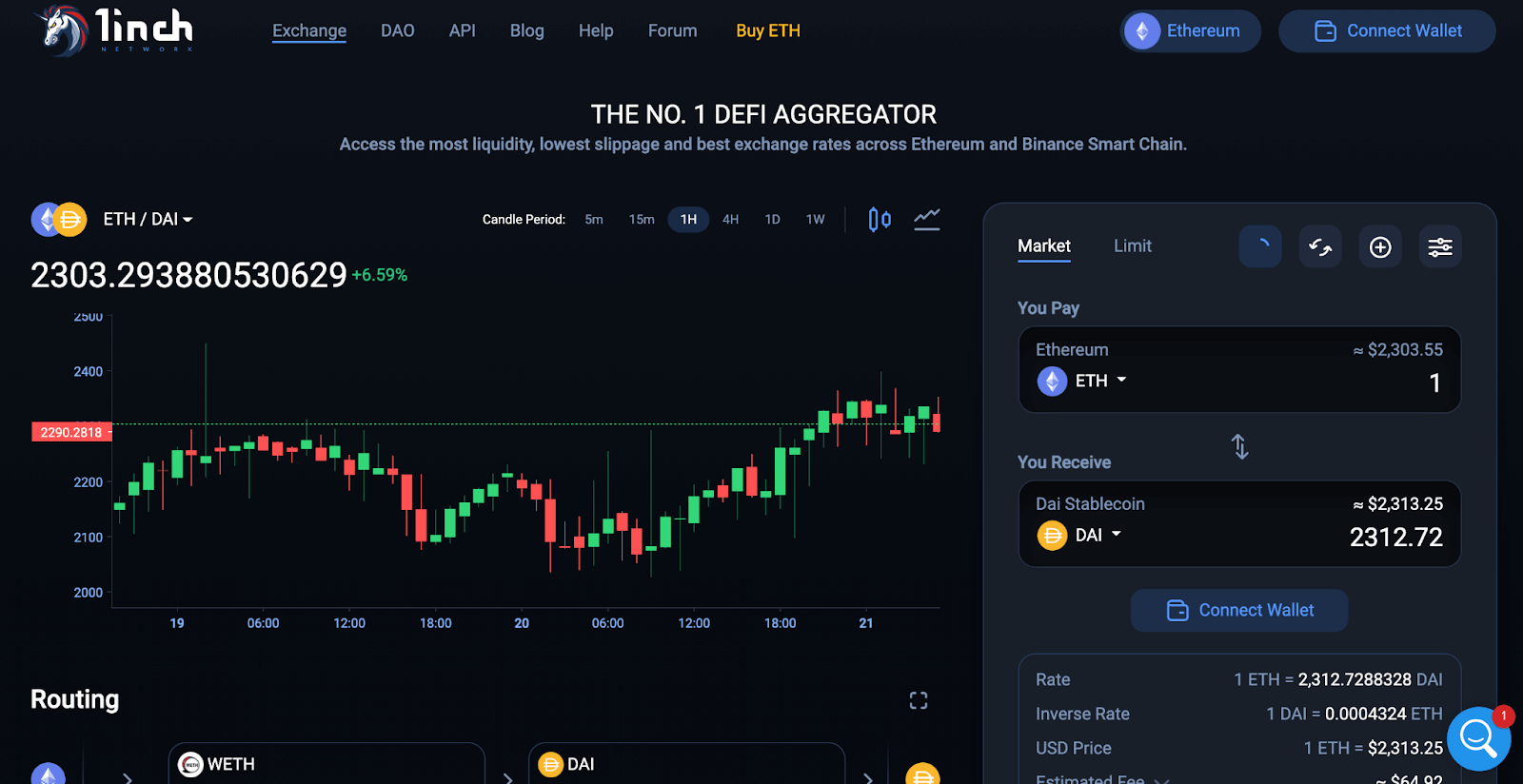
1inch is best understood as a DEX aggregator. Instead of acting like a single exchange with its own order book, it scans multiple decentralized exchanges and liquidity sources to help users find a better route for a token swap.
That matters because in DeFi, the quoted price is only part of the story. Liquidity can be fragmented, fees vary by route, and larger swaps can suffer from slippage. 1inch tries to solve that by splitting or routing trades across different venues rather than forcing everything through one pool.
If you are still getting familiar with the basics, it helps to first read our crypto trading guide for a broader view of how crypto markets, exchanges, and trading tools fit together.
Disclaimer: The information shared by AltSignals and its writers should not be considered financial advice. This article is for educational purposes only. We are not responsible for any investment decision you make after reading this post. Never invest more than you can afford to lose, and consider speaking with a qualified financial advisor.
What is 1inch Exchange?
1inch is a non-custodial DeFi platform best known for aggregating liquidity across decentralized exchanges. In plain English, it helps users swap one crypto asset for another by searching across multiple DEXs and selecting a route that may offer a better overall outcome.
Rather than depositing funds into a centralized exchange account, users typically connect a self-custody wallet and approve transactions directly onchain. That means you keep control of your assets, but it also means you are responsible for wallet security, transaction approvals, and network fees.
The core idea is simple: if liquidity is spread across several protocols, a smart routing engine may be able to find a more efficient path than a manual one. For traders, that can mean better execution, especially when markets are volatile or liquidity is thin.
How 1inch works
When you enter a swap on 1inch, the platform checks available liquidity across supported decentralized exchanges and routing paths. It may:
- send the whole trade through one venue
- split the trade across multiple pools
- choose a route designed to reduce slippage or improve the final amount received
This is why 1inch is often described as a swap optimizer rather than a traditional exchange. You are not really trading “on 1inch” in the same way you would trade on a centralized platform. You are using 1inch to access liquidity that exists across the wider DeFi market.
What are decentralized exchanges?
Decentralized exchanges, or DEXs, are crypto trading protocols that let users swap assets without handing custody to a centralized company. Trades are executed through smart contracts, and users interact with the protocol using their own wallets.
Compared with centralized exchanges, DEXs usually offer more direct control over funds and broader access to onchain assets. The trade-off is that they can feel less beginner-friendly. You need to understand wallet connections, token approvals, gas fees, and the risk of interacting with smart contracts.
That usability gap is one reason aggregators like 1inch became popular. They simplify the process of comparing routes across multiple DEXs instead of making users check each one manually.
What is DeFi?
DeFi, short for decentralized finance, is the part of the crypto market built around blockchain-based financial applications. These services aim to offer things like trading, lending, borrowing, and liquidity provision without relying on a traditional intermediary such as a bank or broker.
DEXs are one piece of that ecosystem. Other DeFi applications include lending protocols, stablecoin systems, derivatives platforms, and yield-focused products. The common thread is that the rules are enforced by code and smart contracts rather than a central operator.
If you trade crypto regularly, understanding DeFi is useful because liquidity, pricing, and market opportunities increasingly move across both centralized and decentralized venues.
Why traders use 1inch
The main appeal of 1inch is execution efficiency. Instead of guessing where the best swap is, users can let the aggregator compare routes automatically.
- Potentially better pricing: routing across multiple liquidity sources can improve the final swap outcome.
- Reduced slippage: splitting orders may help on larger trades or thinner markets.
- Convenience: one interface is easier than checking several DEXs one by one.
- Self-custody: users keep control of their wallets rather than depositing funds with a centralized exchange.
That said, “better” does not always mean “cheaper in every situation.” Network fees, token liquidity, and market conditions still matter. On smaller swaps, gas costs can outweigh any routing advantage.
Risks and limitations to understand
1inch can be useful, but it is not risk-free. DeFi rarely is.
- Smart contract risk: interacting with DeFi protocols always carries technical risk.
- Gas fees: on some networks, transaction costs can make small swaps inefficient.
- Slippage and price movement: quoted prices can change before a transaction confirms.
- Token risk: swapping into low-quality or malicious tokens is still possible if you are not careful.
- User error: approving the wrong contract or sending assets on the wrong network can be costly.
For a practical trading mindset, execution matters just as much as direction. A good setup can still turn into a poor trade if fees, slippage, or liquidity are ignored. That is one reason many traders combine market analysis with tools like the AltAlgo indicator to improve timing and decision-making before they place an order.
What is the 1INCH token?
1INCH is the native token associated with the 1inch ecosystem. Its role has historically included governance and broader participation in the network, rather than simply acting as a payment coin for swaps.
As with many protocol tokens, the exact utility can evolve over time as the platform develops. That is why it is better to think of 1INCH as an ecosystem token tied to governance and network participation, not as a guaranteed proxy for platform growth.
One thing worth correcting from older coverage: short-term price moves do not prove long-term demand or quality. Token prices can rise for many reasons, including speculation, broader market momentum, and temporary narratives. If you are researching 1INCH as an asset, focus on utility, governance relevance, liquidity, tokenomics, and market risk rather than a single historical rally.
Is 1inch a good choice for beginners?
It can be, but with a caveat. The interface is generally easier than manually comparing several DEXs, yet DeFi itself still has a learning curve. If you are brand new, start small and make sure you understand:
- how wallet connections work
- what token approvals mean
- which network you are using
- how gas fees affect the total cost of a trade
Beginners often focus only on the quoted swap rate. Experienced traders know the real cost includes execution quality, fees, and risk.
Final thoughts
1inch is not a traditional exchange in the usual sense. It is a routing layer for DeFi that helps users access liquidity across multiple decentralized exchanges from one place.
That makes it useful for traders who want better swap execution without giving up custody of their assets. Just keep expectations realistic. It can improve routing, but it does not remove market risk, smart contract risk, or the need to understand what you are trading.
If you want help turning market analysis into clearer trade decisions, you can also explore AltSignals trading signals for additional market context.
FAQ
Is 1inch an exchange or an aggregator?
Does 1inch hold your crypto?
No, it is generally used as a non-custodial platform. You connect your own wallet and approve transactions yourself, which means you keep control of your assets.
Can 1inch always get the best price?
Not in every case. It is designed to search for efficient routes, but the final outcome still depends on liquidity, slippage, gas fees, and market conditions at the time of the trade.
What is the 1INCH token used for?
The 1INCH token is associated with the 1inch ecosystem and has been used for governance and network participation. As with many DeFi tokens, its role can evolve over time.






It is mainly a DEX aggregator. It helps route swaps across multiple decentralized exchanges rather than operating like a single centralized exchange.