


Making money trading Bitcoin is possible, but it is not as simple as buying a charting app, adding a few indicators, and hoping for the best. Bitcoin is volatile, fast-moving, and unforgiving when risk management is ignored.
If your goal is to trade Bitcoin more effectively, focus on three things first: a clear strategy, a repeatable process, and strict risk control. Indicators can help, but they work best when they support a plan rather than replace one.
Disclaimer: This article is for educational purposes only and should not be considered investment advice. Crypto markets are risky. Never trade with money you cannot afford to lose, and consider speaking with a qualified financial professional before making trading decisions.
How do traders make money trading Bitcoin?
At the most basic level, traders try to profit from Bitcoin price movements. That can mean buying lower and selling higher, shorting when momentum turns bearish, or trading shorter swings inside a wider trend.
What separates disciplined traders from gamblers is not luck. It is process. Most profitable Bitcoin traders rely on a mix of:
- Technical analysis to identify trend, momentum, support, and resistance
- Risk management to control losses when the market moves against them
- Trade planning with defined entries, exits, and invalidation levels
- Patience to wait for setups instead of forcing trades
If you want a broader foundation before focusing on Bitcoin setups, start with our crypto trading guide.
What actually matters more than “the best indicator”
Many beginners look for one perfect tool. In practice, Bitcoin trading usually works better when you combine a few simple tools with context.
For example, an RSI reading alone does not tell you much if Bitcoin is trending strongly. A Fibonacci level alone does not guarantee a bounce. And a moving average crossover can arrive late if the move has already happened.
A better approach is to ask:
- Is Bitcoin trending or ranging?
- Where are the key support and resistance zones?
- Is momentum confirming the move or fading?
- How much am I risking if this trade fails?
That is where the indicators below become useful.
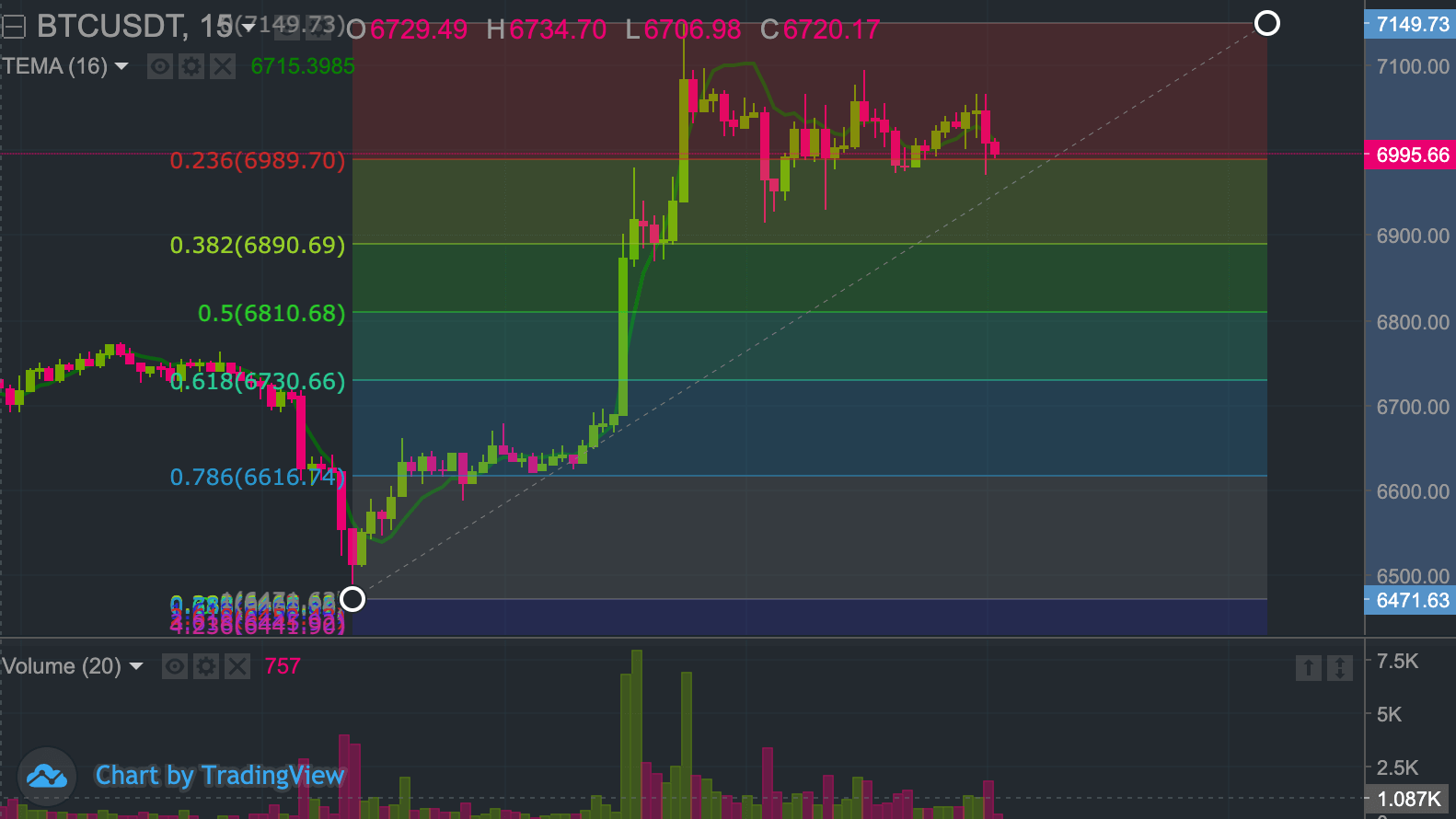
Fibonacci retracement levels
Fibonacci retracement is commonly used to map potential pullback zones during a trend. Traders draw the tool from a swing low to a swing high in an uptrend, or from a swing high to a swing low in a downtrend, to identify areas where price may react.
Bitcoin traders often watch the 0.382, 0.5, and 0.618 levels. These are not magic numbers, but they can help highlight areas where buyers or sellers may step back in.
Here is the practical part: Fibonacci works better when it lines up with something else, such as:
- a previous support or resistance zone
- a trendline
- a moving average
- a momentum signal like RSI divergence
So instead of treating a retracement level as an automatic entry, treat it as an area to investigate.
If you want a broader look at chart tools, our guide to the top 5 trading indicators is a useful next read.
Relative Strength Index (RSI)
The Relative Strength Index, or RSI, is a momentum oscillator that moves between 0 and 100. Traders often use it to judge whether momentum is stretched.
A common rule of thumb is:
- Above 70: potentially overbought
- Below 30: potentially oversold
That said, Bitcoin does not always respect neat textbook levels. In strong uptrends, RSI can stay elevated for longer than expected. In sharp selloffs, it can remain weak while price keeps falling. That is why RSI should be used as context, not as a blind buy-or-sell trigger.
RSI becomes more useful when you look for:
- Divergence between price and momentum
- Failure swings near key levels
- Confirmation of a breakout or pullback setup
If Bitcoin is approaching a major support zone and RSI is recovering from oversold conditions, that can be more meaningful than the RSI reading alone.
Exponential moving averages (EMAs)
Exponential moving averages help smooth price action while giving more weight to recent candles. Traders use them to identify trend direction, dynamic support and resistance, and possible momentum shifts.


Popular EMA combinations include:
- 12 EMA and 26 EMA for shorter-term momentum
- 50 EMA and 200 EMA for broader trend analysis
When price is trading above key EMAs and those averages are sloping upward, the trend is generally stronger. When price loses those levels and the averages flatten or roll over, momentum may be weakening.
EMAs are especially useful for Bitcoin traders who want structure. Instead of chasing every candle, you can use them to decide whether you should be looking for long setups, short setups, or no trade at all.
They also pair well with Fibonacci and RSI. For example, a pullback into a Fibonacci zone that also sits near the 50 EMA can be more interesting than either signal on its own.
Risk management is where most Bitcoin traders either survive or disappear
You can be right about direction and still lose money if your position sizing is poor. That is why risk management deserves as much attention as chart analysis.
A few practical rules:
- Risk only a small percentage of your capital on any single trade
- Use a stop-loss based on market structure, not emotion
- Avoid overleveraging just because Bitcoin looks “obvious”
- Know your exit before you enter
The U.S. Securities and Exchange Commission has a useful investor overview on the risks of crypto assets here: Investor.gov crypto asset guidance.
If you are still learning how to turn analysis into a repeatable setup, tools like the AltAlgo indicator can help simplify chart reading without removing the need for discipline.
A simple way to combine these tools
You do not need a screen full of indicators. A cleaner workflow often works better:
- Use EMAs to identify the broader trend
- Mark support and resistance
- Use Fibonacci to map likely pullback zones
- Check RSI for momentum confirmation or divergence
- Set entry, stop-loss, and target before placing the trade
That keeps your process structured and reduces impulsive decisions, which is half the battle in crypto trading.
Can signals help when trading Bitcoin?
Signals can be useful if they fit into a wider plan. They are not a substitute for understanding the market, but they can save time by highlighting setups you may want to review.
The key is to treat signals as decision support, not as automatic instructions. Good traders still check trend, risk, and market conditions before entering.
If you want help spotting Bitcoin and crypto setups, you can explore AltSignals trading signals as a practical next step.
Final thoughts
If you want to make money trading Bitcoin, stop looking for certainty. Focus on stacking small advantages: trend awareness, momentum confirmation, sensible entries, and disciplined risk management.
Fibonacci retracement, RSI, and EMAs are all useful tools, but none of them prints money on command. Used together, they can help you read the market more clearly and avoid some of the mistakes that wipe out inexperienced traders.
That may not sound glamorous, but in Bitcoin trading, boring discipline usually beats exciting chaos.
FAQ
Can beginners make money trading Bitcoin?
What is the best indicator for trading Bitcoin?
There is no single best indicator. Many traders combine trend tools like EMAs with momentum tools like RSI and price-based levels such as support, resistance, or Fibonacci retracements.
Is Bitcoin trading better than holding?
They are different approaches. Trading aims to profit from shorter-term price moves, while holding depends on long-term appreciation. Trading requires more time, more discipline, and tighter risk control.













Yes, but beginners are also the most likely to lose money if they trade without a plan. Start small, learn basic chart structure, and focus on risk management before thinking about profits.