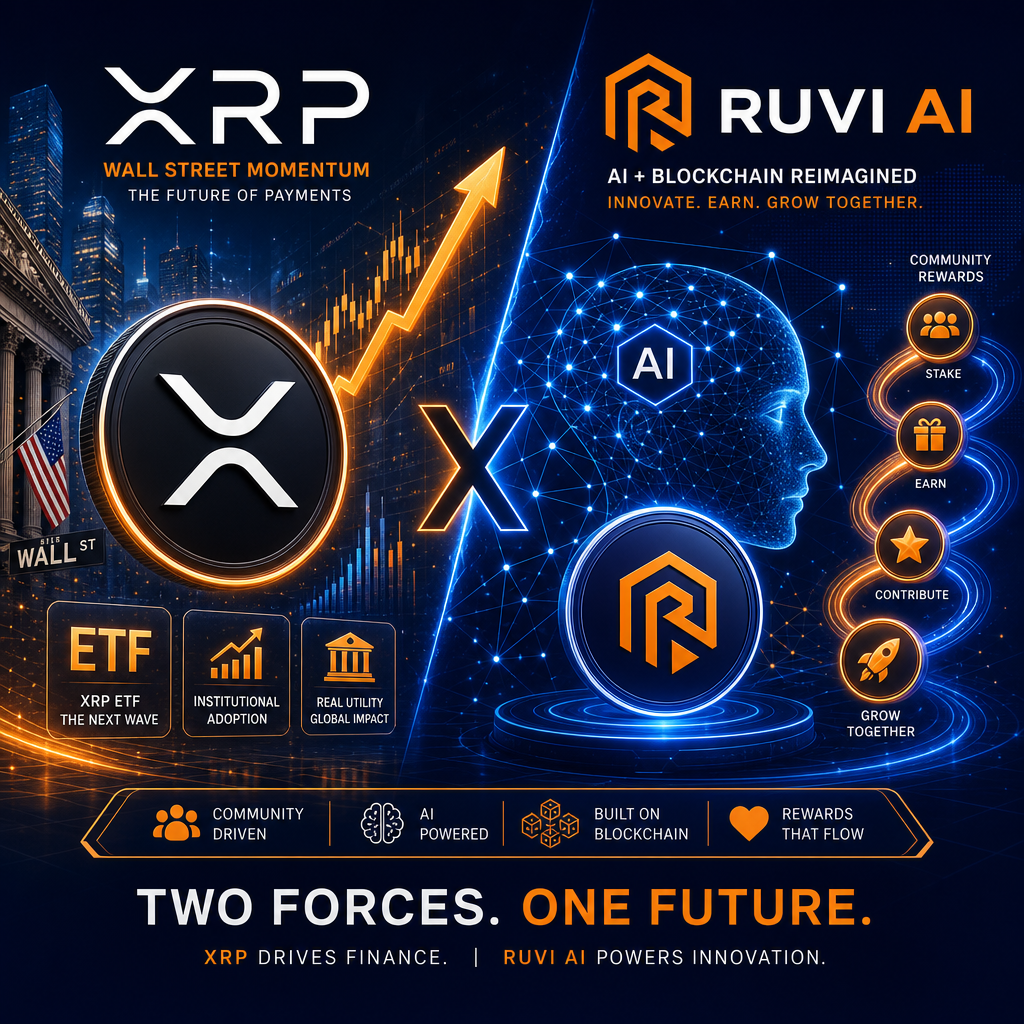
XRP, one of the most widely traded cryptocurrencies, is once again the center of attention on Wall Street and in crypto circles as analysts debate its price trajectory for the remainder of the year. With the emergence of new investment products and alternative opportunities such as the Ruvi AI (RUVI) token sale, both experienced and new investors are evaluating their next move.
XRP’s Rollercoaster: Testing Key Resistance on Growing ETF Interest
As of early June, XRP is trading near $1.32, boasting an impressive 89% increase over the past year. Fueling this uptrend is renewed investor interest, driven in part by the ongoing success of XRP Exchange-Traded Funds (ETFs). With total assets in these funds now exceeding $628 million, market sentiment is turning optimistic about the token’s future price action.
Momentum has brought XRP to a crucial technical inflection point. The $1.45 to $1.50 range is viewed by analysts as a breakout resistance zone. If XRP can decisively move above this threshold, it could open the door toward more ambitious price targets, including an eye-catching $5 projection that some Wall Street analysts now tout—contingent on sustained ETF inflows.
The Wall Street Case for $5 XRP—What’s Behind the Buzz?
Wall Street’s growing appetite for digital assets is not just limited to Bitcoin and Ethereum. Standard Chartered and other institutional research teams have published bullish reports, some forecasting multi-dollar XRP valuations in the near future. Meanwhile, a panel of AI-driven models recently released a forecast, suggesting possible XRP prices ranging from $1.40 to as high as $14 by 2026.
The current focus, however, remains on the short term. A successful breakout above $1.50 would validate technical analysts who see $5 as a possible year-end target, especially if institutional investors continue to flow into XRP ETF products at current rates. Yet, as excitement builds, voices of caution highlight several critical caveats.
Market Cap Realities: The Limiting Factor on Lofty Predictions
While a $5 XRP would certainly generate headlines, this price level is not without its challenges. At $5, XRP’s total market capitalization would approach an extraordinary $300 billion. For context, that figure would make XRP larger than most companies on the planet, and second only to Bitcoin and Ethereum in the cryptocurrency sector.
Moreover, critics argue that XRP’s value proposition is not as clear-cut as its competitors. Unlike many digital assets that directly benefit from increased network activity, XRP holders do not directly earn a share of the transaction fees flowing across the Ripple network, also known as Ripple’s “rails.” The perceived disconnect between network growth and tokenholder benefits continues to be a point of debate among industry insiders and skeptics alike.
XRP Holders Eye Alternatives: The Rise of Ruvi AI (RUVI)
This gap between network utility and value capture has led a growing faction of XRP holders to diversify their portfolios by participating in innovative blockchain projects focused on user participation and revenue sharing. One such project is Ruvi AI, a decentralized superapp that integrates more than 20 artificial intelligence models. Ruvi is currently conducting a public token sale across multiple phases, with initial pricing as low as $0.020 per RUVI token.
Ruvi offers a compelling proposition: it rewards contributors—those who help correct, rank, or refine AI-generated outputs—directly with its native $RUVI token. This reward mechanism is designed to ensure that value generated on the platform is distributed among its users, not just its founders or corporate backers. The rewards are powered by a 1.25 billion token allocation reserved for ecosystem incentives, creating direct financial motivation for participation.
Unlike XRP, where fee flows largely bypass the token holders, Ruvi’s structure allows for on-chain buybacks funded by platform revenue, which permanently burns tokens, thereby enhancing scarcity and potentially supporting price appreciation for long-term holders.
How the Ruvi Token Sale Works: Phases, Bonuses, and Value Growth
Ruvi’s token sale is meticulously organized across seven phases, with a strict cap of 5 billion tokens—non-mintable to prevent inflation. The earliest phases have offered the most attractive prices; Phase 1 at $0.010 and Phase 2 at $0.015 have already sold out swiftly. The current phase offers $RUVI tokens at $0.020 each, with later phases rising to $0.070, and the post-listing target set at $0.10 per token.
To illustrate the potential, consider this example: A $500 buy-in at Phase 3’s $0.020 price point nets the buyer 25,000 $RUVI tokens. At Phase 7’s final sale price ($0.070), this lot would be valued at $1,750, while at the $0.10 target, it rises to $2,500. If, hypothetically, $RUVI were to reach $1, the initial $500 investment would balloon to a staggering $25,000.
Ruvi also features a VIP bonus system for larger contributors. Committing to 500,000 $RUVI—the equivalent of $10,000 at $0.020 per token—qualifies buyers for a substantial 100% bonus, effectively doubling their allocation. All purchases are handled transparently on-chain, ensuring fairness and veracity.


Another attractive feature for early backers is the lack of a vesting period or cliff. Once the presale concludes, buyers receive their tokens in full and are free to trade or utilize them as they see fit. This immediate liquidity stands in contrast to the often rigid vesting structures common in many blockchain projects.
Comparing XRP and Ruvi: Revenue Models and Community Benefits
The contrast between XRP and Ruvi’s approach to value distribution is striking. Whereas XRP holders must wait for broad adoption and potential price appreciation, without a direct link to the network’s transactional revenue, Ruvi users receive real payouts for their participation and contribution to the platform’s growth.
This user-centric model, underpinned by network effects and incentivized training, positions Ruvi uniquely in the landscape of utility tokens. As the blockchain and AI sectors evolve, investors and traders are increasingly searching for protocols and applications that reward participation and foster loyal, engaged communities.
Ruvi’s approach suggests an alignment of incentives similar to “play-to-earn” models, but with a focus on “train-to-earn” for the generative AI era. Contributors not only benefit directly from the ecosystem’s success, but the built-in token buyback and burn mechanism also introduces a deflationary pressure that many believe is crucial for price stability and long-term appreciation.
What Investors Should Know Before Jumping In
While Ruvi’s tokenomics and rapid early adoption—with more than 3,000 holders already—are promising, prospective buyers should undertake careful due diligence. As with any new and fast-growing project, risks abound, especially in the relatively unregulated landscape of digital assets. Token price volatility, execution risk, and evolving competition from other decentralized AI platforms are all potential factors that could impact future returns.
On the XRP front, the coming weeks are critical. If the token cannot decisively clear the $1.50 resistance, short-term traders may shift to other, more dynamic opportunities, further amplifying market volatility. On the other hand, a breakout could see momentum traders and institutional flows drive prices higher, though the specter of a $300 billion market cap remains a substantial psychological and logistical hurdle.
Conclusion: Navigating the Road Ahead for XRP and Ruvi Investors
XRP continues to fascinate and frustrate in equal measure. Its enduring popularity is evident from strong ETF inflows and active trading, yet questions linger regarding its ability to translate network success into tangible rewards for holders. The $1.50 breakout zone represents the immediate battleground for bulls and bears alike. Should Wall Street’s $5 price target come to fruition, it would mark a seismic shift in crypto investment flows and cement XRP’s place among the sector’s giants—albeit with the ongoing caveat of value distribution challenges.
Meanwhile, Ruvi AI’s innovative approach to decentralization and user incentives is drawing attention from disaffected XRP holders and forward-thinking digital asset investors. Its phased token sale, reward-focused ecosystem, and on-chain transparency offer a radically different investment narrative—one that may appeal to those seeking both immediate and long-term value capture from the rapidly evolving intersection of AI and blockchain.
As always, prudent research and portfolio diversification are critical. Whether betting on XRP’s next technical breakout or seeking out early-stage opportunities like Ruvi, success in the fast-paced world of digital assets requires vigilance, agility, and a clear understanding of each asset’s unique risks and rewards.
FAQs on XRP and Ruvi
What is the XRP price prediction if the $1.50 breakout holds?
If XRP successfully breaks above the $1.50 resistance level, analysts suggest the token could reach the $5 mark by year-end, driven by persistent ETF inflows and positive market momentum. However, at $5, XRP’s market capitalization could reach $300 billion, raising questions about sustainable growth and upside limits.
Why are XRP holders looking into Ruvi?
Many XRP holders are frustrated by the lack of direct value capture from network activity. Ruvi offers an active rewards model that pays contributors in $RUVI, and implements token buybacks and burns to reward participants and enhance scarcity—features not currently present in XRP’s design.
Is Ruvi a better investment than XRP?
Ruvi offers a tangible, reward-driven ecosystem that directly incentivizes contributors and aligns user interests with platform growth. With a capped supply, multiple live AI models, and an active holder base, Ruvi presents a unique value proposition for those prioritizing direct revenue-sharing mechanisms. Still, as with all early-stage ventures, caution and due diligence are essential.