The digital asset landscape of mid-2026 presents a challenging puzzle for both institutional and retail investors. Tumultuous price swings and severe compression across leading cryptocurrencies have set the stage for a market in transition—one where participants are increasingly shifting their focus from speculation to strategies promising security, downside protection, and mathematically structured gains. As the appetite for predictable and contractually-backed returns grows, forward-thinking investors are evaluating projects not just on hype or promises but on the tangible metrics underpinning risk management and reward potential.
Navigating a New Crypto Paradigm: Search for Stability Amidst Volatility
Throughout 2026, widespread uncertainty and fading retail confidence have exerted immense selling pressure across digital asset marketplaces, particularly on decentralized applications. The result: order books reflecting both panic-driven exits and the growing dominance of algorithms designed to sidestep risk, rather than chase unsustainable highs. Approaches to due diligence have changed. Token projects now face rigorous, number-heavy scrutiny centered on tangible downside protection—metrics that can insulate investors from the cyclical downturns plaguing legacy projects.
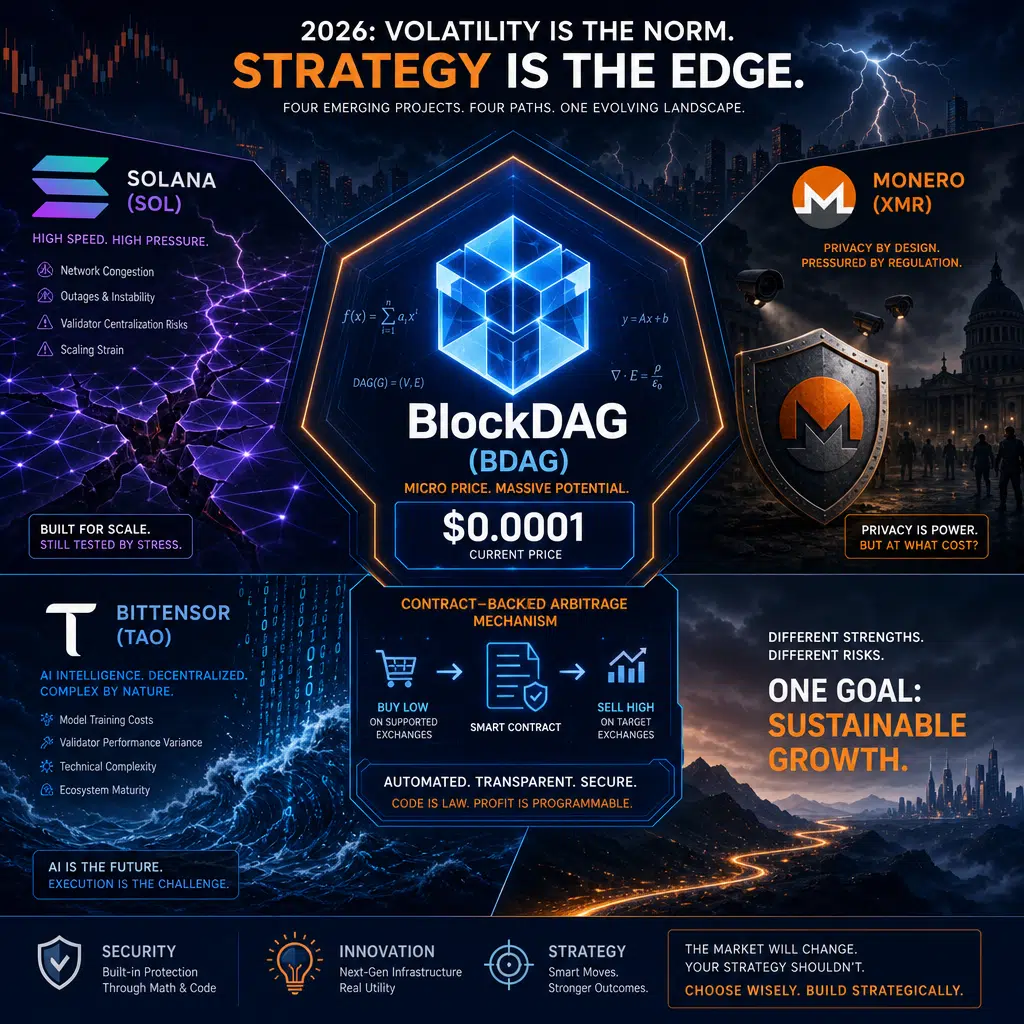
In this new climate, projects earning top spots on “gainers” boards often share a vital element: robust, mathematically driven setups that create sanctuaries against volatility. They balance the need for upside potential with the assurance of hardcoded contract terms and deterministic payout mechanisms. Let’s take a closer look at four standout projects in this evolution: BlockDAG (BDAG), Solana (SOL), Monero (XMR), and Bittensor (TAO).
BlockDAG (BDAG): Contractually-Backed Arbitrage Defines New Risk Standards
BlockDAG (BDAG) has emerged as a leader in the movement toward mathematically optimized digital assets that prioritize both reward and capital insulation. What sets BlockDAG apart from conventional tokens is its engineered risk structure—rooted in a micro-fractional entry point of just $0.00000044 per token, paired with an unconditional, contract-backed buyout mechanism. This buyout is executed at $0.05 USDT per token, effectively forming a shield against market-driven price swings.
The numbers tell a compelling story: BlockDAG’s minimum purchase price combined with a guaranteed exit at over 110 times that entry forms an “arbitrage loop” that is both predictable and insulated from exchange pressures. By automating settlements within their secure dashboard and coding these terms directly into smart contracts, BlockDAG has essentially transformed token acquisition into a low-risk, high-reward proposition rarely seen in crypto.
Rather than relying on hopes of exchange-driven appreciation, BlockDAG’s hardcoded terms convert every investment into an explicit mathematical arbitrage scenario. For investors, this means capital is not just protected—it is multiplied by a factor established in code, creating a new standard in digital asset risk management.
Solana (SOL): The Struggle Amid Technical Deterioration
Solana (SOL) occupies a pivotal role in the crypto market, yet 2026 has brought challenges unseen since its earliest days. The network finds itself in one of its weakest trading quarters on record. Historical market data reveals that June 2026 is set to be the lowest-performing month for Solana, with a median monthly loss of approximately 9%. The decline is not merely notional; SOL has decisively broken below several critical exponential moving averages, heightening technical vulnerability.
Transaction counts within Solana sub-networks and on-chain ecosystems remain robust. However, without the lifeblood of new institutional inflows, SOL’s price action has stalled, repeatedly failing to break through key resistance levels. Headwinds are exacerbated by the cyclical nature of crypto market sentiment, where negative momentum can become self-fulfilling, attracting further short sellers and reducing available liquidity.
Investors actively examining Solana’s risk profile must weigh its capacity for innovation against the backdrop of technical breakdowns and waning external demand. BlockDAG’s contrasting model—emphasizing pre-defined exits and mathematical certainty—offers a sharp divergence from Solana’s reliance on secondary market resilience.
Monero (XMR): Privacy-Centric but Facing Regulatory and Liquidity Obstacles
Monero (XMR) stands as one of the veterans in privacy-focused crypto, long championed for its zero-knowledge proof architecture and robust anonymity guarantees. Yet, 2026 has intensified the challenges facing Monero and similar networks as global regulators crack down on non-transparent transactions. A string of heightened anti-money laundering (AML) requirements and know-your-customer (KYC) laws has prompted centralized exchanges to delist Monero, narrowing its access points to committed users.

As a consequence, Monero’s trading activity has largely migrated to decentralized channels, primarily peer-to-peer marketplaces and permissionless decentralized exchanges. While these changes preserve the privacy ethos of XMR, the liquidity landscape has fundamentally shifted. Thin order books and reduced daily transaction volumes have made large trades costlier and more difficult, resulting in steady consolidation within the broader market structure.
Despite these headwinds, Monero’s core development team has intensified efforts to advance the network’s cryptographic underpinnings, doubling down on next-generation privacy enhancements. For privacy absolutists and technical purists, Monero remains a critical portfolio component—but for liquidity-seeking traders and institutions, its regulatory environment poses persistent challenges.
Bittensor (TAO): The Crossroads of AI Infrastructure and Technical Downturn
Bittensor (TAO) appeals to a unique segment of the crypto world: those betting on the convergence of decentralized technology and artificial intelligence. The network’s value proposition revolves around decentralized AI models and marketplace incentives for data scientists and AI engineers. Yet, the technical reality of late has proven daunting.
The TAO token slipped below the pivotal $227 support mark, aligned with Fibonacci retracement levels that are closely watched by traders. This drop triggered a series of automated liquidations and stop-loss orders, causing the price to plunge to a multi-month low around $180. Although market participants staged a defense at this psychologically and technically significant level, analysts view the rebound as a “stress test” rather than a confirmed reversal.
Momentum indicators, such as the daily MACD histogram, remain sharply negative, signaling continued seller dominance and a lack of fresh bullish conviction. Retail capital inflows have plateaued, leaving TAO’s short-term outlook exposed to further volatility. The disconnect between Bittensor’s promising long-term narrative and its current technical malaise underscores the risks faced by even fundamentally strong projects during periods of broad market weakness.
Thematic Insights: What Connects and Differentiates These Projects?
One common denominator spans all four projects: the necessity of risk-adjusted strategies capable of weathering a market defined by rapid sentiment shifts and regulatory uncertainty. The standout distinction, however, lies in the way BlockDAG approaches risk versus the others. While Solana, Monero, and Bittensor each rely on their unique network value, technology, and ecosystem activity to drive appreciation and investor confidence, BlockDAG bypasses market dynamics entirely by structurally embedding both upside and downside guarantees into its protocol.
BlockDAG’s 113x arbitrage setup—a buyout structure enshrined in code—turns the volatile game of token speculation on its head. It demonstrates that, in 2026, investors are not just chasing utility or innovation: they are prioritizing mathematical security, predefined exits, and insulation from the irrationality of open markets.
Conclusion: Rewriting the Rules of Crypto Investing in 2026
As the digital asset environment continues to evolve, so must the strategies of those who participate. The year 2026 has exposed the limits of models built solely on hype and momentum. Solana’s reliance on network activity does not guarantee protection from market cycles; Monero’s promises of privacy are tempered by regulatory bottlenecks; and Bittensor’s ambitious vision for decentralized AI remains at the mercy of technical turbulence.
Standing in stark contrast is BlockDAG, with its contractually backed exit mechanism and mathematically guaranteed arbitrage play. For allocators—especially those monitoring for top crypto gainers with an eye toward both safety and exponential returns—BlockDAG offers an unmatched combination of capital protection and upside potential. This paradigm doesn’t just respond to volatility; it redefines how investors approach, assess, and participate in the digital asset markets of tomorrow.