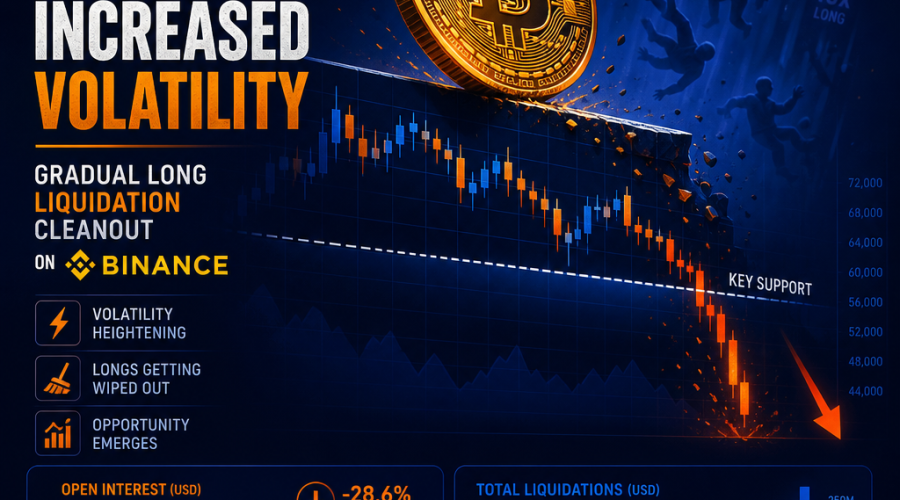
Markets faced renewed turbulence to start the week, as cryptocurrency assets experienced a sharp downturn even amidst anticipation of continued accommodative monetary policy. Bitcoin, the bellwether of the crypto sector, led the slump, with its price falling by over 6% at its session lows before paring losses to close down around 4.5%. In contrast, broader equities remained relatively stable, with the Nasdaq 100 and the S&P 500 registering only modest declines of 0.2% and 0.3% respectively. Gold marginally outpaced Bitcoin’s performance, continuing to hover near its recent highs and providing a safe haven amidst the volatility rippling through other asset classes.
Federal Reserve Policy Remains a Central Concern
A dominant theme in recent market action has been the market’s intense focus on U.S. Federal Reserve policy, specifically regarding interest rates and system liquidity. According to CME’s FedWatch Tool, there is now an 87% probability assigned to a 25 basis point rate cut in December, underscoring investor expectations for near-term monetary easing. However, key short-term rates are sending distress signals. The Secured Overnight Financing Rate (SOFR)—a pivotal rate in money markets—has climbed materially above the Fed’s policy corridor. This persistent breach suggests that bank reserves are growing scarce and that there may be constraints on the system’s ability to manage liquidity.
This unusual development has placed significant emphasis on the Fed’s next steps. Market participants are awaiting announcements regarding changes to either the Fed’s balance sheet operations or its administered rates toolkit, which would aim to relieve tension and recalibrate money market pricing within the target range. Until more clarity emerges, investor nerves are likely to keep risk assets on edge.
Widespread Weakness Across Crypto Markets
The recent pullback in cryptocurrencies has been broad and swift. Most sector indices underperformed Bitcoin itself during this slide, compounding the pain from an already challenging month for riskier assets. Crypto miners were an exception, with their index rising by 2.3%, continuing a recent trend of decoupling from the broader digital asset universe. Crypto equities moved slightly higher by 0.1%, providing a rare pocket of resilience. Elsewhere, however, losses mounted: modular blockchain tokens plummeted by 11.3%, gaming tokens fell 9.1%, and the AI-related basket slid 8.1%. Layer 2 scaling solutions, decentralized exchanges (DEXs), and decentralized physical infrastructure networks (DePIN) experienced daily drops in the 6% to 8% range.
This pattern highlights a market-wide move to reduce risk exposure, particularly in higher-beta tokens, as investors stand by for clearer signals from central banks about the path forward on liquidity and monetary policy.
Market Update: Strategy (MSTR) in the Spotlight
One of the most high-profile casualties of the risk-off sentiment on Monday was Strategy (MSTR), a major cryptocurrency-linked stock that has frequently acted as a proxy for Bitcoin’s public market performance. MSTR extended its recent drawdown, with intraday trading seeing its shares dip below $160 before recovering to close near $171. Over the past month, the stock has tumbled about 37%, and it is now more than 60% below its July 2025 highs.
A notable market dynamic is reflected in the movement of MSTR’s modified Net Asset Value (mNAV) ratio, which slipped below 1 in early November and edged lower toward 0.75. This decline signals a growing risk-averse environment. If the equity price remains at a sustained discount to its underlying assets, there’s a risk of forced selling or more severe downside moves as vehicles designed to track net asset value may need to offload assets.
This risk is crystallized when equity issuance becomes value-destructive rather than accretive, removing a key funding lever for MSTR. Should the discount persist, the company could be forced to turn to less desirable funding options, such as liquidating some of its Bitcoin reserves or entering derivatives transactions tied to Bitcoin—neither of which is ideal amid a broader sell-off.
Strategy’s Management Response: Bolstering Cash Reserves
In response to these pressures, Strategy’s management disclosed that the company has established a hefty cash reserve of around $1.4 billion. This reserve has been funded by recent equity issuances and is explicitly earmarked to cover at least 12 months of dividends, with ambitions of extending this coverage to as long as 24 months. The strategic intent is clear: reassure investors that the company can weather a protracted downturn without resorting to the sale of any portion of its substantial Bitcoin holdings—estimated to be in the neighborhood of 650,000 BTC. These announcements helped stem further decline in the company’s stock, as it provided assurance regarding dividend stability during times of heightened market uncertainty.
Further clarity emerged during the company’s investor call, where management revised down their year-end price assumption for Bitcoin from an ambitious $150,000 to a more cautious range of $85,000 to $110,000. This translated into a reduced target for Bitcoin-related gains—now anticipated at $8.4 billion to $12.8 billion—thus exposing full-year earnings to significant volatility depending on Bitcoin’s ultimate closing price for the year. Management highlighted a critical breakeven: a year-end Bitcoin price below roughly $94,000 would mean operating at a net loss, whereas a higher close would support positive income generation.
Leveraged ETFs Amplify the Pain
The market turmoil has been especially brutal for leveraged ETFs built around the MSTR trade. Funds like MSTX and MSTU—which aim to deliver two times the daily return of Strategy—are now among the worst-performing U.S. ETFs of the year, having lost over 80% of their value. The newer MSTP has trailed a similar path since its inception, with the combined value of these leveraged products shrinking from over $2.3 billion in October to about $0.8 billion. These steep losses underscore the inherent risks present with leveraged ETF strategies, where volatility decay can erode returns through compounding losses even if the underlying asset eventually recovers. As a result, retail investors who piled into the “levered MSTR” trade have sustained outsized and often unrecoverable losses. This episode now serves as a cautionary tale about the dangers of negative reflexivity and leverage in volatile markets.


HumidiFi’s WET Token ICO: Questions Linger Amid Rapid Growth
In the decentralized finance (DeFi) space, attention is sharply focused on the upcoming initial coin offering (ICO) for HumidiFi’s WET token, scheduled for December 3. WET will become the first token launched on Jupiter’s Decentralized Token Formation (DTF) platform, with immediate trading set to kick off on Meteora and the HumidiFi platform following the Token Generation Event (TGE) on December 5.
HumidiFi stands out as a proprietary automated market maker (AMM) developed by Temporal—a research and development firm native to the Solana blockchain. Temporal’s influence is evident in its other projects as well, including Nozomi (a transaction landing service for Solana) and Harmonic (a block-building system vying to challenge Jito).
The WET token will have a maximum supply of 1 billion units. Only 10% will be distributed through the ICO, split among three groups:
- Wetlist (6%): Reserved for whitelisted wallets, including HumidiFi users and active community contributors.
- JUP Stakers (2%): Allocated to stakers of the JUP token.
- Public Presale (2%): To be conducted on a first-come, first-served basis.
To determine pre-sale eligibility, the team conducted a snapshot on November 11. Data shows that traders with over $100 million in lifetime volume have previously accounted for more than 50% of HumidiFi’s daily activity, indicating that professional market makers and arbitrage bots dominate usage and are likely favored in allocations.
Opaque Tokenomics and Governance
The remaining 90% of WET tokens will be allocated in the following manner: 40% to the Zero Position Foundation, 25% to Ecosystem programs, and 25% to Labs (presumably Temporal). However, with the ICO imminent, there remain a number of unanswered questions. Notably, there is no clear disclosure regarding the control or operation of the Zero Position Foundation. The Labs allocation is assumed to be directed to Temporal, aligning with its role as the primary engineering contributor.
The announcement also mentions a 23% circulating float at launch, a strategy reminiscent of other recent Solana launches characterized by low float and high fully diluted valuations (FDVs), which have often been met with market skepticism. The unlock schedule calls for 19.25% of the total supply (192.5 million tokens) to be released every six months over the two years following the TGE. This approach arises despite past experience showing that similar launch strategies have been harshly punished by crypto investors, especially on the Solana chain.
HumidiFi’s Market Impact and Token Utility
Despite the controversy around the upcoming WET launch, HumidiFi itself has emerged as the top proprietary AMM by trading volume in recent months. In November alone, it accounted for over half (51%) of all SOL-stablecoin trading on Solana and 36% of total Solana decentralized exchange volumes—outpacing long-standing platforms such as Orca, Raydium, and Meteora. Furthermore, HumidiFi’s spot volume for SOL-USD pairs has recently overtaken even Binance, previously considered the dominant venue in this space, indicating a meteoric rise since its June launch that reflects major advances in proprietary AMM design.
For investors, however, questions linger. Until now, there has not been a straightforward method to gain direct exposure to the growth and dominance of proprietary AMMs. WET’s tokenomics and governance structure may not provide the vehicle investors have been seeking. While WET will feature utility for users—such as fee rebates via staking—the team has been explicit that WET “is not and should not be viewed as an investment.” Core details about the token’s value accrual, governance for the foundation’s significant allocation, and the rationale for the fundraising remain undisclosed, leaving prospective investors in suspense as to whether WET will deliver long-term value or serve as little more than a marketing tool.
Conclusion: Caution Amid Turbulence
The current landscape for crypto assets is decidedly risk-averse, influenced not just by the uncertainty surrounding U.S. monetary policy, but also by broader market dynamics and local developments. The plight of MSTR and the leveraged ETF ecosystem provides a real-world illustration of how volatility and leverage combine to amplify losses, often at the expense of retail investors. Meanwhile, the highly anticipated launch of WET highlights both the innovations and the opacity that still characterize parts of the DeFi industry.
As markets await clearer signals from central banks and as new projects like HumidiFi’s WET token push forward, both investors and observers are well-advised to remain cautious—scrutinizing potential risks as carefully as potential rewards.