


Technical analysis is the practice of reading charts to make trading decisions.
Instead of starting with balance sheets, tokenomics, or macro models, it starts with what the market is already showing you: price, volume, structure, momentum, and volatility. That makes it useful in both crypto and forex. A Bitcoin chart and a EURUSD chart do not move in exactly the same way, but traders still look for many of the same things: trend direction, key levels, momentum shifts, breakouts, and signs that a move is running out of strength.
If you are new to trading, technical analysis gives you a framework for reading charts without guessing. If you already trade, it helps turn scattered observations into repeatable setups.
Once you want more structure around your chart work, you can explore the AltAlgo indicator, trading signals, or the Trading Boot Camp.
What Is Technical Analysis?
Technical analysis studies market behaviour through charts. The basic idea is simple: price action reflects the ongoing battle between buyers and sellers, and that battle leaves clues on the chart.
Most technical traders work from a few broad assumptions often echoed in mainstream trading education, including sources such as CFI’s overview of technical analysis: markets absorb information quickly, trends can persist for a period of time, and recurring behaviour can create recurring patterns.
That does not mean charts predict the future with certainty. It means traders work with probabilities, not guarantees.
A technical trader is usually asking practical questions. Is the market trending or ranging? Where are the important support and resistance levels? Is momentum strengthening or fading? Is this breakout likely to continue, or is it more likely to fail?
Technical analysis vs fundamental analysis
Technical analysis and fundamental analysis are often framed as opposites, but in real trading many people use both.
Fundamental analysis focuses on underlying value and market drivers. In forex, that can include interest rates, inflation, central bank policy, and economic releases. In crypto, it can include adoption, token supply, network activity, regulation, and broader market sentiment.
Technical analysis focuses more on timing, structure, and execution.
A trader might be fundamentally bullish on Bitcoin but still use technical analysis to decide whether to buy a pullback, wait for a breakout, or avoid entering directly into resistance. The same applies in forex: a trader may have a macro view on the US dollar, then use chart structure to plan entries and exits.
If your focus is crypto specifically, continue with crypto technical analysis.
Who uses technical analysis?
Technical analysis is used by day traders, swing traders, position traders, and discretionary traders reading charts manually. It is also used by systematic traders who turn chart rules into code.
A few terms are worth separating clearly because they often get mixed together.
Technical analysis is the chart-reading framework itself.
Algorithmic trading means rules are coded and executed systematically.
Automation means parts of the trading process are handled automatically, such as alerts, entries, or trade management.
Trading bots are software tools that execute trades based on predefined logic.
AI trading is different again. AI-based systems may adapt, classify, or optimise decisions using machine learning or related methods. Traditional technical analysis can be fully manual, and algorithmic trading can be entirely rule-based without using AI at all.
Copy trading is not the same as any of the above. It follows another trader’s positions rather than requiring you to build your own chart-based process.
In practice, many traders use a hybrid approach: manual chart analysis for context, indicators for confirmation, and automated tools for alerts or execution.
Core Building Blocks of Technical Analysis
Before you use indicators or patterns, you need to understand the raw material of the chart.
Price, volume, and timeframes
Price is the foundation. Every indicator is derived from price, volume, or both.
Volume shows how much activity took place during a given period. In many markets, rising volume can help confirm breakouts or strong directional moves. In crypto, volume can be especially useful when judging whether a move has broad participation behind it or is just a thin, low-liquidity spike.
Timeframe matters because the same market can look bullish on one chart and bearish on another. The daily chart may show a clear uptrend, the 4-hour chart may be pulling back into support, and the 15-minute chart may still be choppy and indecisive.
That is why many traders use multiple timeframe analysis. A common approach is to use the higher timeframe for bias and the lower timeframe for entries.
Market structure
Market structure is one of the most useful concepts in technical analysis because it keeps you focused on what price is actually doing.
At its simplest, traders look at swings. Higher highs and higher lows suggest an uptrend. Lower highs and lower lows suggest a downtrend. Repeated reactions between boundaries suggest a range.
This matters because indicators work better when read in context. An RSI dip in a strong uptrend means something different from an RSI dip in a weak, sideways market.
Structure also helps you avoid forcing trades. If price is stuck in the middle of a range with no clear edge, waiting is often the better decision.
Multiple timeframe analysis
A lot of beginner mistakes come from reading only one chart. A cleaner process is to start with the higher timeframe, identify whether the market is trending or ranging, mark obvious support and resistance zones, then drop to a lower timeframe and wait for a setup near those areas.
That sequence keeps you from taking random signals in poor locations.
Charting platforms and tools
Most traders use charting software to analyse markets, draw levels, and apply indicators. If you want platform-specific help, see how to use indicators in TradingView, best MT4 indicators, or top MT4 indicators for successful trading.
If you want the official platform basics, TradingView and MetaTrader 4 both provide their own documentation and platform information.
Whatever platform you use, the principle is the same: keep your charts readable. More tools do not automatically mean better analysis.
Risk belongs here, not at the end
Risk management is not separate from technical analysis. It is part of it.
A chart setup only matters if you know where you enter, where the trade is wrong, how much you risk, and where you plan to take profit. Without that, technical analysis becomes chart commentary instead of a trading plan.

Types of Technical Indicators and How They Work
Indicators help traders organise information from price and volume. They do not replace chart reading. They simplify it.
A useful way to think about indicators is by job role.
Leading vs lagging indicators
This distinction matters.
Lagging indicators react after price has already moved. They are often useful for trend confirmation. Moving averages are the classic example.
Leading indicators try to signal potential turning points or shifts before a move is fully obvious. Oscillators such as RSI or Stochastics are often used this way, though they can stay overbought or oversold for longer than traders expect.
Neither type is better in every situation. Lagging tools can keep you aligned with trend. Leading tools can help with timing. Problems usually start when traders expect one tool to do both jobs.
Trend indicators
Trend indicators help answer one question: is the market moving directionally, or not?
Moving averages are often the first indicator traders learn because they smooth price and make trend direction easier to see. If you want practical strategy examples, read top 3 best MA moving average trading strategies.
Ichimoku gives a broader view of trend, momentum, and dynamic support or resistance in one framework. For a deeper explanation, see Ichimoku Cloud explained.
ADX is also commonly used to judge whether trend strength is building or fading.
Momentum indicators and oscillators
Momentum tools measure the speed or strength of price movement.
Popular examples include RSI, MACD, and Stochastics. These tools can help traders spot momentum confirmation in trend, weakening momentum before a reversal, overextended conditions in ranges, and divergence between price and momentum.
Used well, momentum indicators add context. Used badly, they create noise. One of the most common mistakes is shorting every overbought reading in a strong uptrend or buying every oversold reading in a strong downtrend.
For more on indicator selection, see key technical analysis indicators and applications and top 10 cryptocurrency indicators to perform technical analysis.
Volatility and volume indicators
Volatility tells you how aggressively price is moving. That matters because the same setup behaves differently in calm and fast markets.
ATR is commonly used to estimate normal price movement and help with stop placement. For a broader volatility explainer, see what is the VIX? or the Cboe overview of the VIX.
Volume-based tools can help confirm whether a breakout has real participation behind it. In crypto especially, this can help separate genuine expansion from thin moves that reverse quickly.
Custom and algorithmic indicators
Some traders use standard built-in indicators. Others use custom tools that combine several inputs into one signal framework.
That is where it helps to separate a few ideas clearly. A technical indicator is any chart-based calculation. An algorithmic indicator applies predefined rules systematically. An AI-assisted tool may add adaptive filtering or decision support on top of technical rules.
These are related, but they are not identical.
If you want a ready-made tool that brings multiple technical factors together, you can explore AltAlgo. It helps organise trend, momentum, volatility, and signal conditions into a cleaner workflow.
How to avoid indicator overload
A clean chart usually beats a crowded one.
A practical rule is to give each tool one job:
- one trend tool
- one momentum tool
- one volatility or confirmation tool
- price structure and levels as the base layer
If two indicators tell you the same thing, you probably do not need both.
Readers who want more platform-specific indicator ideas can also explore best MT4 indicators and how to use indicators in TradingView.
Chart Patterns: How to Read Market Structure
Chart patterns are recurring formations created by crowd behaviour. They are not magic shapes. They are visual expressions of accumulation, hesitation, breakout pressure, exhaustion, or reversal.
Continuation patterns
Continuation patterns suggest the existing trend may resume after a pause.
Common examples include flags, pennants, triangles, and rectangles. These patterns often form when price pauses after a strong impulse move. Traders then watch for a breakout in the direction of the original trend.
If you want examples from crypto markets, start with top 5 crypto trading patterns and crypto trading patterns and how to spot them.
Reversal patterns
Reversal patterns suggest the current trend may be weakening.
Common examples include head and shoulders, inverse head and shoulders, double tops, double bottoms, and wedges. These patterns matter most when they appear at meaningful locations, such as major support or resistance, after an extended move, or alongside momentum divergence.
Breakouts, breakdowns, and retests
A pattern is only part of the story. Execution matters.
A breakout trader usually wants to know whether price actually closed beyond the level, whether there was enough momentum or volume behind the move, whether price retested the broken area and held, and whether the breakout is happening into open space or straight into the next barrier.
This is where many false signals happen. Traders see the shape, enter too early, and ignore context.
For a more practical breakdown, see breakout strategies to use while trading.
Pattern validation and common mistakes
Patterns work better when they line up with other evidence. Higher timeframe trend, nearby support or resistance, momentum confirmation, volume expansion on breakout, and a clean invalidation level all help.
The usual mistakes are predictable: seeing patterns everywhere, forcing trades before confirmation, ignoring the broader trend, and trading patterns without a stop-loss plan.
For bullish and bearish examples in crypto, see top 4 bullish trading patterns and top 5 bearish trading patterns in the crypto market.
Candlestick Patterns and Price Action Signals
Candlesticks show the open, high, low, and close for a given period. That makes them one of the fastest ways to read short-term sentiment.
A candle with a long upper wick can show rejection of higher prices. A strong full-bodied candle closing near its high can show aggressive buying. A small indecisive candle after a large impulse move can show hesitation.
Single-candle signals
Common single-candle patterns include pin bars, doji, hammers, and shooting stars. These patterns are most useful when they appear at important locations. A hammer in the middle of nowhere means far less than a hammer forming at higher timeframe support after a pullback.
Multi-candle patterns
Multi-candle patterns add more context. Common examples include bullish and bearish engulfing patterns, morning star and evening star formations, and inside bars.
These can help traders judge whether control is shifting from buyers to sellers or the other way around.
Candlesticks need context
Candlestick patterns are often overhyped when taught in isolation.
A better way to use them is as confirmation for a broader idea: support or resistance, trend continuation, breakout retest, or momentum shift. That keeps you from treating every doji or engulfing candle as a trade signal.
Crypto vs forex candlestick nuances
In crypto, long wicks can be more common because volatility is often higher and liquidity can vary more across venues and trading hours.
In forex, session opens and major economic releases can create sharp spikes that distort candle shapes. A candle that looks like clean rejection may simply reflect a news-driven burst of volatility.
That is why candlestick reading works best when combined with structure, trend, and risk control.
Support, Resistance, Trends, and Momentum
This is where technical analysis becomes practical.
Support and resistance
Support is an area where buying interest has previously been strong enough to slow or stop a decline. Resistance is the opposite.
These are usually better treated as zones than exact lines. Traders often identify them using prior swing highs and lows, repeated reaction areas, range boundaries, and psychological round numbers.
The goal is not to draw dozens of levels. It is to find the few areas where price has clearly reacted before.
Trend structure
Trend is not just a moving average slope. It is the structure of price itself.
An uptrend usually shows higher highs, higher lows, and pullbacks that hold above prior support. A downtrend usually shows lower highs, lower lows, and rallies that fail below prior resistance.
Trendlines and channels can help visualise this, but they should support structure rather than replace it.
Momentum: impulse vs correction
Momentum helps you judge the quality of a move.
A strong impulse leg usually travels quickly and decisively. A correction tends to be slower, choppier, and more overlapping.
That distinction matters. In a healthy uptrend, a pullback with weak bearish momentum may simply be a pause before continuation. In a weak market, the same pullback may be the start of a deeper reversal.
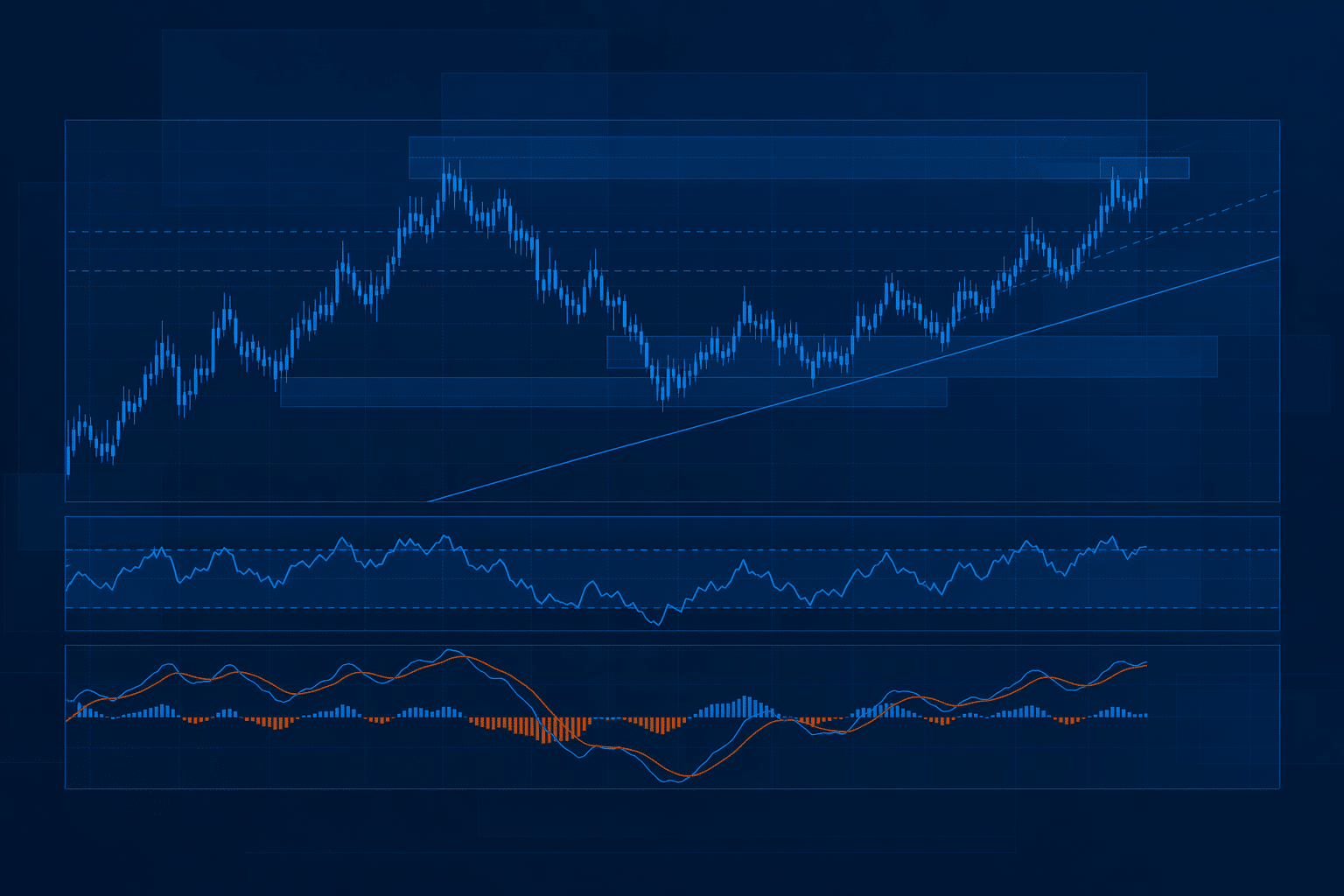
Combining levels with indicators
This is where confluence becomes useful.
Price may pull back into support while staying above a rising moving average. RSI may reset during a trend and turn higher near structure. A breakout above resistance may be confirmed by expanding momentum.
No single factor is enough on its own every time. But when structure, trend, and momentum point in the same direction, the setup usually becomes clearer.
Building Complete Trading Setups
A trading setup is more than an entry signal. It is a full plan.
At minimum, a setup should define the market conditions, entry trigger, stop-loss location, target or exit logic, position size, and what invalidates the idea.
Example 1: Trend-following setup
A simple trend-following framework might look like this:
- higher timeframe shows higher highs and higher lows
- price pulls back into a support zone or moving average
- RSI cools off during the pullback rather than collapsing
- lower timeframe shows bullish confirmation
- stop goes below the structure that should hold
This kind of setup works because it aligns with the existing trend instead of fighting it. For more ideas, see top 3 best MA moving average trading strategies.
Example 2: Breakout setup
A breakout setup might include a clear consolidation or chart pattern, repeated tests of resistance or support, a breakout close beyond the level, confirmation from momentum or volume, and sometimes a retest before entry.
The key is patience. Many traders lose money by entering before the breakout is confirmed or by chasing after the move is already extended.
For more detail, read breakout strategies to use while trading.
Example 3: Swing and momentum setup
A swing trader may combine structure with momentum to catch medium-term moves. That can mean identifying a market that is rotating from correction back into trend, waiting for momentum to turn in the direction of the larger move, and entering near a logical invalidation point rather than in the middle of expansion.
For a closer look, see combining momentum and swing trading for maximum profit.
Risk management rules that keep setups usable
Even a strong setup fails sometimes. That is normal. What matters is whether losses are controlled.
Useful rules are simple. Risk a small, consistent amount per trade. Define risk before entry, not after. Think in R multiples so reward is measured relative to risk. Avoid increasing size just because a setup looks perfect.
This is also where ideas like risk of ruin matter in practice. If losses are too large or position sizing is inconsistent, a workable strategy can still fail.
Psychology matters because execution matters
A setup on paper is easy. Following it live is harder.
Common problems include entering early out of fear of missing out, moving stops to avoid taking a loss, taking profits too quickly, and revenge trading after a losing streak.
Technical analysis gives you structure. Psychology determines whether you actually follow it.
If you want a more structured way to learn how setups, risk, and execution fit together, the Trading Boot Camp is a practical next step.

Technical Analysis for Crypto vs Forex
The core principles of technical analysis are transferable. Price structure, trend, support and resistance, momentum, and volatility matter in both markets.
But crypto and forex do not move in exactly the same way.
What stays the same
In both markets, traders still use trend analysis, support and resistance, chart patterns, candlestick confirmation, momentum tools, volatility awareness, and risk-based trade planning.
A breakout is still a breakout. A range is still a range. A trend pullback is still a trend pullback.
What changes in crypto
Crypto markets are open 24/7 and often move with higher volatility. That can create faster expansions, sharper reversals, more wick-heavy candles, stronger emotional swings in sentiment, and greater sensitivity to liquidity conditions.
That means traders often need wider stops, more patience around fakeouts, and more caution when using standard indicator settings without adjustment.
If crypto is your main focus, continue with crypto technical analysis.
What changes in forex
Forex is shaped more directly by trading sessions, macro events, and economic releases. That can create session-based volatility patterns, sharp reactions around scheduled news, tighter moves in some periods and sudden expansion in others, and stronger influence from spreads and leverage decisions.
A setup that looks clean before a major release can behave very differently once the event hits.
Applying the same setup to BTCUSD vs EURUSD
Take a simple pullback setup using structure, a moving average, and RSI.
On BTCUSD, you may need to allow for larger intraday swings and more aggressive wick behaviour. On EURUSD, you may pay closer attention to session timing and scheduled macro events.
The logic is the same. The execution details change.
One more point matters here: the tool is not the strategy. The same indicator can behave differently across volatility regimes. That is one reason traders often adjust expectations and settings rather than assuming one template works everywhere.
How AltAlgo and AltSignals Use Technical Analysis
Technical analysis can be done fully manually, but many traders prefer tools that make the process faster and more consistent.
AltAlgo as a technical analysis tool
AltAlgo brings multiple technical inputs into one workflow. Rather than switching between several separate tools, traders can use it to organise trend, momentum, volatility, and signal conditions more efficiently.
That does not remove the need for judgment. It can simply help reduce chart clutter and make analysis easier to follow.
AltSignals trading signals
AltSignals applies technical analysis within a broader trading process. In practical terms, that means chart-based analysis is combined with trade conditions and risk rules rather than treated as isolated indicator readings.
Where AI and automation fit
This is another area where clear definitions matter.
- Technical analysis is the chart-reading method.
- Algorithmic trading turns rules into code.
- Automation handles execution or monitoring tasks automatically.
- AI-assisted trading can sit on top of technical analysis and automation, but it is not the same thing as either.
So when traders use technical tools, alerts, or signals, that does not automatically mean they are using AI. And when they use AI-assisted tools, that does not mean chart structure and technical logic stop mattering.
A practical hybrid workflow
A common real-world approach is to use higher timeframe technical analysis to define bias, mark support and resistance manually, use an indicator to simplify confirmation, use signals or alerts to avoid missing setups, and manage risk manually according to a fixed plan.
If you want to see how that looks in practice, start with AltAlgo or explore the available trading signals.
How to Learn Technical Analysis Step by Step
Most traders learn faster when they keep things simple.
1. Learn the basics first
Start with chart types and candlesticks, support and resistance, trend structure, one or two core indicators, and timeframe selection.
Useful starting points include key technical analysis indicators and applications, how to use indicators in TradingView, and top 10 cryptocurrency indicators to perform technical analysis.
2. Build a small toolkit
Do not try to master everything at once.
A better beginner toolkit is usually one trend tool, one momentum tool, support and resistance, and two or three repeatable setups. That is enough to build consistency.
3. Backtest and journal
Before risking real money, test your ideas.
A trading journal should record the market and timeframe, setup type, entry, stop, and target, a screenshot of the chart, the reason for entry, the result in R, and whether you followed the plan.
This is how you find out whether a setup actually works for you, not just whether it looked good once.
4. Add risk management and psychology
Once you can identify setups, the next step is controlling behaviour.
A trader with average entries and strong discipline often outperforms a trader with good analysis and poor execution.
5. Use tools only after the process is clear
Indicators, alerts, and signals work best when you already understand what they are helping you do.
That is why many traders first learn the logic manually, then use tools to make execution more efficient.
If you want a structured curriculum rather than piecing everything together yourself, the Trading Boot Camp is one option.
FAQ
Is technical analysis enough on its own?
Which technical indicators work best for crypto vs forex?
There is no universal best indicator. Moving averages, RSI, MACD, and volatility tools are widely used in both markets, but settings and expectations often need to change. Crypto usually demands more respect for volatility. Forex often demands more respect for sessions and scheduled news.
How many indicators should I use?
Usually fewer than you think. One trend tool, one momentum tool, and clean price structure is enough for many traders. Too many indicators often create conflicting signals.
What timeframe is best for technical analysis?
The best timeframe depends on your trading style. Day traders often work from lower timeframes, while swing traders rely more on 4-hour and daily charts. In most cases, it helps to use a higher timeframe for context and a lower timeframe for entries.
How do I know if a chart pattern is valid?
A pattern is more reliable when it forms in the right context, has clear boundaries, aligns with trend or key levels, and confirms with momentum or volume. A shape alone is not enough.
Can beginners learn technical analysis?
Yes. Technical analysis is often one of the easiest ways to start understanding markets because charts make behaviour visible. The key is to keep your toolkit small and focus on repeatable setups.
How does AltAlgo differ from standard MT4 or TradingView indicators?
Standard platform indicators usually perform one job at a time. [AltAlgo](/indicator) is designed to bring multiple technical factors into one workflow, which can make chart reading more efficient. It is still a technical analysis tool, not a substitute for risk management or judgment.
How do I combine technical analysis with trading signals?
A practical approach is to use your own chart analysis for context, then use [trading signals](/signals) as confirmation or execution support. That way, signals fit into a plan instead of replacing one.
What are the biggest mistakes traders make with technical analysis?
Common mistakes include overloading charts with indicators, ignoring higher timeframe structure, trading every candlestick pattern in isolation, skipping stop-loss planning, and changing rules after a few losses.
How long does it take to learn technical analysis properly?
You can learn the basics quickly. Building consistency takes longer because it depends on screen time, journaling, testing, and discipline. Most traders improve faster when they focus on a small number of tools and setups instead of trying to learn everything at once.
How should I practise technical analysis safely?
Start by studying charts, replaying historical setups, and journaling what you see. Test ideas before using real money, keep risk small, and avoid using leverage aggressively while you are still learning.
Final thoughts
Technical analysis is not about predicting every move. It is about reading market structure clearly, building repeatable setups, and managing risk when the market proves you wrong.
The traders who get the most from it usually do a few things well: they keep charts simple, respect trend and structure, wait for confluence, define risk before entry, and review results honestly.
If you want to go deeper, start with AltAlgo, explore trading signals, or work through the Trading Boot Camp.









Sometimes, but not always. Many traders use technical analysis for timing and risk management while also paying attention to fundamentals, macro events, or market-specific news. Technical analysis is strongest when treated as a probability framework, not a guarantee.